Product kits
The Product Kits extension supports two flexible kit creation methods - Predefined Kit and Smart Kit - allowing you to create either fixed product bundles or dynamic, rule-based combinations. Both approaches help increase average order value by promoting related products together with targeted discounts.
General Information
These settings define the basic properties and availability of your kit.
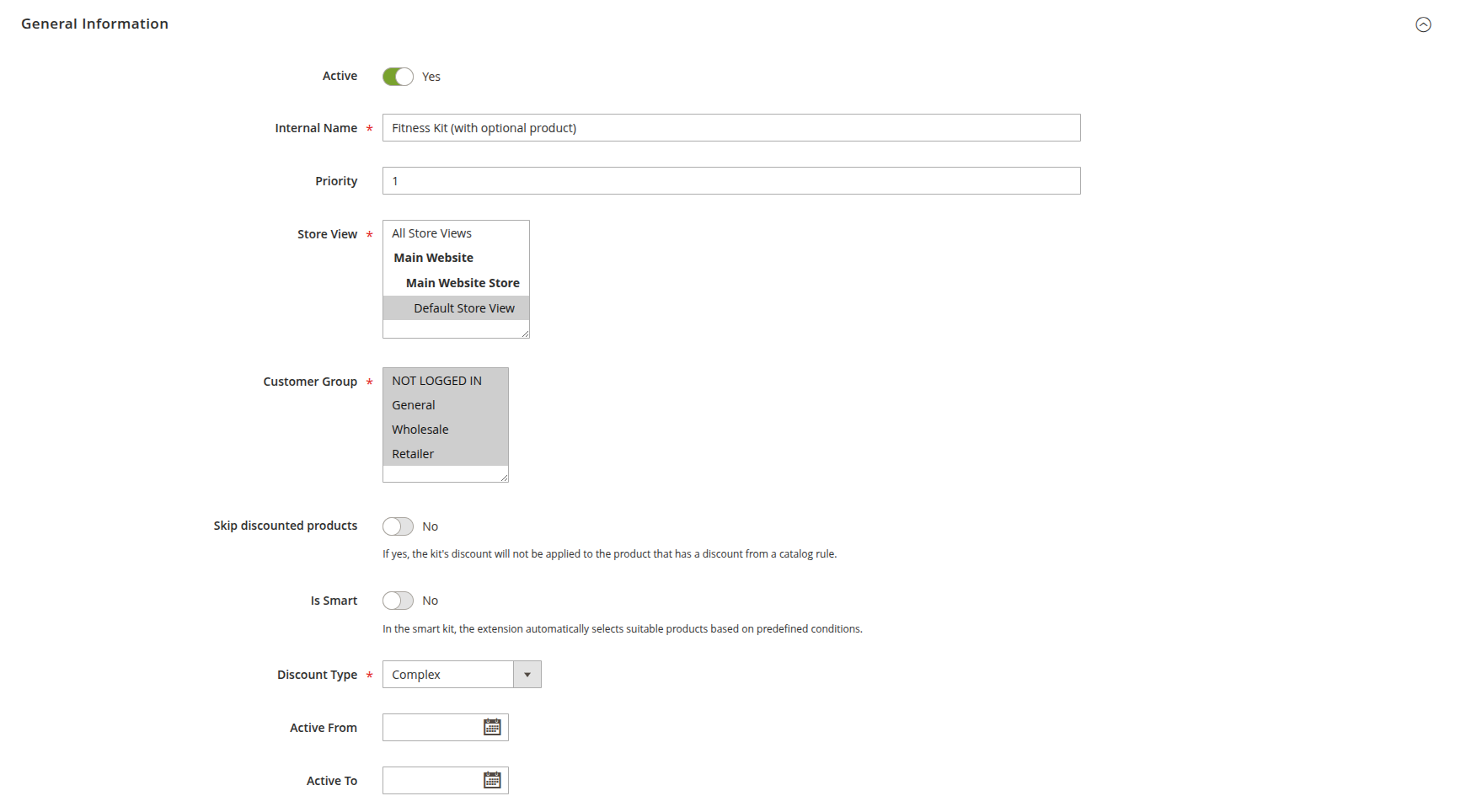
- Active: enables or disables the kit for the storefront.
- Internal name: the kit’s administrative name, used internally for management and reference.
- Priority: determines the order in which kits appear on the frontend when multiple kits are displayed together.
- Store view: specifies which store views will display this kit, allowing localized or targeted offers.
- Customer groups: defines which customer groups can see and purchase the kit, enabling segmented promotions.
- Skip discounted products: if enabled, the kit’s discount will not be applied to products already discounted by a catalog price rule.
- Is smart: indicates whether the kit is a Predefined Kit (manual selection) or a Smart Kit (rule-based generation).
- Number of products (Smart Kit only): sets the total number of products to be included in each kit generated by the rules.
- Discount type: defines how the discount is applied. Options include:
- Fixed – $: applies a fixed amount discount to the item.
- Percentage – %: applies a percentage discount to the item.
- Relative – %, %, %: applies a percentage discount to the item based on the discount defined for the item in the previous position.
- Relative Kit – %, %, %: applies a percentage discount to the item based on a reference discount defined at the kit level.
- Final Price – $: sets the final price for the item.
- Complex: allows advanced discount configuration.
- Active from: sets the start date from which the kit becomes available.
- Active to: sets the end date after which the kit will no longer be available.
Appearance
These options control how the kit is displayed to customers.

-
Title: the main title of the kit block, shown on the product page or cart.
-
Label: shown in the cart totals as the discount description, e.g. Discount (Buy together). Leave empty to hide the discount label.
-
Override Cent Values?: allows adjusting the final kit price to a specific value ending.
tipFor example, if the calculated kit price is
$25.67but you want it to appear as$25.99, set this option to##.99for consistent pricing.
Store view specific labels
This section appears only in multi-store installations. It lets you override the Title and Label per store view directly from the admin panel, without editing translation files.
For each active store view, two fields are available:
- {Store name} – Title: replaces the default Title for this store view.
- {Store name} – Label: replaces the default Label for this store view.
Leave a field empty to fall back to the default value set in the Appearance section.
This is the recommended way to display the kit title and discount label in multiple languages. For example, set Title to Buy together as the default and enter Samen kopen for the Dutch store view.
Products
The method for adding products depends on the kit type.
- Use Predefined Kits when you need a fixed selection of products, such as curated bundles or seasonal promotions.
- Use Smart Kits when you want flexible, automatically generated combinations based on your catalog rules - ideal for large product ranges or ongoing cross-sell campaigns.
Predefined Kit
Manually select specific products to include in the kit:
- Click Add Products.
- Select the required products in the pop-up.
- Click Add Selected Products.
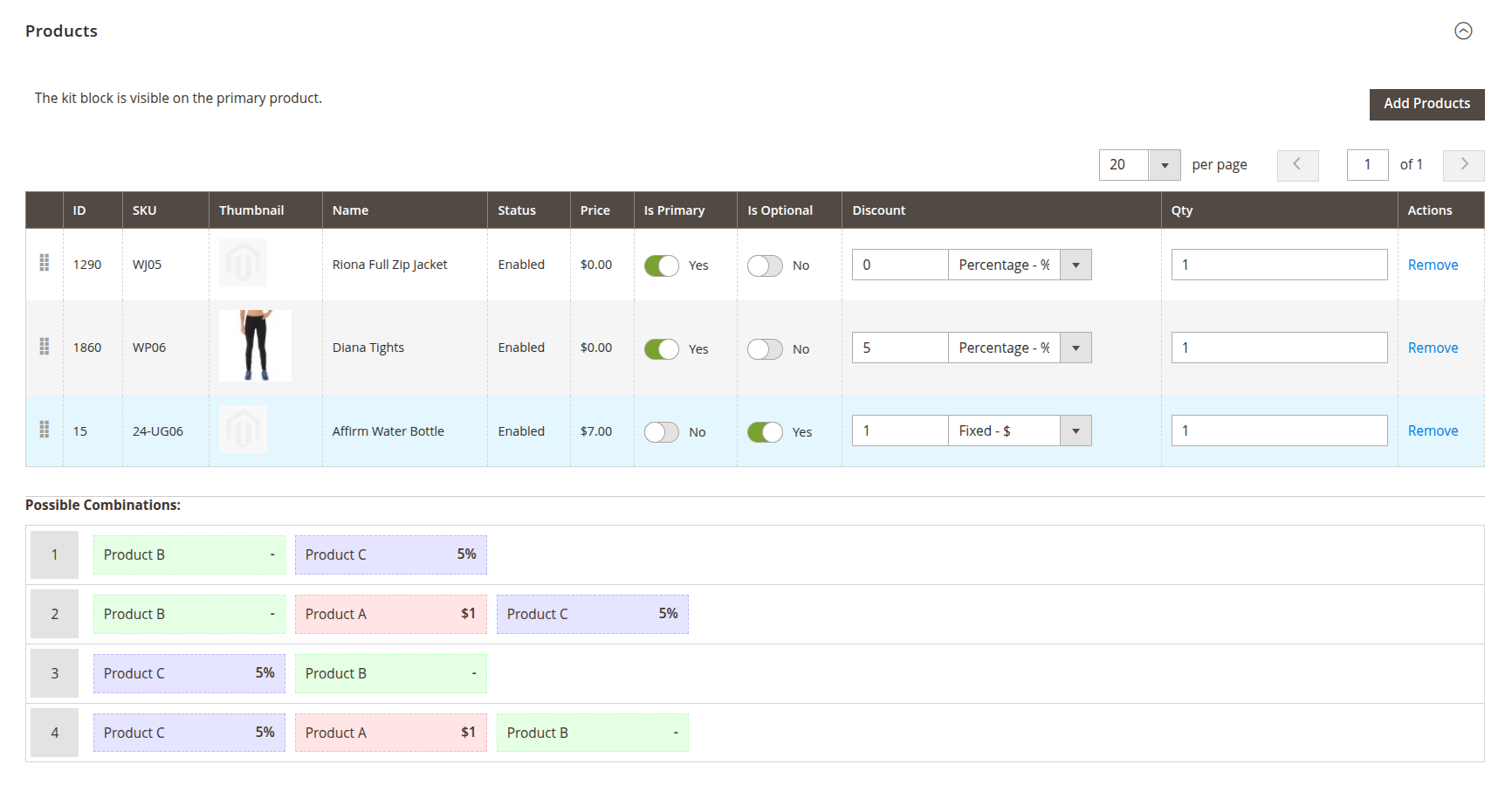
For each product in the kit, you can configure:
-
Is optional: marks the product as optional or required for the kit. When an optional product goes out of stock, it is hidden from the kit while the kit itself remains visible — provided at least one other product is still available. When a required product goes out of stock, the entire kit is hidden from the storefront.
-
Is primary: determines which product pages display the kit block.
NoteAt least one product must be primary.
Mark multiple products as primary to show the kit on each of their product pages. Mark only one product as primary to display the kit exclusively on that product’s page.
-
Discount: applies a discount to the product when purchased in the kit. Supported types:
- Fixed – $: applies a fixed amount discount to the item.
- Percentage – %: applies a percentage discount to the item.
- Relative – %, %, %: applies a percentage discount to the item based on the discount defined for the item in the previous position.
- Relative Kit – %, %, %: applies a percentage discount to the item based on a reference discount defined at the kit level.
- Final Price – $: sets the final price for the item.
-
Qty: the quantity of this product in the kit.
Smart Kit
Generates kits dynamically based on rules instead of manually selected products. This rule-based approach allows you to create one kit configuration that automatically generates multiple valid combinations, reducing manual setup and keeping offers up to date with your catalog.
For each position in the kit (up to the number of products defined in Number of products), you can configure:
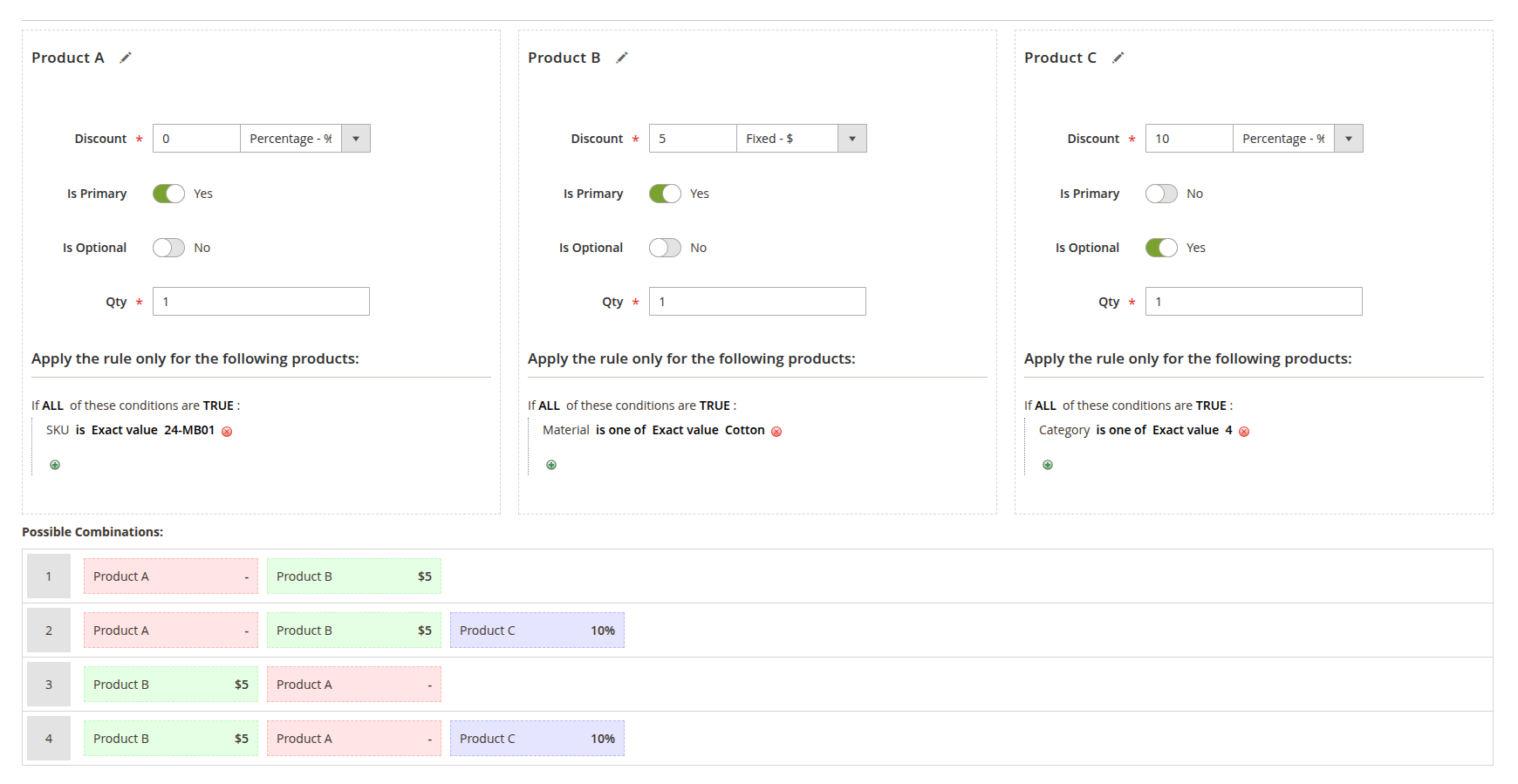
- Is Optional: marks the product in this position as optional or required.
- Discount: applies a discount to the product in the same way as a Predefined Kit.
- Qty: the quantity of products for this position in the kit.
- Apply the rule only for the following products: defines conditions (e.g., category, attribute values, price range) to determine which products can appear in this position.
Kit Health
Kit Health tells you at a glance whether a kit is correctly configured and ready to appear on the storefront. It is available in two places in the admin panel.
Grid column
The kit listing grid at Catalog -> Product Kits includes a Health column. Each row shows either OK or Has issues so you can spot misconfigured kits without opening them.
Form widget
When you open a kit for editing, a Kit Health widget is shown directly inside the form. It reflects the current state of the fields in real time — you do not need to save the kit to see the result update.
- When everything is correctly configured the widget displays OK with a check mark.
- When something needs attention it displays Has issues with a cross and lists each specific reason below it.
Health check reasons
A kit reports Has issues when one or more of the following conditions are detected:
- Schedule — the kit's schedule is outside the active window. This covers two cases:
- Active from is set to a future date and the kit has not yet started.
- Active to is set to a past date and the kit has already expired.
- No items — no products have been added to the kit yet.
- No primary item — the kit has products but none of them has Is Primary enabled. At least one primary product is required so that the kit knows which product pages to display on.
- No valid combinations — the kit contains fewer than two products. A minimum of two products is needed to form any combination.
- No salable combinations — no combination produces two or more visible products. This occurs when all required products are out of stock, or when all optional products are out of stock leaving only the primary product (a kit with a single visible product is not displayed on the storefront). Stock is judged in the store views the kit is assigned to, so on a store with several websites a product counts as in stock only on the website where the kit sells.
A kit is shown as OK only when all of the above checks pass.
A kit with Active set to No is not reported as unhealthy. Health reflects configurational correctness, not whether the kit is currently enabled.