Efficiency report
Extension provide a simple efficiency reports for Built-in mode. To check it navigate to System > Page Cache Warmer > Efficiency Report
At the top of the page, there are statistical charts that display the performance of the extension and the Magento cache system. Using the switches at the top, you can select the date range, data granularity , as well as the chart appearance (chart, diagram, lines, columns).
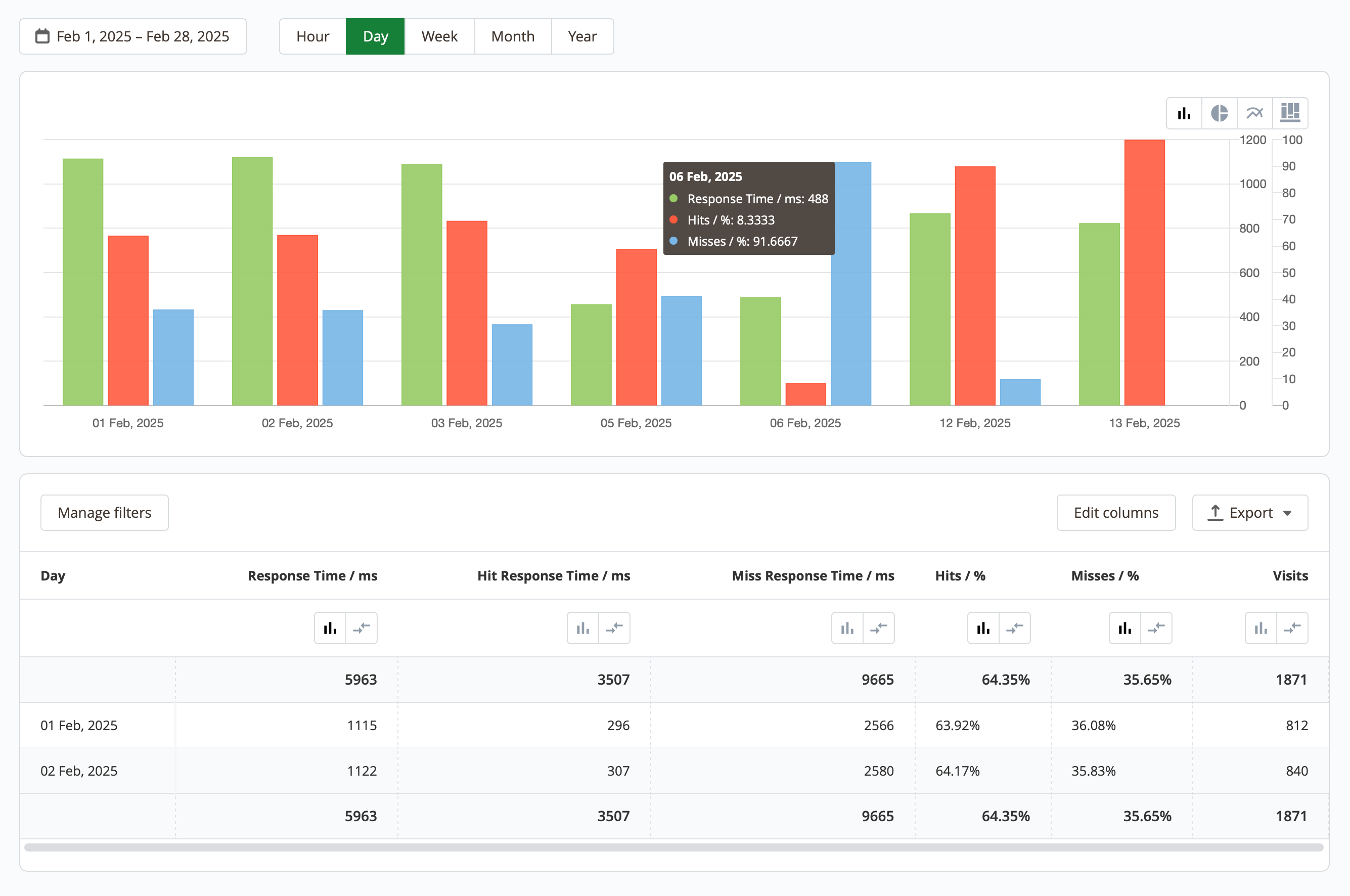
If necessary, you can apply filters, edit columns, and export the data to an XML or CSV file. By default, the following data is available:
- Time: shows the selected date range (hour, day, week, month, year).
- Response time / ms: average response time (TTFB) of all tracked page views, as measured in the visitors' browsers.
- Hit response time / ms: average response time of page views served from the full page cache.
- Miss response time / ms: average response time of page views that Magento had to generate.
- Hits / %: the percentage of tracked page views served from the full page cache.
- Misses / %: the percentage of tracked page views that were not served from the full page cache.
- Visits: the number of tracked page views.
How Hit/Miss Response Time is measured
The report is based on real visits to your store, not on warmer requests. It is collected only when Enable statistics = Yes in the Statistics settings.
- Response time. A small script on every storefront page (except checkout) reads the browser's Performance Timing data and sends the time to first byte (TTFB) to Magento. This time is measured in the visitor's browser from the start of the request to the first byte of the response, so it includes DNS lookup, connection setup, network transfer, and the server time. It is not a pure server-side time: a visitor far from your server gets a higher value for the same page.
- Hit or miss. When Magento generates a page, it writes a value from the visitor's cookie into it. On the next page, the browser compares this value with its own cookie: if they differ, the page was generated for someone else earlier and was served from the cache (a hit); if they match, the page was generated for this request (a miss).
- First page of a visit. The first page a visitor opens has nothing to compare with, so it is not counted. That is why Visits shows tracked page views, not all visits.
How to read the report
Each row shows the average of all page views from all visitors in the selected period. Keep the following in mind:
- Low traffic hours. When there are only a few page views in a period, a few visitors from distant countries (with a TTFB of 1-2 seconds) can raise the average a lot. In such periods Hit response time can even be higher than Miss response time, if only a handful of misses were recorded. Before drawing conclusions from a spike, switch the granularity to Hour and check the Visits column: a value based on a few page views is not reliable.
- Comparing with other tools. A crawler or a speed test (for example, Screaming Frog) runs from one location and measures each page under the same conditions, while the report averages real visitors from everywhere. The numbers are not directly comparable. To check the cache itself, see How to verify if pages are cached.
- What to look at. The difference between Hit response time and Miss response time on periods with enough visits shows how much faster cached pages are, and Hits / % shows how often visitors get a cached page. A growing Hits / % means the warmer keeps more of the pages your visitors open in the cache.