Prompts
AI Assistant starts generating text in respond to a text prompt. The list of prompts are located at System -> AI Assistant -> Prompts.
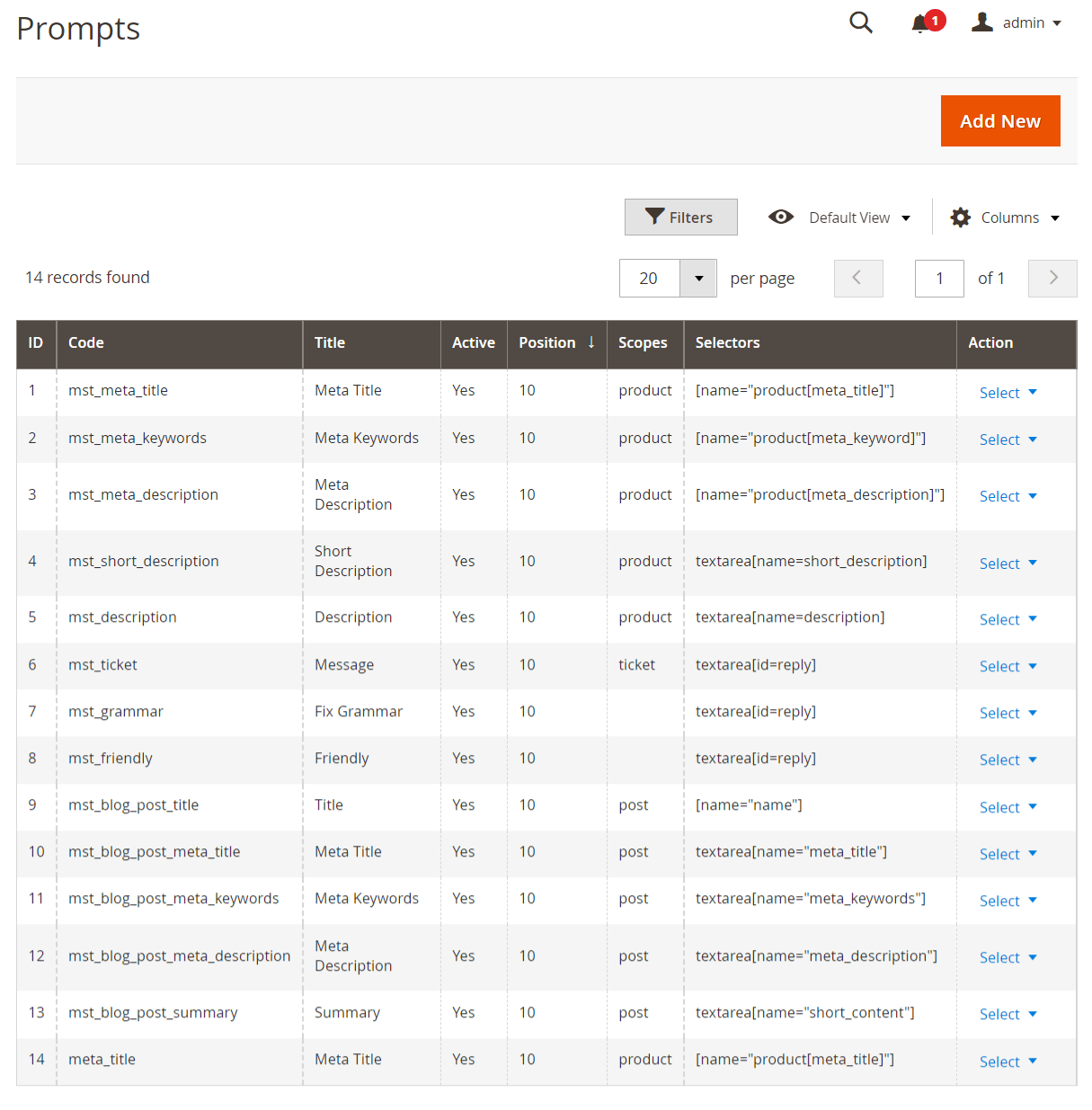
Here, you'll find the following fields:
- ID: ID of the prompt.
- Code: internal code.
- Title: prompt name.
- Is active: prompt status.
- Position: the prompt priority.
- Action: actions on the selected prompts in the queue:
- Edit: allow see and edit prompt.
- Delete: allow delete prompt.
Configure prompt
Use Action -> Edit to view or modify the existing prompt. The following fields will be available:
General settings
- Active: activates the prompt to be accessible for usage.
- Code: prompt identifier to be used by the extension.
- Title: prompt name that is visible in the Magento admin to the user.

Title field example - Sort order: sets the prompt position in the list of all prompts.
AI configuration
-
AI provider: set specific AI provider, by default used value from configuration section.
-
AI model: select AI model for a particular prompt. The From config value for this option means the prompt will use the default AI model from the configurations of the extension. Field appears if OpenAI, Anthropic Claude, or Google Gemini was selected as the AI provider. When Grok (xAI) is selected, no model selector is shown — the prompt always uses the Default Grok model from the configuration.
-
Frequency penalty: the frequency penalty is a parameter that allows us to control how often the same text expression can be used. By default, AI provider uses a value of 0, which allows the same phrases to repeat in the text. To make the text more unique, you can increase the frequency penalty value to 1. In this case, you'll receive more unique text.
-
Stop sequences: a comma-separated list of values that cut the answer as soon as the AI model outputs one of them. Use
\nto keep the answer to a single line. The built-in Meta title, Meta keywords and Meta description prompts are shipped with\nfor that reason.warningIf you rewrite one of these prompts, keep an instruction such as "Output only the value on a single line. Do not add any preamble, explanation, quotes, or label." in it. Without that instruction the model often opens with an introductory sentence, the
\nstop sequence cuts the answer right after it, and the field receives only that opening phrase instead of the generated value. The alternative is to clear the Stop sequences field for the prompt. -
Enable Web Search: when enabled, the AI model can search the web for up-to-date information while generating content. The model decides autonomously when and what to search based on the prompt content. See Web Search section below for details.
Content settings
- Scopes: select where the prompt will be available:
- Product
- Category
- Blog post: supports only Magefan, Amasty and Mirasvit Blog MX extensions.
- Blog category
- CMS page
- CMS block
- Helpdesk ticket: support only Mirasvit Help Desk MX extension.
- Email: supports only default Magento Newsletters and Mirasvit Follow Up Email extension.
- KB category: supports only Mirasvit Knowledge Base extension.
- KB article: supports only Mirasvit Knowledge Base extension.
- Brand: support only Mirasvit Layered Navigation extension.
- Order: support Order Comments field in default Magento order.
- Field selectors: add a Magento selector field in which the extension will insert the AI model output.
- System message: select a system message to include with this prompt. System messages provide context or instructions that will be sent to the AI along with the main prompt.
- Prompt: contains a short prompt for AI model. Use variables to adjust the ChatGPT response to the specific request.
- Get variables' values from: select the store from which the assistant should grab values for variables.
Current storemeans the assistant will autodetect the store. For automation rulesCurrent storewill be the store for which the prompt applies at the moment. This setting most useful for translations. Applicable for Products, Categories, and Blog posts (Mirasvit Blog MX). - Remove HTML tags from input: if disabled, the extension will not remove HTML tags from variable values. The prompt size might increase which can lead to AI model maximum content length error (depends on the model). Enabled by default. Disabling this option most useful for translating content from WYSIWYG editor and the Page Builder.
- Convert output to HTML: places the AI model output within the HTML tags. Only available when the Remove HTML tags from input option is enabled.
Appearance
- Help text: additional text for AI model to use when generating content. For example, additional info on the product.
- Open in window: when activated a window appears so you can see the Help Text or alter the prompt. When disabled the ChatGPT output immediately appears in the text field.
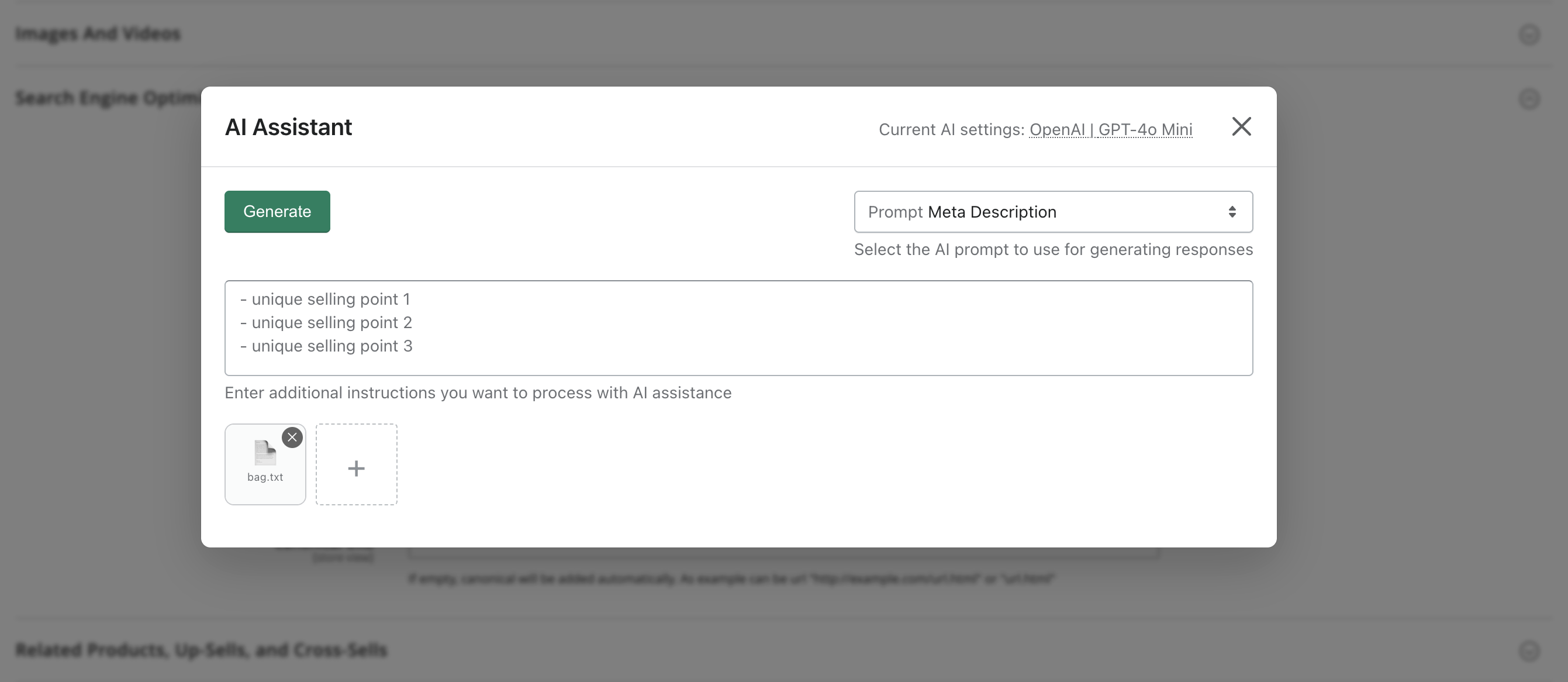
Prompt window
When using the prompt in window mode, you can attach files directly to the AI request using the upload area below the input field. Drag and drop or click the + button to add files.
- Supported formats: JPEG, PNG, GIF, WebP, PDF, TXT, CSV
- Limits: up to 5 files, 5 MB per file
- How it works: attached files are sent directly to the AI provider alongside the prompt text. The AI can analyze images, read PDF documents, and process text/CSV data. Files are not stored on the server — they are sent to the AI and discarded.
File attachments work with all supported AI providers (OpenAI, Claude, Gemini). The filenames of attached files are automatically appended to the input text, so prompts that use {{ global.input }} will include them.
Web Search
When Enable Web Search is turned on in the AI configuration, the AI model can search the web for real-time information while generating content. This is useful for prompts that require up-to-date data, such as market trends, competitor analysis, or current pricing.
How it works:
- The AI model decides autonomously when and what to search — you don't provide a separate search query
- If the model determines that the prompt can be answered from the provided context alone, it may skip the search entirely
- To encourage the model to search, include natural language hints in your prompt, e.g., "Search the web for current market trends for this product"
Supported providers:
- OpenAI — supported on most models. Not supported on gpt-4.1-nano, gpt-4-turbo, gpt-4, and gpt-3.5-turbo (web search is silently skipped for these models)
- Claude — supported on all active models
- Gemini — supported on all active models
- Increased token usage. Web search results are injected into the request context, which can significantly increase input token count (up to 10-30x depending on the query)
- Longer response times. The AI model performs one or more web searches before generating the response, which adds several seconds of latency
- Additional charges. Some providers charge per search on top of standard token costs
- Not used in automation rules. Web search is automatically disabled when the prompt is executed via automation rules (batch processing) to avoid excessive latency and costs
- Model decides when to search. Enabling web search does not guarantee that every request will perform a search — the model may determine that the provided context is sufficient