
Blog MX for Magento 2
Blog MX runs your blog inside Magento, with Page Builder posts, comments, and SEO checks in the admin you already use. Every post, category, author, and tag can differ per store view.
- Score every post for SEO before publishing
- Move an existing blog over for free
- Format the content with Page Builder
- Organize posts with categories and tags
- Moderate comments without leaving Magento
- Add related products to any post



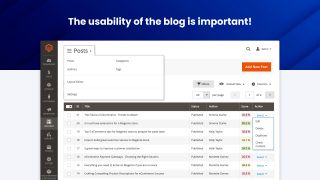

Content brings people to your store before they are ready to buy. Magento has no blog of its own, so most merchants end up running one on a separate platform, with a second admin panel, a second theme to maintain, and product links that go stale.
Blog MX puts the blog inside Magento. Posts, categories, authors, and comments live in the admin you already use, on the theme you already run.
Why choose the Blog MX module for Magento 2
A blog on your own domain earns traffic that keeps paying after the ad budget stops. The reason to run it inside Magento rather than next to it comes down to three things.
Search engines find your posts without extra work
New articles are added to the Magento XML sitemap automatically, so Google learns about a post that nothing links to yet.
Each post, category, author, and tag page gets a canonical URL, its own robots directive, and hreflang alternates when you run several languages. Structured data is emitted as BlogPosting or NewsArticle, with the properties and description source you choose.
Articles send readers into your catalog
Because the blog shares a database with the store, a post can pull in live products: hand-picked, or filled automatically from a catalog category so the block keeps itself current as the category changes.
Posts can also surface on product pages, category pages, and even the 404 page, which turns a dead end into a reading list.
Publishing stays a Magento job
One admin, one theme, one set of user permissions. Writers work with Page Builder, the same editor they use for CMS pages, and the blog inherits your storefront design instead of imitating it.
The frontend is built from widgets and is tested against Luma and Hyvä, with WCAG 2.2 AA accessibility checked as part of that work.
Speed up your blogging process
Page Builder support
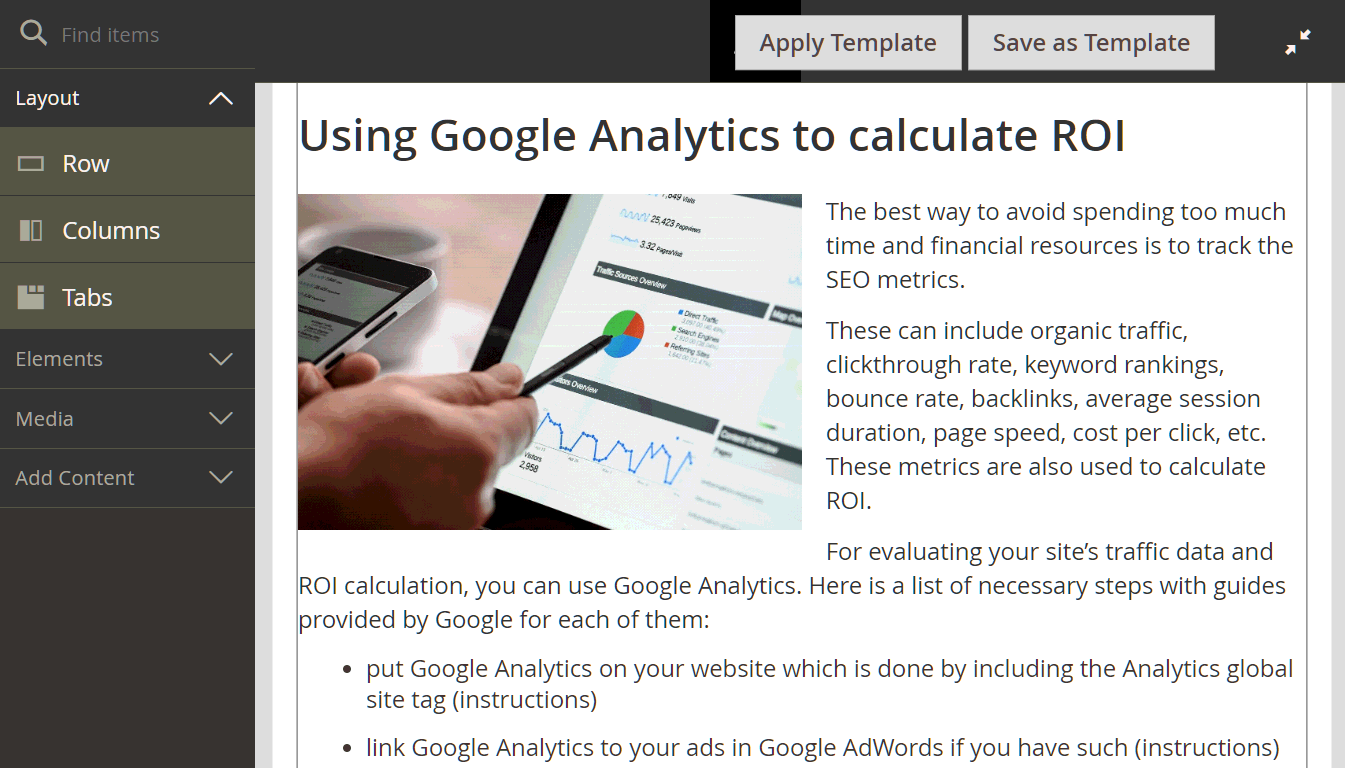
Write posts in Magento Page Builder: rows, columns, lists, images, and video, with no separate editor to learn.
Our quick start guide walks through the first post, from creating an author to putting the blog on your storefront menu.
Publish polished content
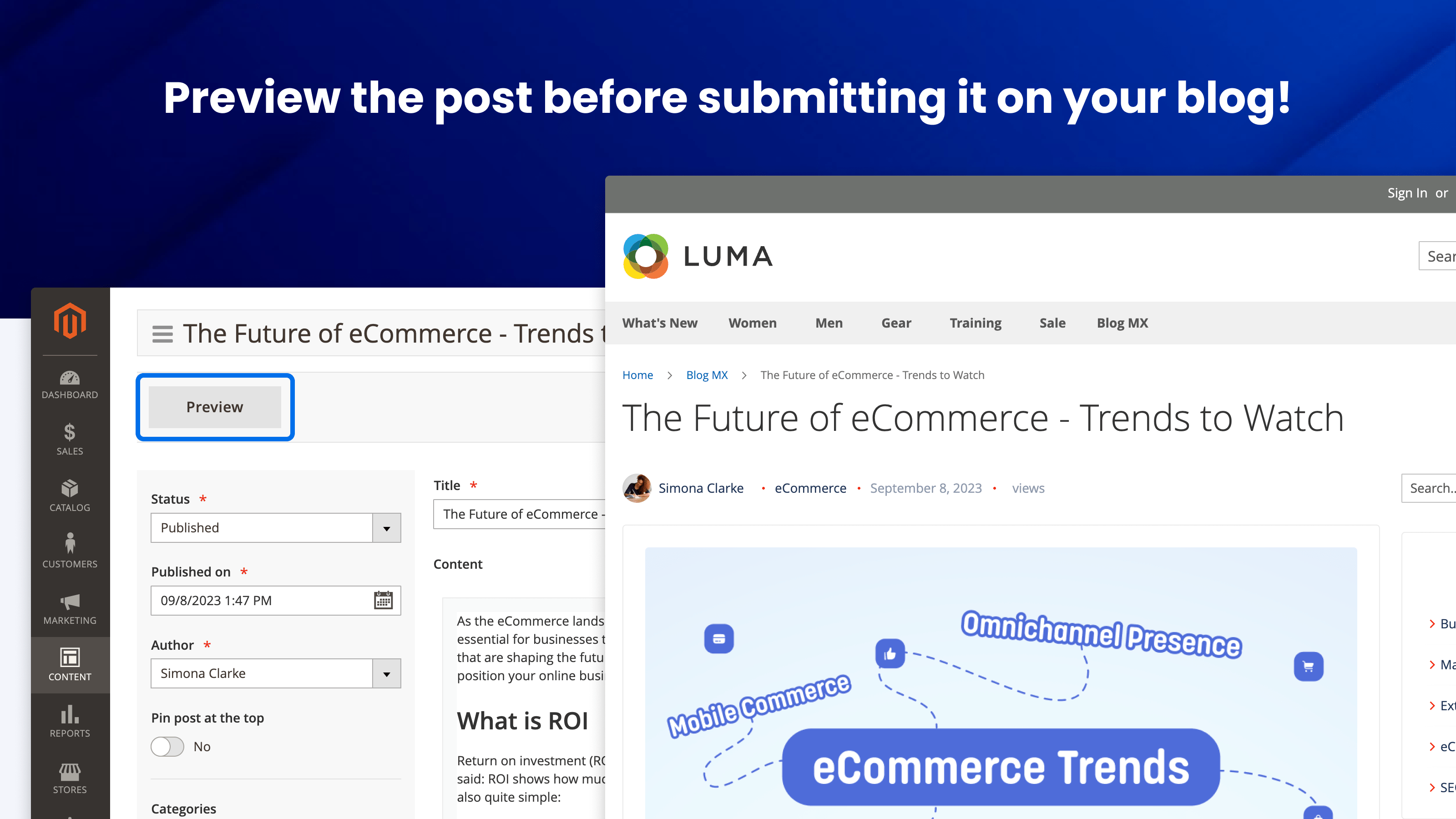
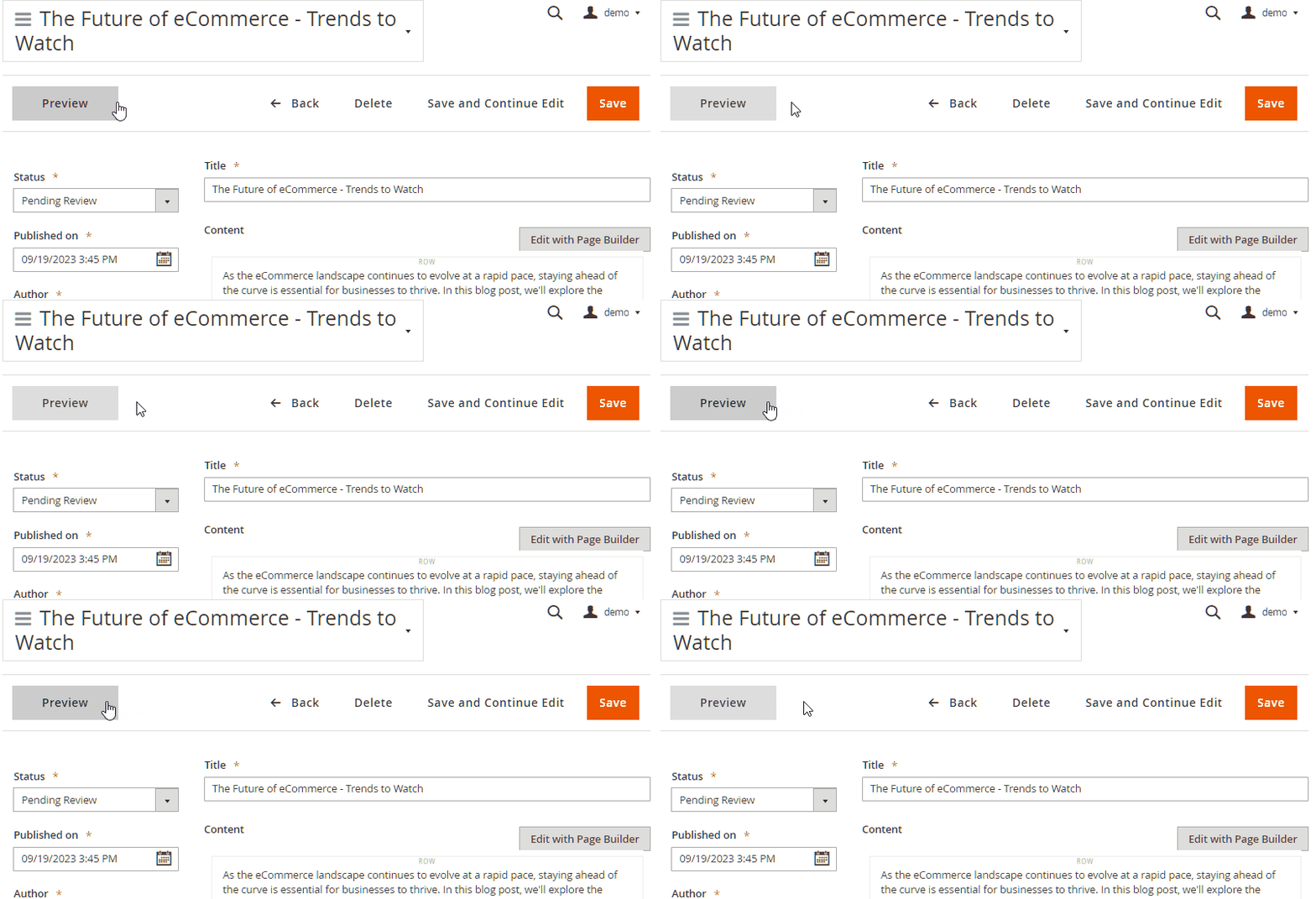
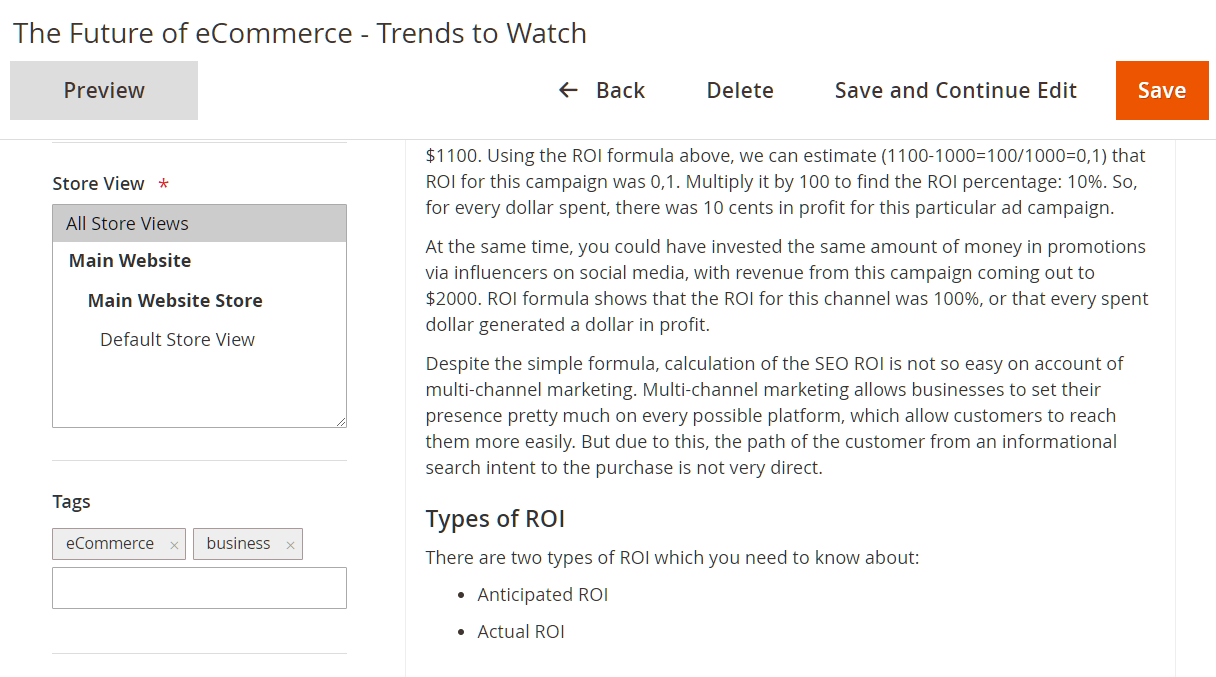
Preview shows the article exactly as readers will see it, on the storefront theme, before anything goes live.
It catches what a draft view cannot: layout that breaks at the wrong width, an image that sits in the wrong place, a headline that wraps badly.
A different blog for every store view
Most extensions treat multi-store as translation. Blog MX treats it as separate content. Switch a post to a store view and almost every field gains a "use default" toggle you can clear:
- Posts: title, excerpt, body, featured image and its alt text, URL key, meta title, description and keywords, author, publish and last-modified dates, status, and whether the post is pinned.
- Categories: name, content, status, sort order, URL key, and meta tags.
- Authors: name, job title, photo, short and full bio, URL key, and meta tags.
- Tags: name and URL key.
- Layouts: each store view can use its own page layout or inherit the shared one.
So a German store view can run a different article, under a different URL, by a different author, on a different layout, while the rest of your stores keep the original. Admin and storefront text ship in 16 languages.
Simple cross-sell and up-sell
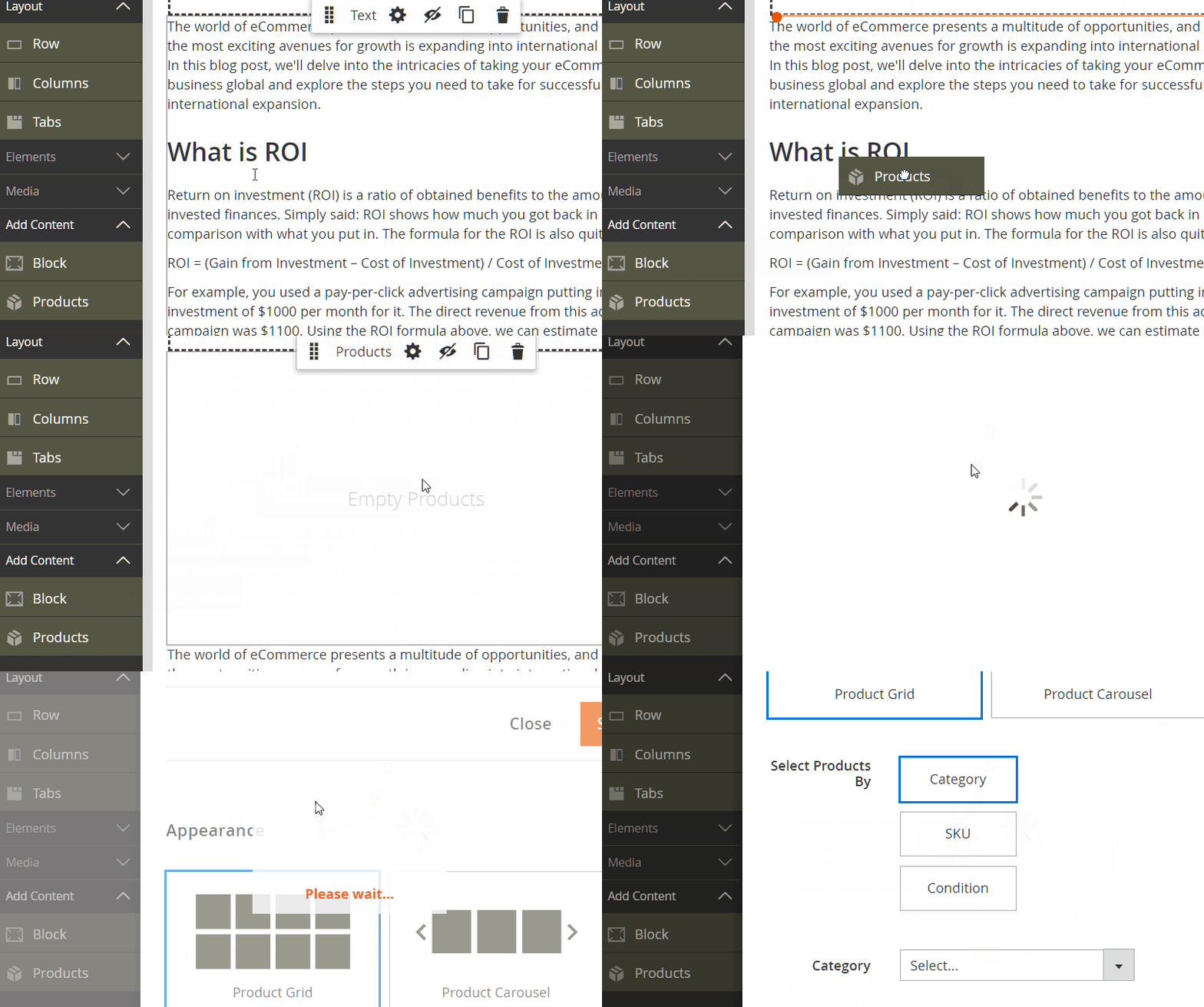
Drop the Related Products widget into a post and choose where the products come from: a manual list you arrange by drag and drop, or a catalog category that fills the block for you and follows that category's own anchor and sorting settings.
If you run Automatic Related Products, its selection rules become a third option. Sort order, direction, and the product list itself can differ per store view.
Plan your publishing
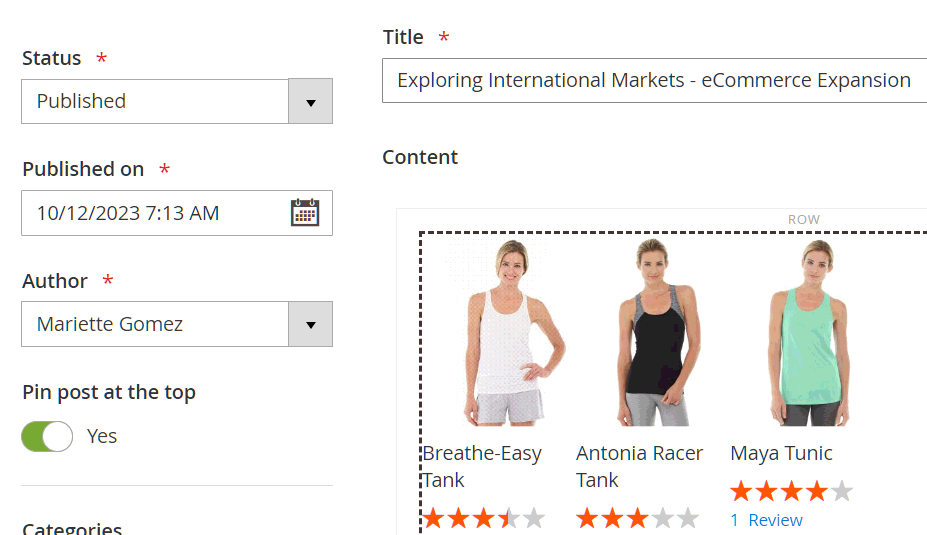
Set a future date and time and the post appears on its own, which is what makes an editorial calendar or a news section practical to keep.
Deleted posts go to a Trash bin rather than disappearing. Restore one and it comes back with its original URL and related-post links intact; anything older than your retention period, 30 days by default, is cleared by cron.
Move your existing blog over
Switching platforms usually stalls on the archive, so we do that part for you: our team migrates posts, categories, authors, and images from WordPress or another Magento blog extension, free of charge.
The same applies if you are still on the old free Mirasvit blog module. Ask support before you install and we will plan the upgrade.
Make your blog on Magento visually unique and easy to navigate
Easier navigation with a multi-level structure
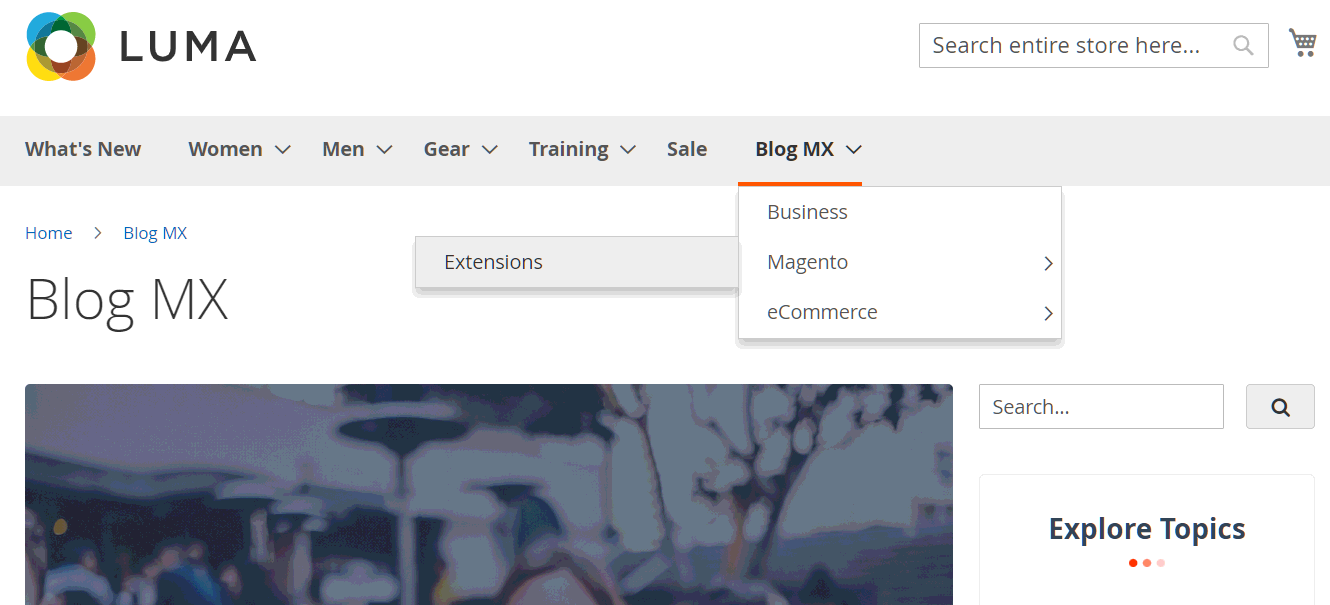
Nest categories as deep as the subject needs, and let the category widget show either the whole tree or just the branch the reader is currently in.
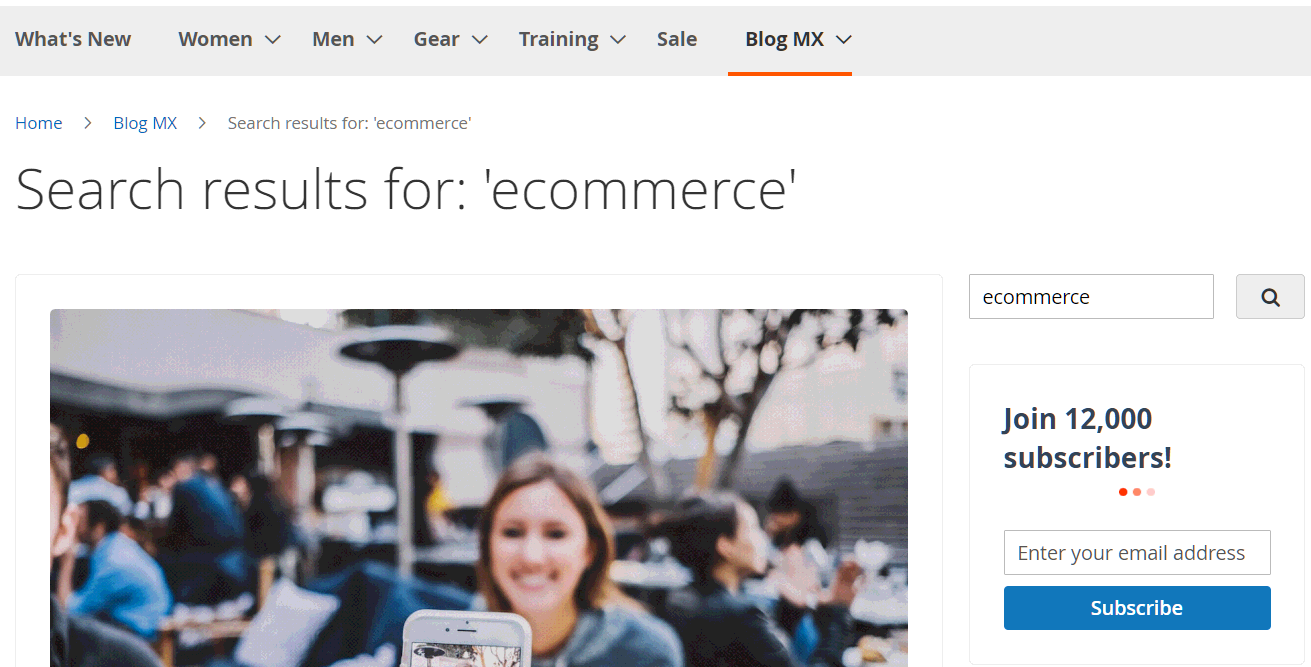
Instant blog search
The search box works both ways: suggestions appear as the reader types, and a full results page is there for longer queries.
Native Magento search does not look inside blog posts at all. With Search Ultimate installed, your articles also show up in the main store search and its autocomplete, alongside products.
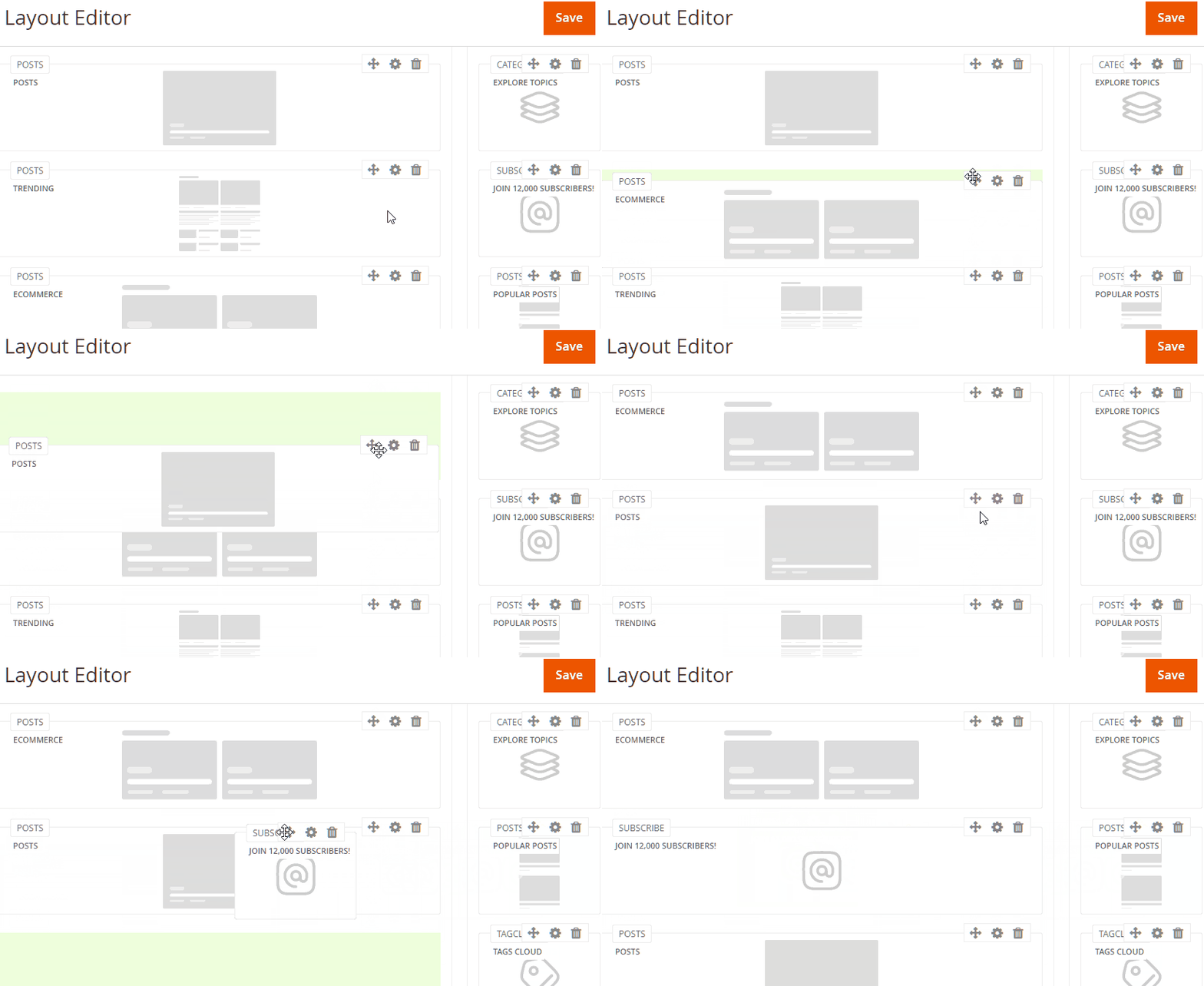
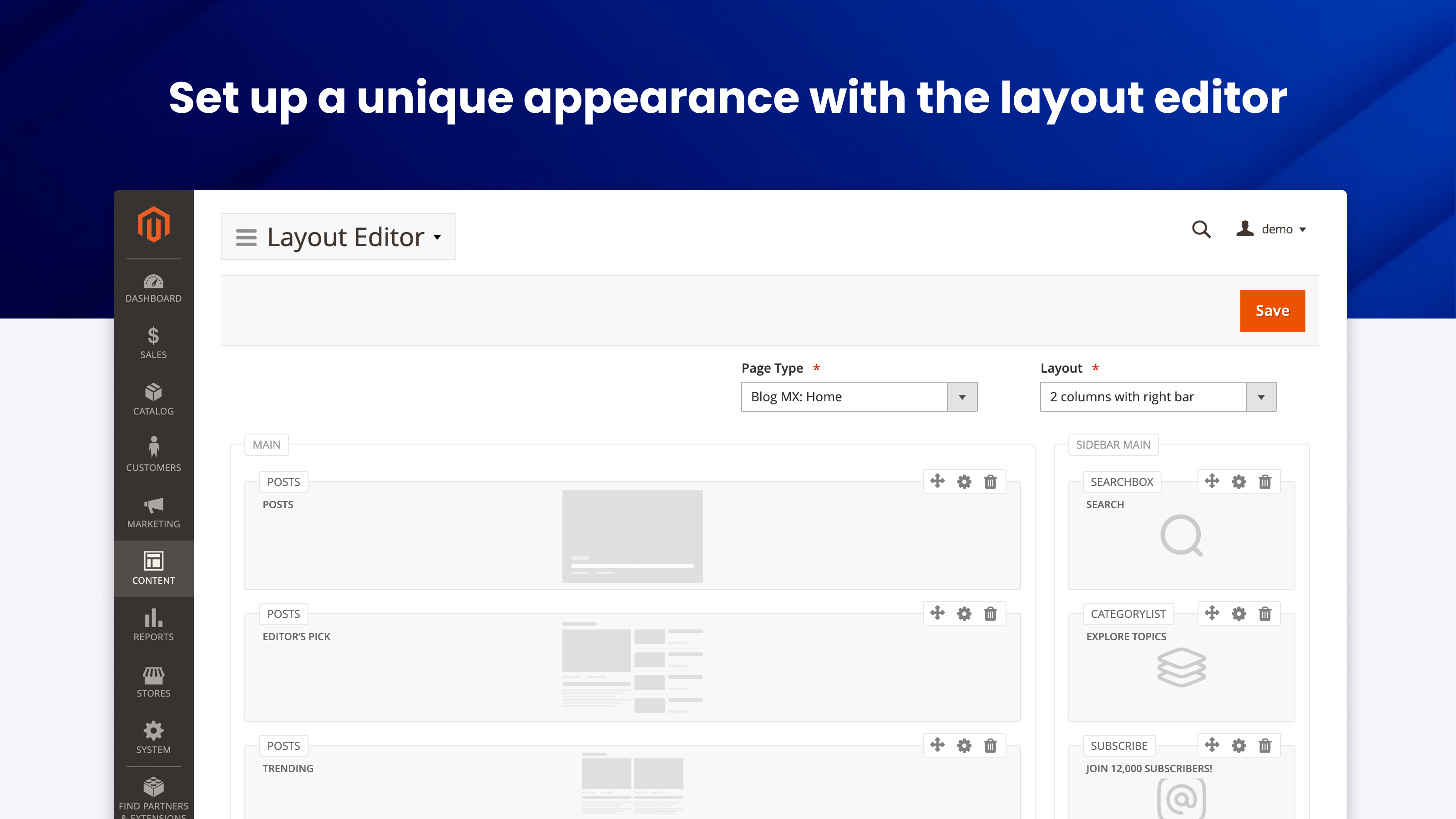
Configure the blog layout with drag and drop
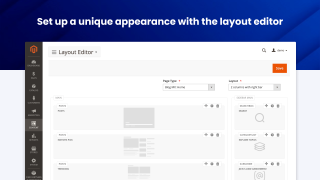
Build each page type in the Layout Editor: choose a one or two column layout, then drag blocks into the main column and the sidebar. Saving clears the relevant cache, so the storefront updates immediately.
Deeper design changes still belong in your theme templates, and the code ships unencrypted so your developer can make them.
Prebuilt widgets for quick blog layout design
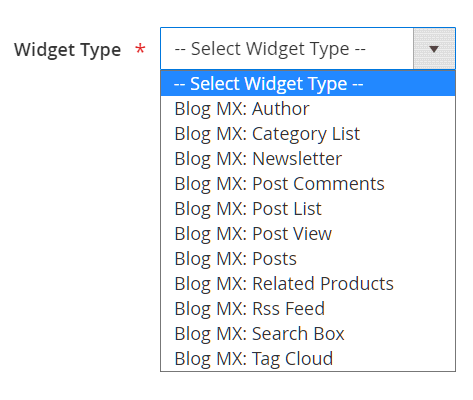
The whole frontend is made of widgets, and there are 12 types to work with: posts, post view, post comments, related products, category list, tag cloud, search box, author, newsletter, RSS, CMS block, and post list.
The Posts widget alone ships 8 templates, from a single hero article to card grids and sidebar sliders.
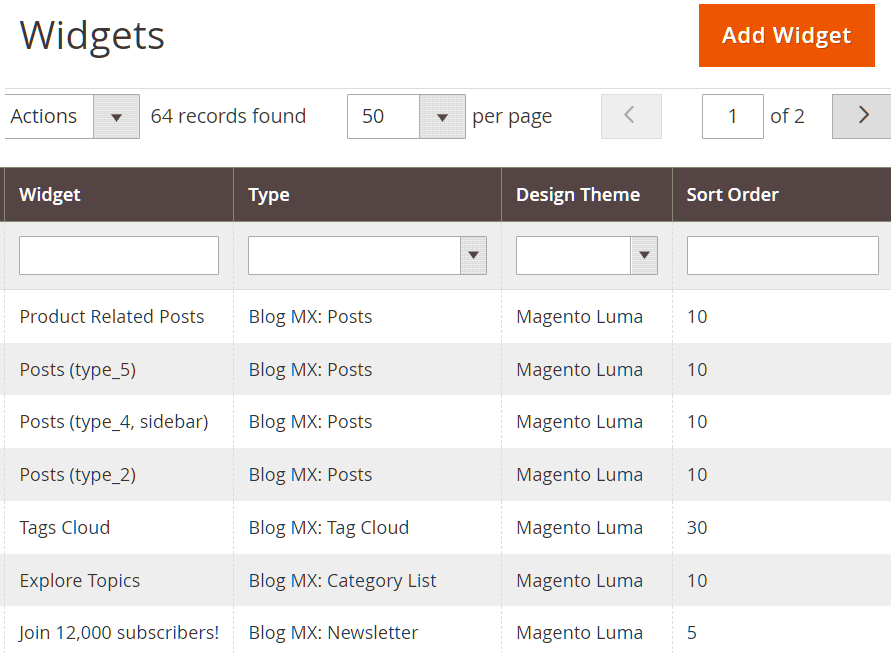
Blog in Magento 2 with custom widgets and templates
Widgets go on any page of the store, not only blog pages, and they read the context of the page they sit on: put a post list on a category page and it shows posts for that category.
Need something the templates do not cover? Point a widget at a custom template in your theme.
Promote blog posts on the pages of your store
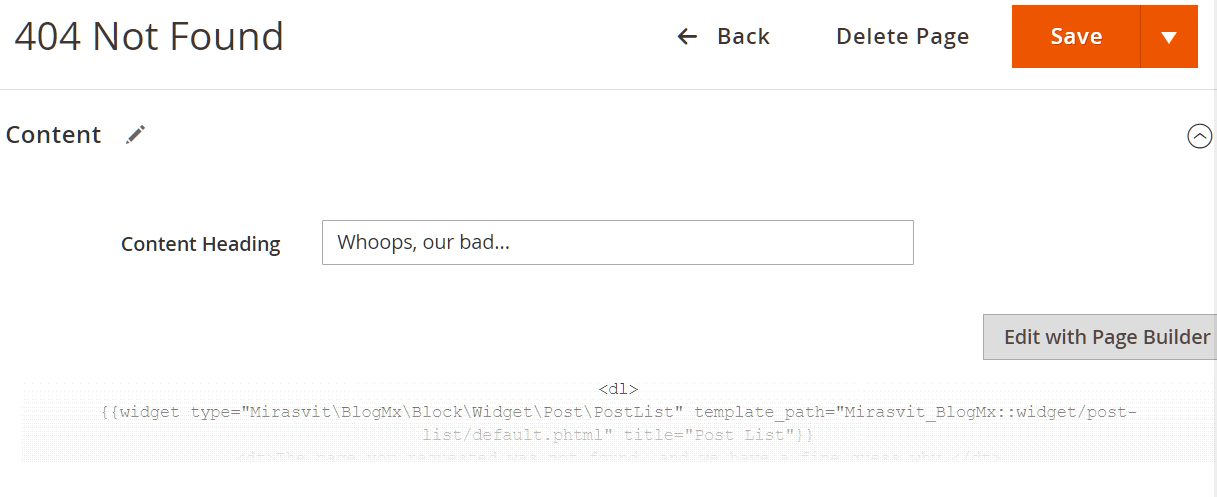
Recent or related articles can sit on product pages, category pages, or the 404 page, where a list of posts is more useful than a dead end.
Related posts are ordered by relevance: articles sharing the most tags come first, then ones in the same category.
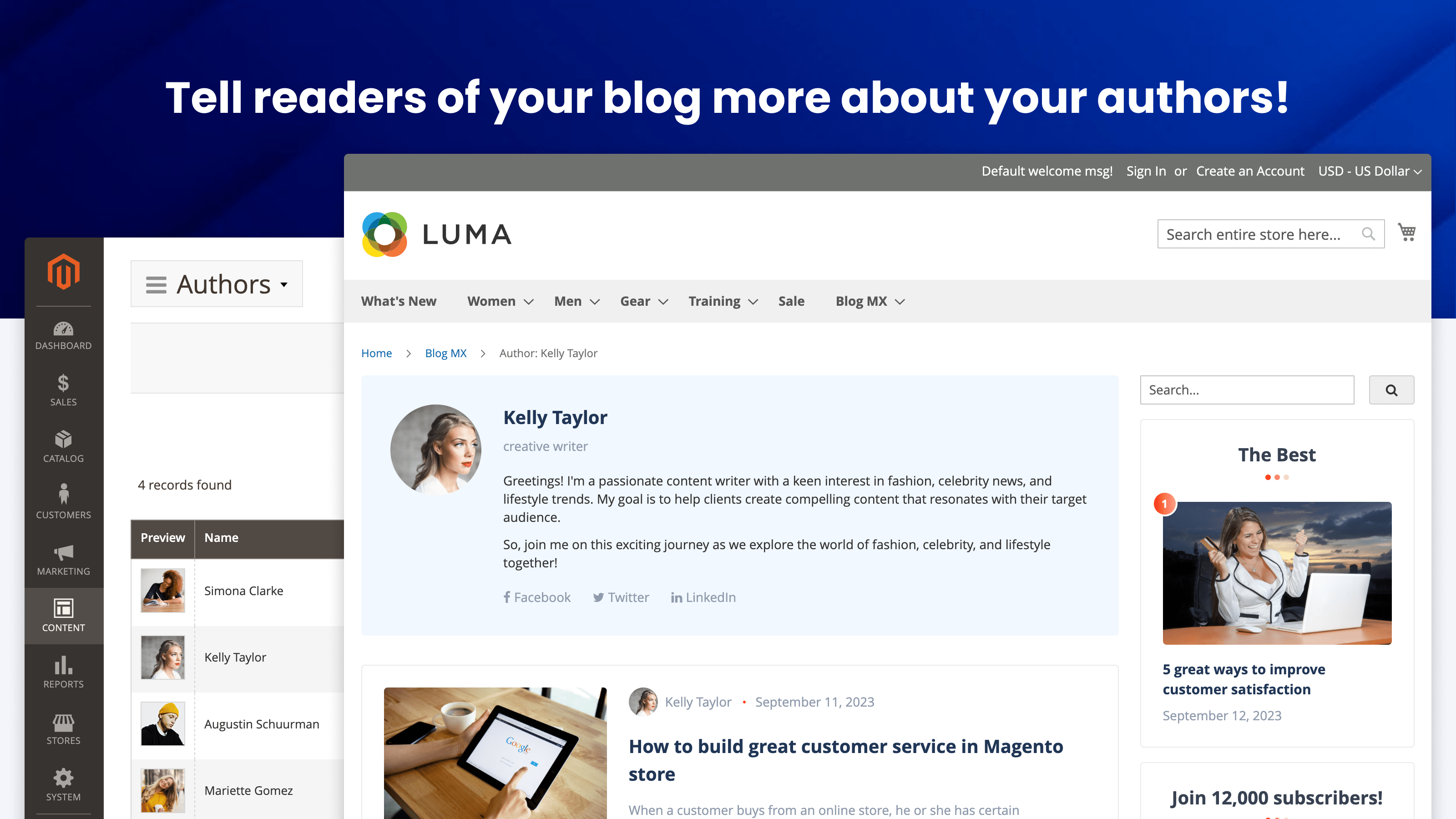
Establish trust with readers through author pages

Give each writer a page with a photo, a bio, and links to their profiles, then let readers browse everything that author has written.
Named authors with visible credentials read as more trustworthy, to people and to the systems that assess content quality. Posts also carry an author meta tag and per-store author overrides, so a translated article can credit the person who actually wrote that version.
Let your readers promote your blog articles
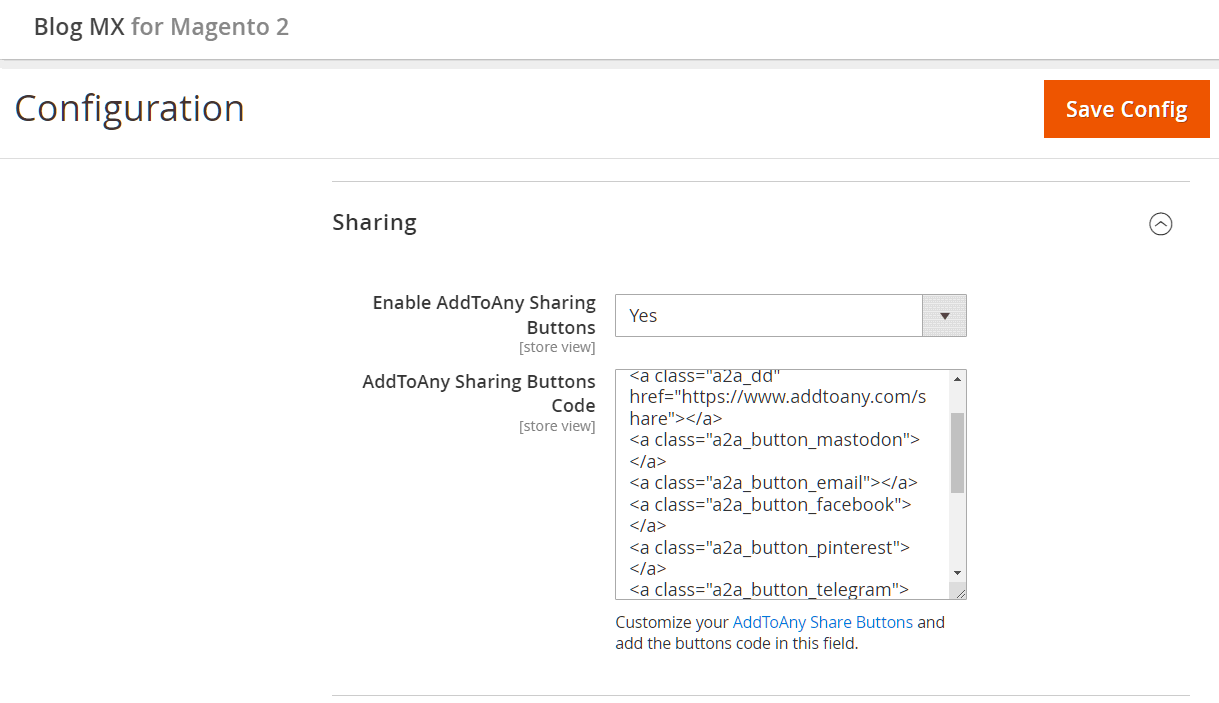
Sharing runs on AddToAny: paste your button code into the settings and pick whichever networks your readers actually use. Because the set is yours, you are not stuck with someone else's list of icons.
Let readers leave comments in blog to boost engagement
Comments are included, and they run on your own site rather than through a third party.
Guests can post, optionally with a required email address, or you can limit commenting to signed-in customers. Turn automatic approval off and everything waits in a moderation queue in the admin, where you approve, reject, or reply. Admins are notified about pending comments, participants get an email when someone answers them, and readers can vote a comment helpful or unhelpful. Facebook comments remain available if you prefer them.
Small things that keep people reading
Posts show an estimated reading time and a progress bar as the reader scrolls, and a table of contents widget builds itself from the headings you choose.
You can also publish a post by direct link only, protected with a password, which is handy for an embargoed announcement or a page meant for one client.
Get into Google's top with embedded SEO features
Check content quality across the whole blog
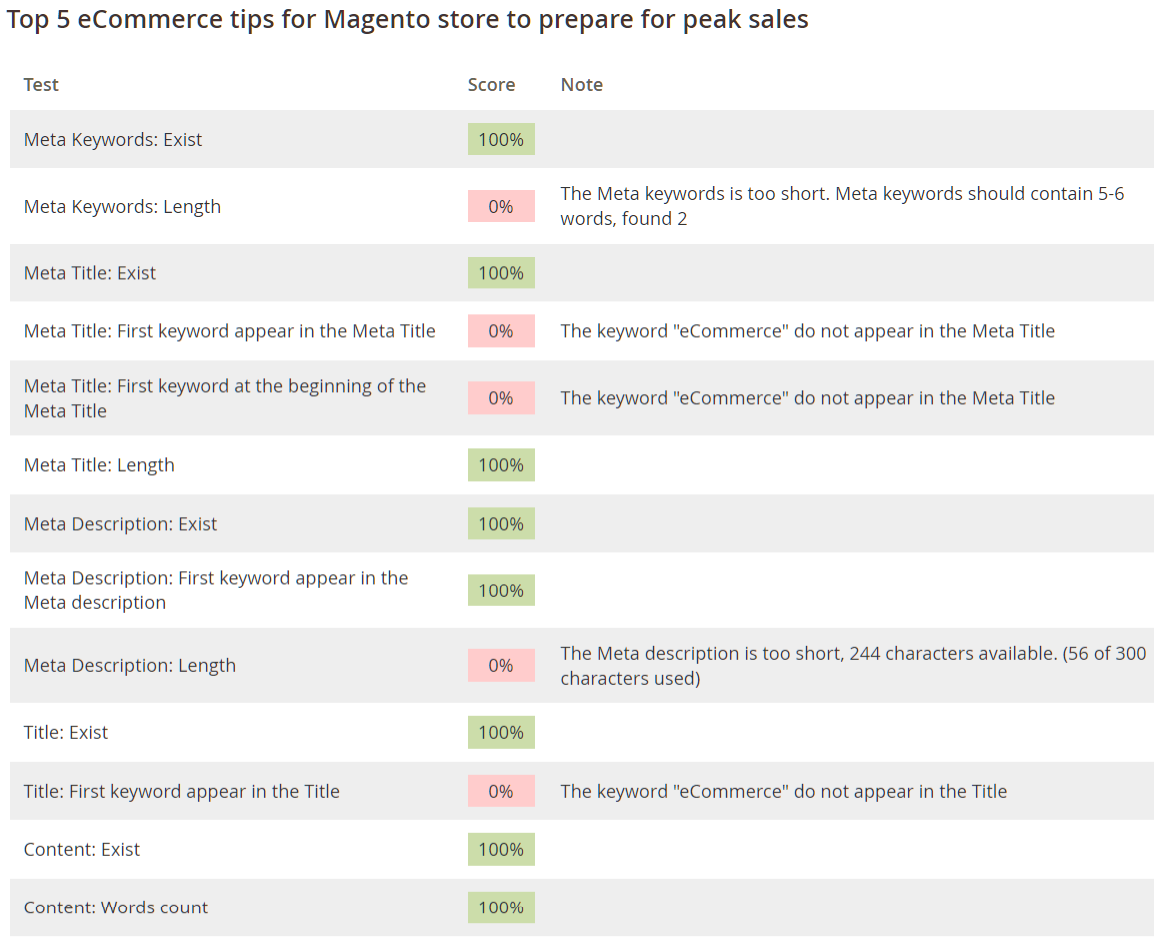
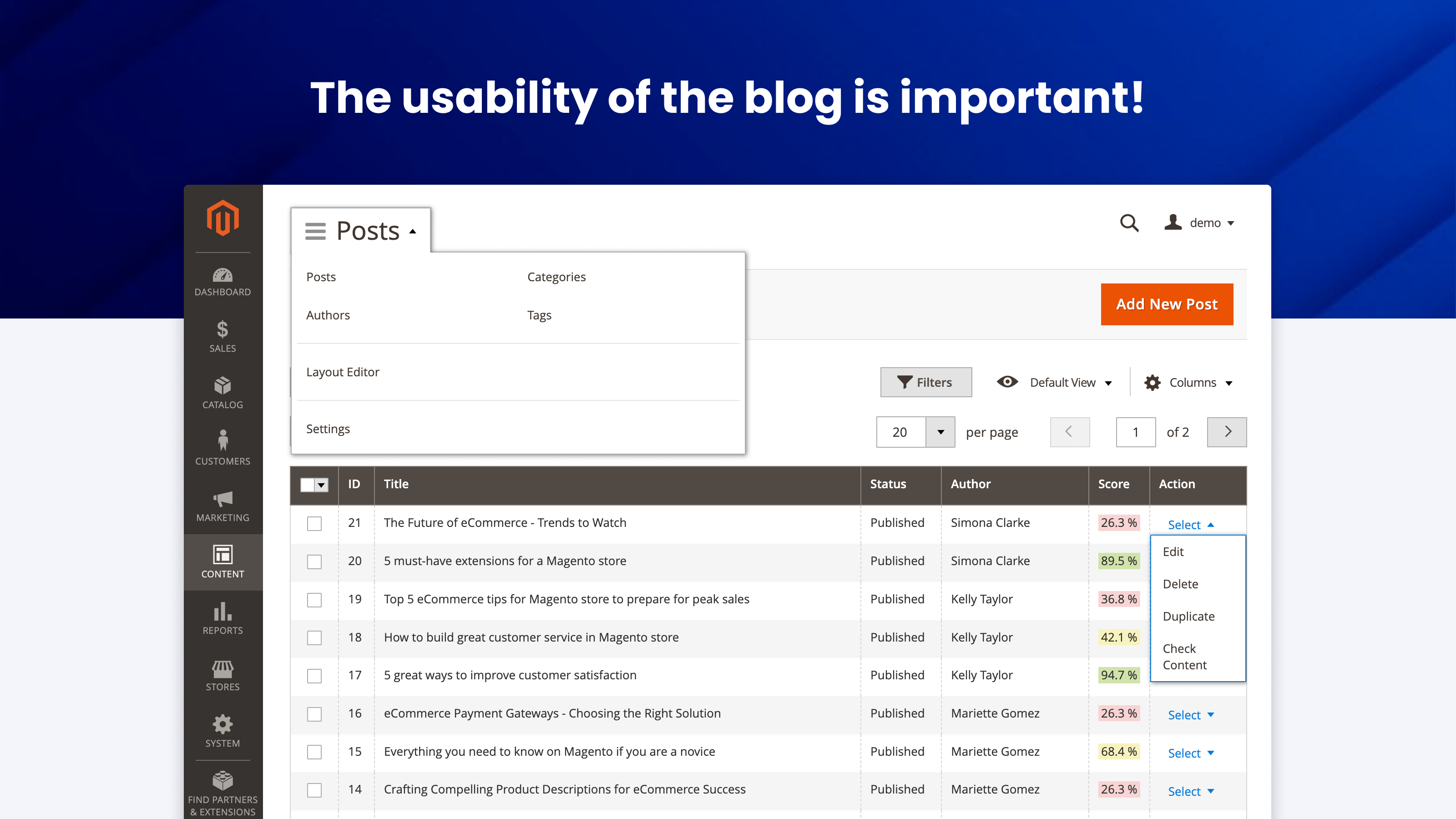
Every post gets a content score, and the Content Checker screen lists all of them in one grid so you can see which articles need work instead of opening them one by one.
It also flags posts containing links that lead nowhere and images that fail to load, which is the kind of rot that accumulates quietly in an older archive.
You decide what the score means: switch individual checks on or off and set how much each one counts. Scores are stored per store view, calculated in the background so saving a post is never slow, and available over the REST API. Access is controlled by its own permission.
Simple interface for meta tags
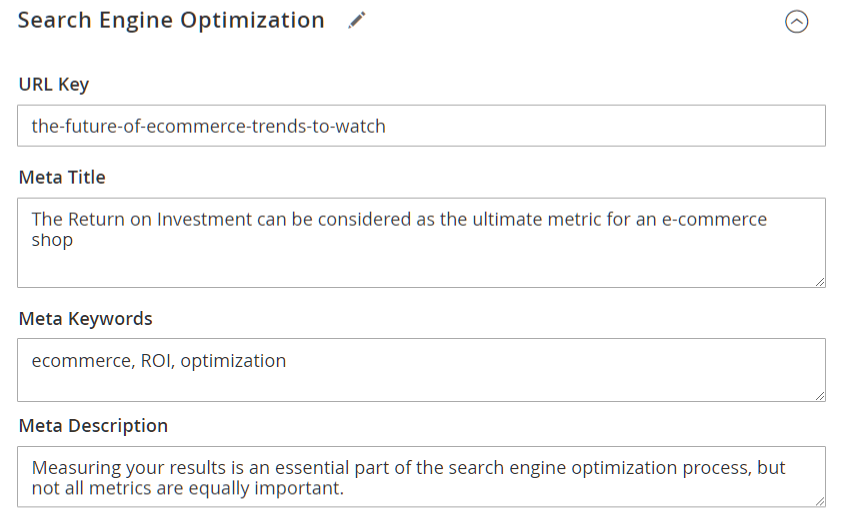
Meta title, description, and keywords sit right below the content, and each can be overridden per store view.
Robots directives are set per entity, so you can noindex a thin tag page while leaving posts indexable, and the blog keeps its own default separate from the site-wide Magento setting.
Automatic SEO-friendly URLs
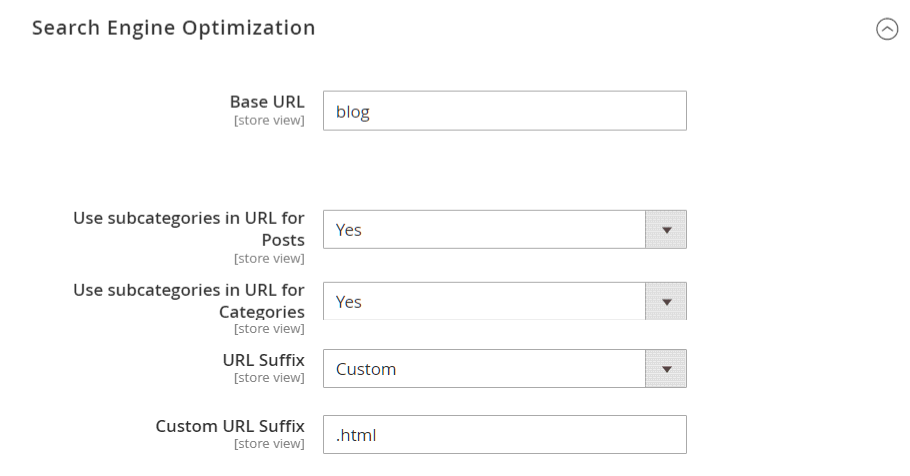
Google recommends keeping URLs readable, and Blog MX builds one from the post title automatically.
Set a base URL and a suffix to shape the whole blog's URL structure, and external links in post content can be given rel="nofollow" in bulk.
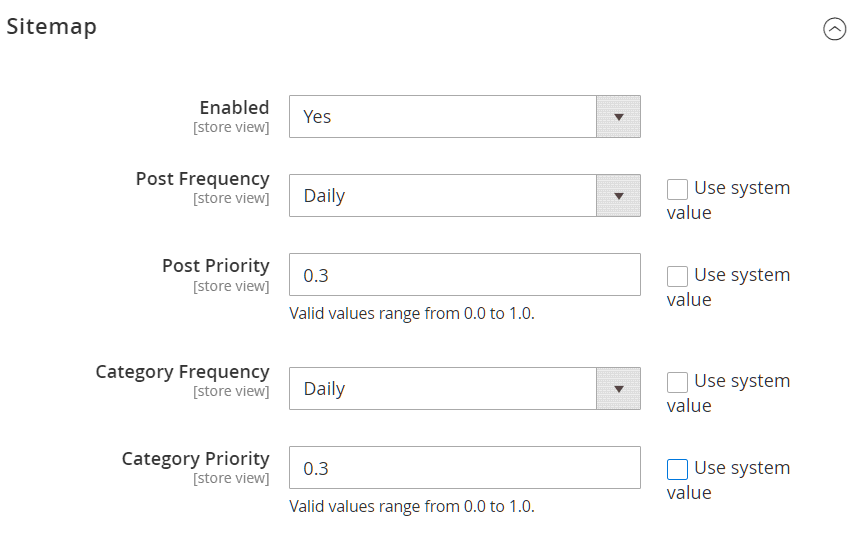
Automatically updated sitemap to inform Google about your new blog posts
A new post has no inbound links yet, so Google may take weeks to notice it. Blog MX adds posts and categories to the Magento XML sitemap as they are published.
If you want sitemap rules across the whole store rather than the blog alone, that is what Advanced SEO Suite is for.
Rich results for your articles
Posts are marked up as BlogPosting or NewsArticle, with author, publish date, and last-modified date, so Google can render your article the way it renders news.
You choose which optional properties to include and whether the description comes from the excerpt or the meta description. Dates carry proper timezone data.
Score a post before it goes live
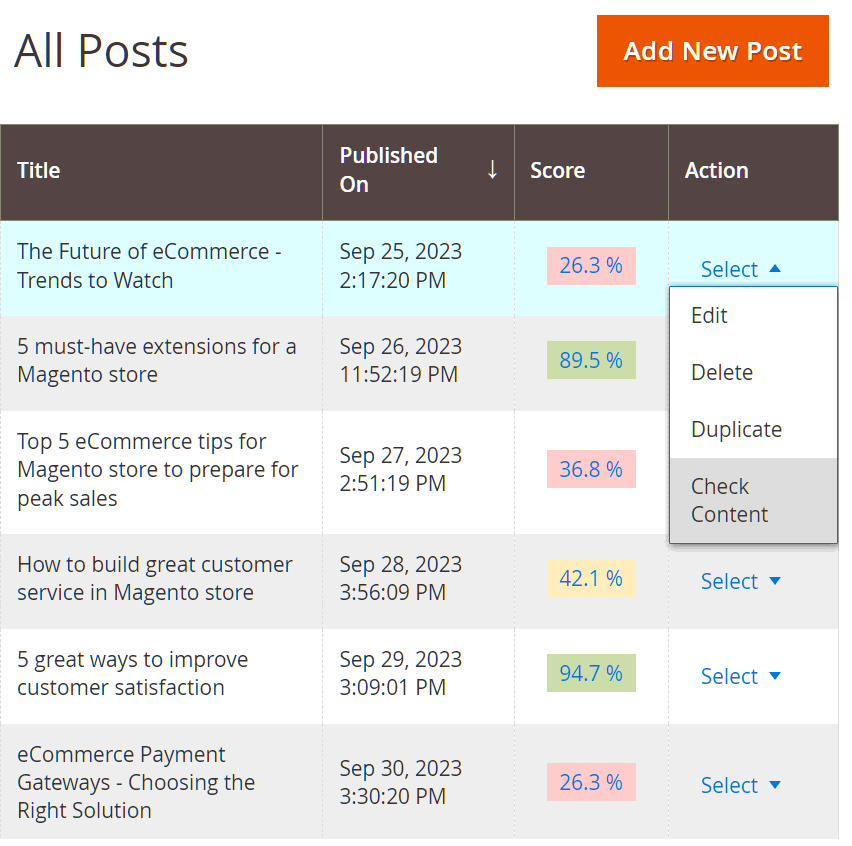
Run the check from the post edit page and you get a report on the things that are easy to forget: whether your keyword appears in the meta tags, whether those tags are the right length, whether the article has images.
Each finding comes with a recommendation, so the fix does not require guessing.
Write with AI, if that is how you work
Blog MX works with our AI Assistant extension: it can draft titles, generate post content and images, and run automation rules over posts and categories, including per store view. AI Assistant is a separate product, not part of this module.
Associating articles with relevant products or other content is quick, scheduling is straightforward, and there are plenty of layout and customization options without making everyday publishing complicated. Creating, scheduling, and deploying new content is easy enough that the extension does not become a burden to maintain.
Hyva compatibility is another major advantage for us. Mirasvit has been superb about supporting Hyva across its extensions without requiring additional purchases or custom modules.
Since I bought this module I stumbled onto way too many way too obvious bugs I had to report and/or fix myself.
Those bugs are so obvious that I came to think I might be the only one actually using/implementing it.
Upside: your support has taken care of most of my reports to this date.
But for a paid module the overall quality is not satisfactory.
Save time by starting your support request online and we'll connect you to an expert.
Do blog posts get added to the XML sitemap?
Yes, and it is built in. Turn on Sitemap in the Blog MX configuration and your posts and categories are added to the Magento XML sitemap automatically, so search engines can find new articles without waiting for another page to link to them.
You only need Advanced SEO Suite if you want more than that from your sitemaps across the whole store: change frequency and priority rules, image and hreflang entries, and splitting large sitemaps. For the blog alone, Blog MX is enough.
Can I change the blog layout from the Magento admin?
Yes. The Layout Editor under Content > Blog MX lets you build each blog page type separately: pick a one or two column layout, then drag widgets into the main area and the sidebar. Saving a layout clears the relevant full page cache, so the change is live right away.
Each store view can have its own layout, or inherit the default one. Where the editor stops is theme-level design: fonts, colours, and spacing come from your storefront theme, and deeper changes are made in template files. The code ships unencrypted, so your developer can edit those templates freely.
Is there still a free version of Blog MX?
No. Blog MX started as a free extension, but that package was retired: its last release was in 2020, it is marked as abandoned on Packagist, and it does not support current Magento versions or receive security fixes. We do not recommend installing it.
If you are still running the old free module, you can move to Blog MX and keep your posts, categories, and authors. Ask our support team and we will handle the upgrade for you.
Is Blog MX a PWA-ready extension?
No. Blog MX renders through Magento templates and is fully responsive, including on Hyvä, so it works well on phones and tablets. You can see it on the demo store.
What it does not do is run as a headless or PWA storefront: there is a REST API for blog entities, but no GraphQL layer, so the blog cannot be published as a standalone app on the App Store or Google Play. If your storefront is headless, this is the limitation to weigh.
Can readers comment, and how do I keep spam out?
Comments are included, with no third-party service required. Guests can comment or you can restrict commenting to logged-in customers, and you can require an email address from guests. Readers can vote comments helpful or unhelpful.
For moderation, turn off automatic approval and every comment waits in a queue in the admin, where you can approve, reject, or reply to it. Admins get notified about pending comments, and thread participants get an email when someone replies. If you would rather use Facebook comments instead, that remains an option in the settings.
: or ., which left the field as a plain multi-select.var/log/exception.log.<!--more--> marker placed inside a paragraph, list or other block breaking the layout of the blog listing and search results. The teaser was cut at the marker as raw HTML, so it could end with an unclosed tag that broke the markup of the page around it. The text before the marker is now shown as plain text, the same way excerpts cut by Default excerpt length already are, so any formatting in that part of the post (bold, links, headings) no longer carries into the teaser.mirasvit/module-blog-mx-hyva was still installed, composer update refused to resolve and named no way out until you removed it by hand. Composer now removes it by itself during the upgrade.<!--more--> excerpt marker being ignored unless the post came in through a WordPress import. The marker is how you say where a post's teaser ends, but it only counted when typed exactly — and the admin editor and Page Builder both save it in an escaped form, so a marker you placed by hand did nothing and the listing fell back to the excerpt size or the Short content field instead. Spacing (<!-- more -->), WordPress's custom-text form (<!--more Read on-->) and the escaped form the editors store are all recognised now. A marker at the very start of a post gives an empty excerpt, as documented — the marker takes priority over a Short content excerpt.<!--more--> marker showing up as visible text in the middle of a post. Because the editors store it escaped, the browser printed it as ordinary words rather than hiding it as an HTML comment, so visitors read <!--more--> mid-paragraph. It is now removed from the post body wherever the body is rendered, including the article text the blog publishes in its structured data for search engines.mirasvit/module-blog-mx-hyva package is part of Blog MX itself. There is one package to install, one version to keep track of, and one release per change instead of two.Hyva_CmsTailwindJit installed, and is invisible everywhere else.mst_blog_post_tailwindcss, mst_blog_category_tailwindcss, mst_blog_author_tailwindcss) hold the compiled Hyvä styles for a post, category or author, one row per theme, and each of mst_blog_post, mst_blog_category and mst_blog_author gains an is_tailwindcss_jit_enabled flag. These come across from the retired companion package; they are applied automatically on upgrade and cost nothing on a store that does not use Hyvä.<details> element, so it also works with the keyboard and without JavaScript.Blog

 Andriy Kovalenko

We are committed to being open and transparent with our customers. When you purchase our module, you automatically receive one year of free support service and free updates.
Why is this important?
- Seamless Installation and Configuration: We understand that setting up a new module can take time to configure according to your specific needs. That’s why we offer a full year of free support. Our experienced team is here to assist you with installation, configuration, and any questions you might have. We're eager to share our expertise to ensure you get the most out of your purchase.
- Stay Updated with Magento (Adobe Commerce) Releases: Magento releases new versions approximately every three months. These updates can sometimes introduce compatibility challenges. To keep your store running smoothly, we provide a year of free access to the latest versions of our modules, ensuring that you can upgrade Magento and our modules without encountering any obstacles.
- Subscription Included: Renewing your subscription ensures continued access to the latest updates and support from our team. This means you can be confident that any issues you encounter with the extension will be resolved quickly and efficiently. You can cancel your subscription at any time without any additional fees.
These are our primary. A major portion of our new clients come from referrals from our existing clients. Our professional team of developers, marketers and support staff have invested the best knowledge and experience in the field into our work, so you know you can come back to us again and again.
One year free and high quality support. We go to great lengths to provide maximum satisfaction with every module you have purchased in our store. By helping you with installation, configuration, answering your every question, we do all our best to eliminate any possible problems.
30-days money back guarantee. If you are not satisfied with our Magento 2 blog extension performance for any reason, we provide a full refund.
We constantly add new features to all our modules, and are always interested in hearing your opinion and implementing your suggested features in our future developments.
We provide an expanded user guide for every aspect of our Magento 2 blog extension, so you can find answers for all your burning questions.
You can customize Magento 2 blog extension according to your needs and requirements.
The Module is easy to install and upgrade, just follow our step-by-step user guide. Additionally, the extension is ready to use with the Hyvä theme.
No core modifications. The Magento 2 blog extension has been tested in a Magento Cloud environment and is fully compatible with it.