
Advanced Product Feeds for Magento 2
Promote your products and achieve higher sales by using the power of marketplaces and comparison shopping engines with magento data feed extension. You can automatically generate and deliver feeds of your product catalog to those services with Magento Product Feeds extension.
This tool is unbelievably quick to use and is also outstandingly flexible. It's compatible with all major shopping and advertising services, including Google Shopping.
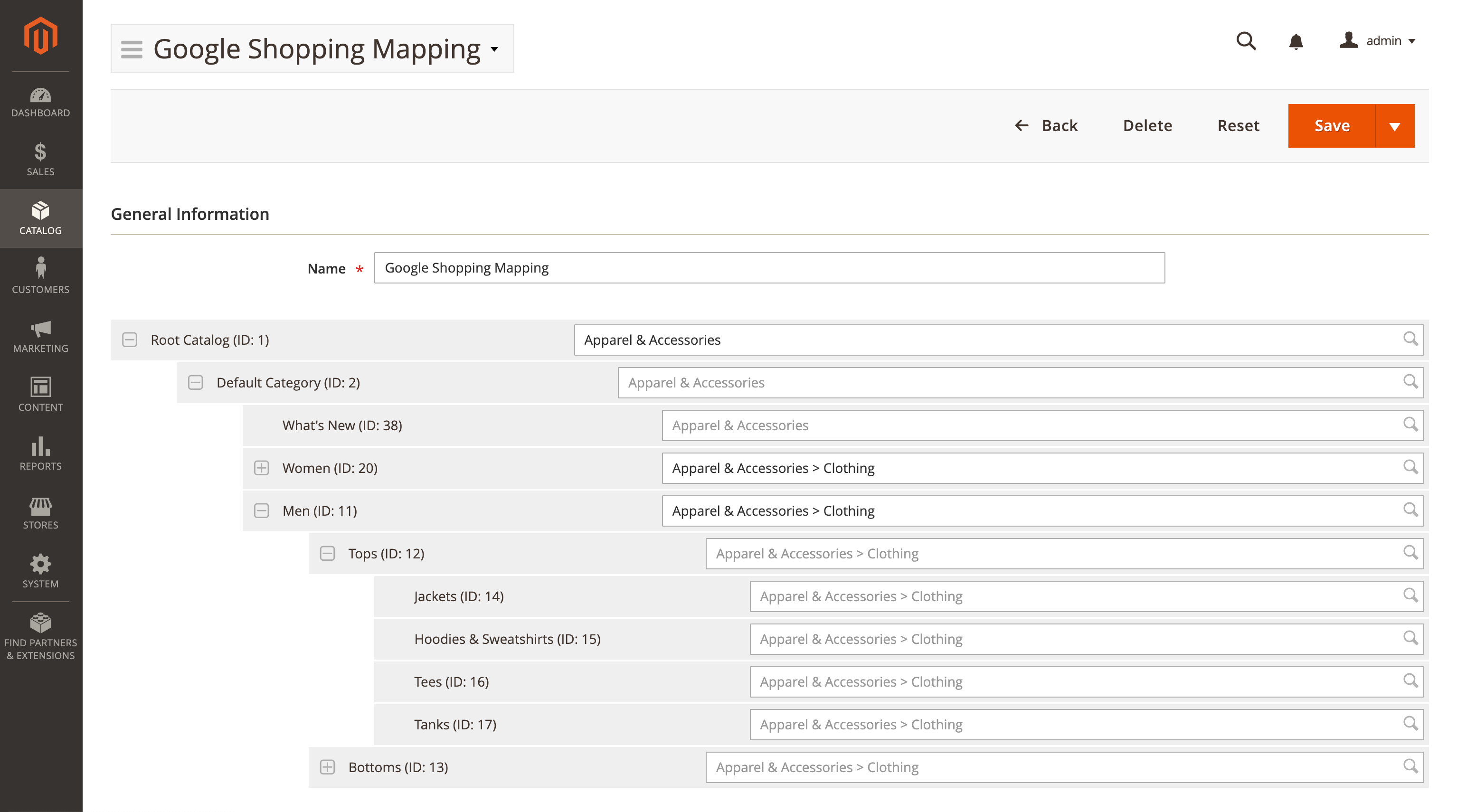
Feeds go straight to Google Merchant Center through Google's API, and AI profiles can rewrite titles, map Google categories and fill in missing attributes before your catalog ever reaches a marketplace.
Simply install the module, generate your very own product feed, present your catalog to a wider audience, and boost your sales right now!
- Optimize titles and attributes with AI
- Leverage the most popular shopping channels
- Use 130+ feed templates
- Submit feeds to Google Merchant Center directly
- Customize the feed with filters and patterns
- Validate feeds before export with built-in checks
- Automate feed generation and delivery
- Analyze feed performance reports
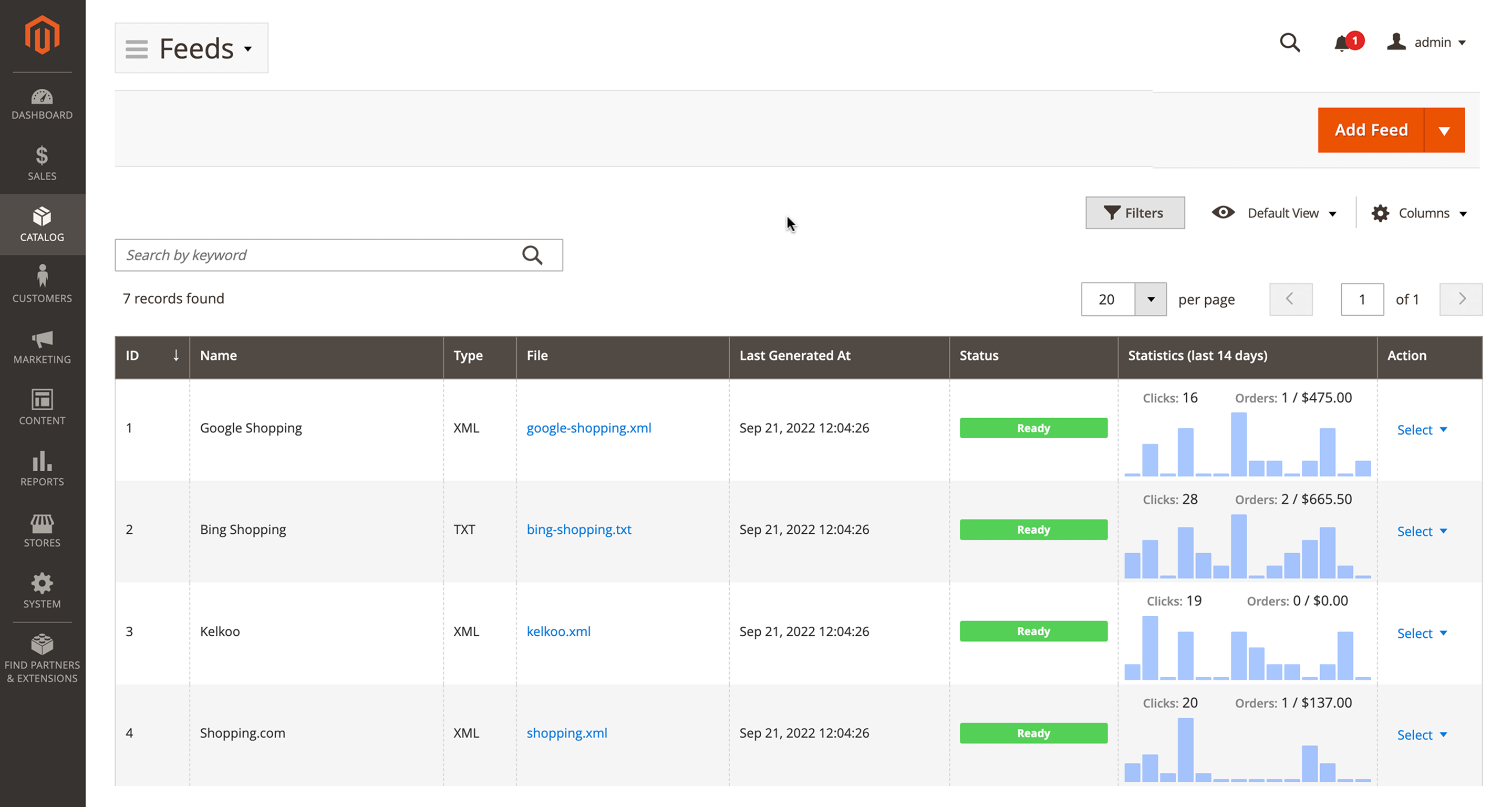
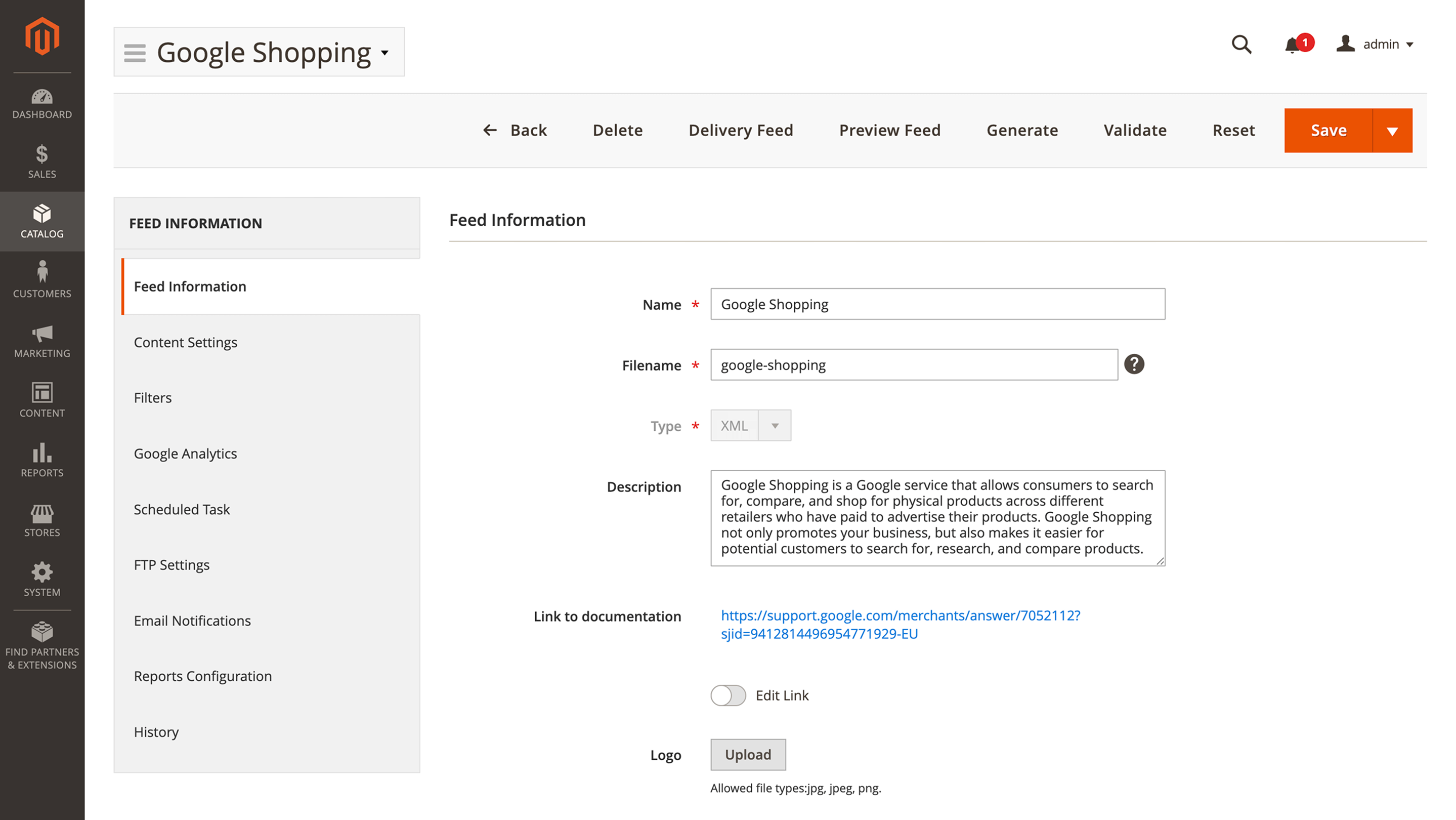
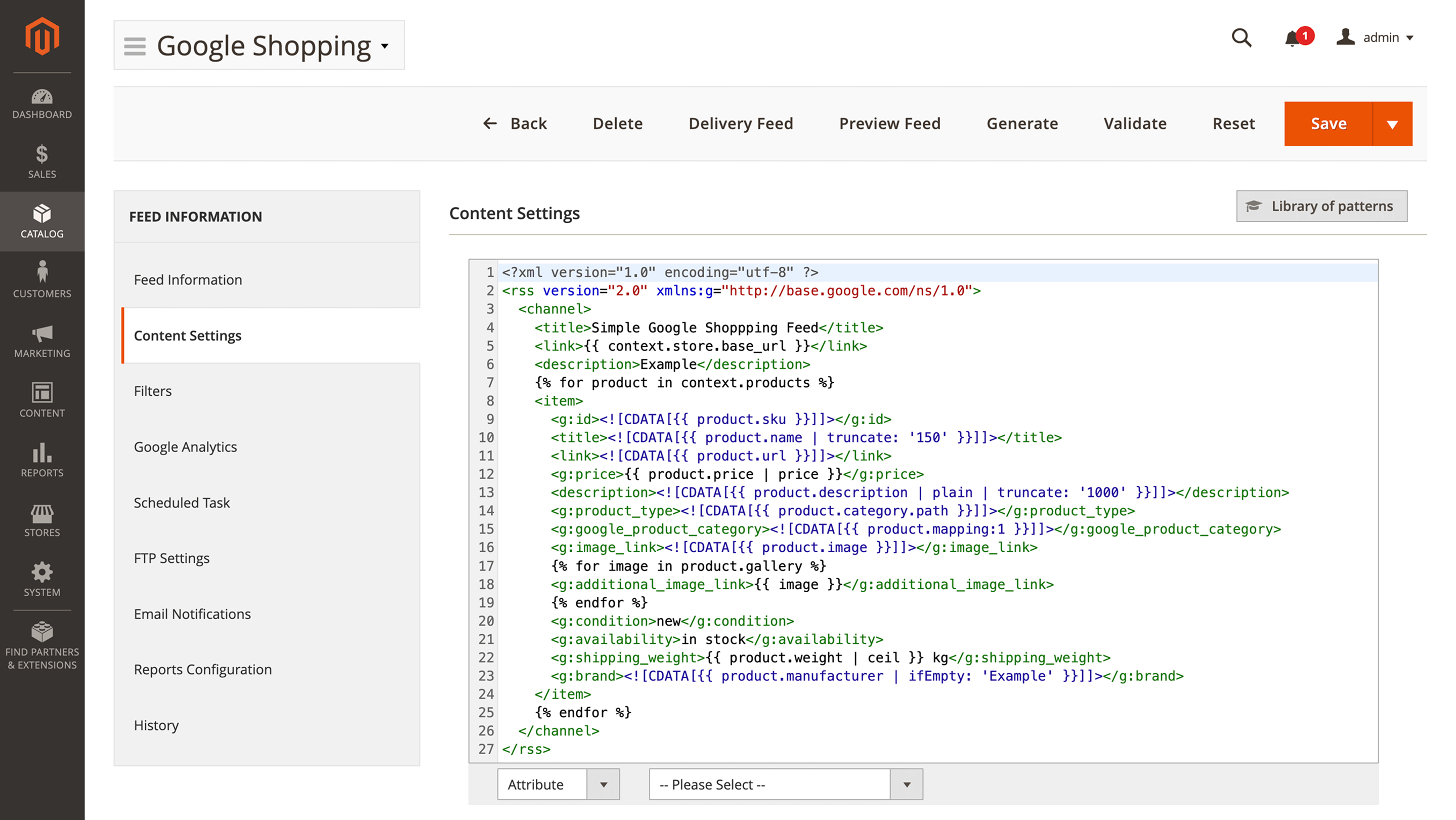
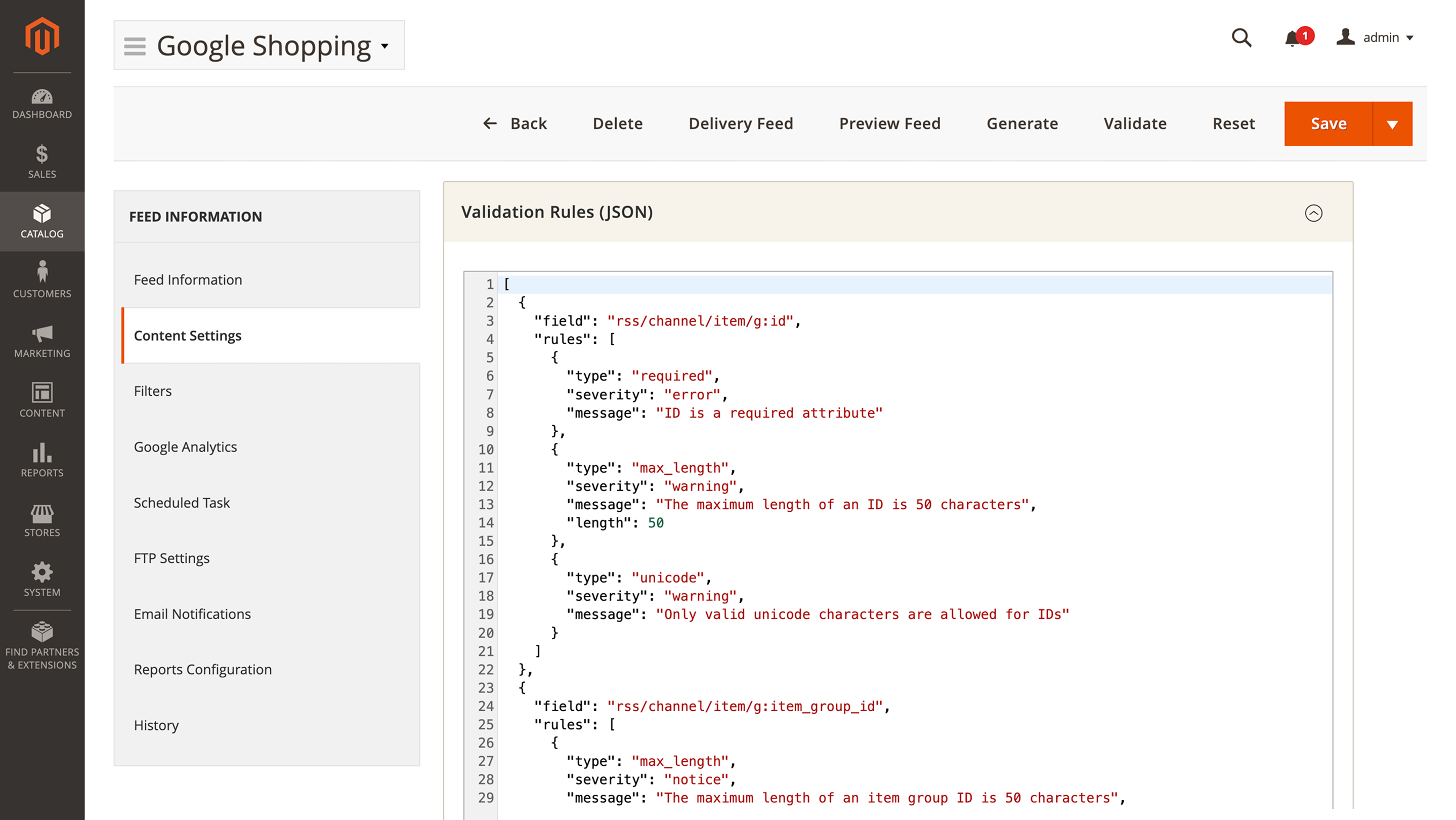
Business Value
Once you get your products listed on the most popular shopping engines and marketplaces, you will be able to attract a far greater number of new customers!
-
The Fastest to Set up: Easily create feeds for your product catalog by using prebuilt templates. You'll never have to create a feed from scratch again with the Product Feed for Magento 2. It includes 130+ templates for all major shopping search engines and marketplaces.
Google Shopping feeds don't even need an upload: the extension submits them to Google Merchant Center through Google's Merchant API.
On top of that, it doesn't matter how many products you have in your store. Our module will quickly generate a feed with any number of products, completely hassle-free!
-
The Most Flexible: The feed will always perfectly fit your needs. You can add as many fields to the feed as necessary, and customize every single one of them.
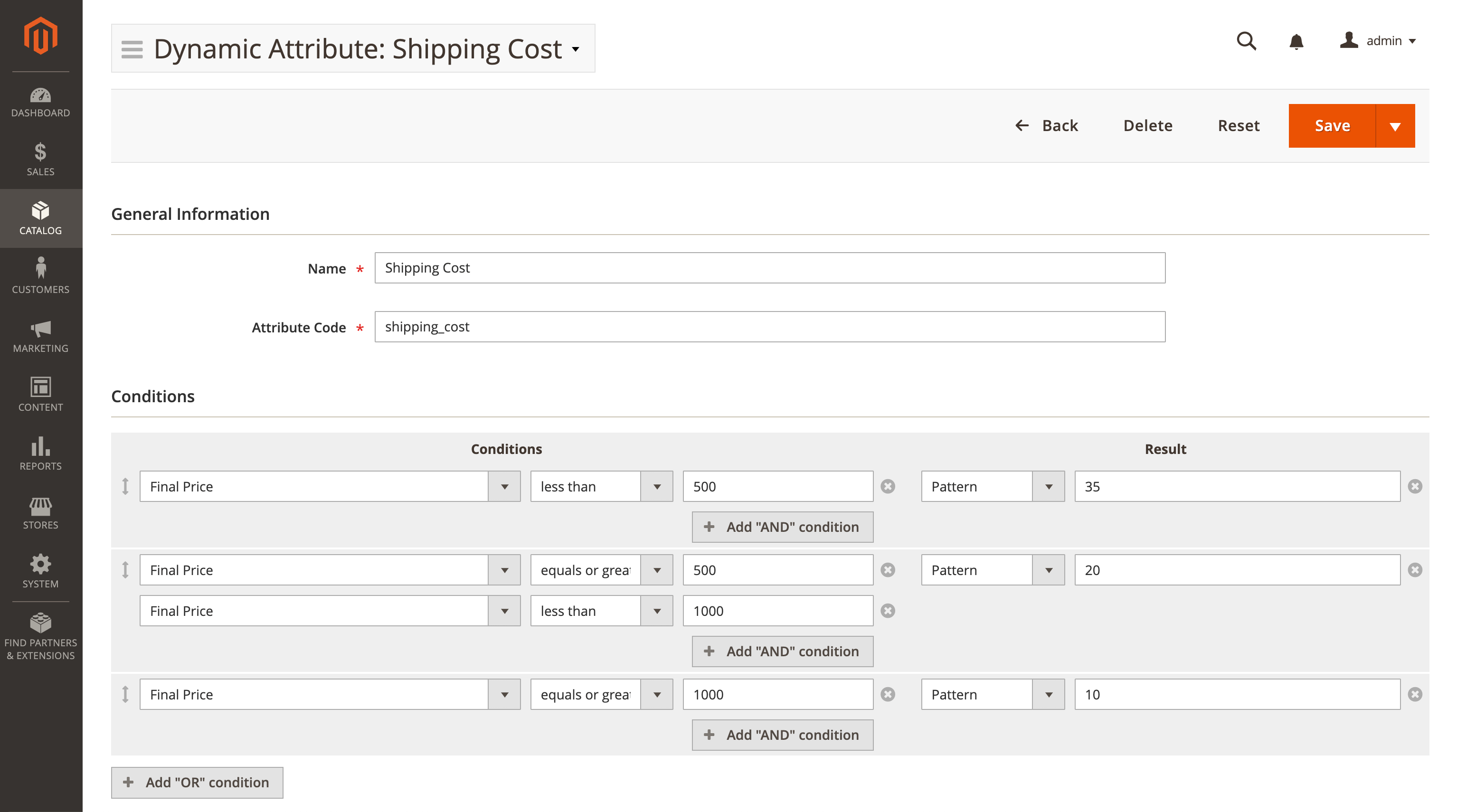
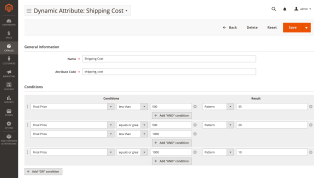
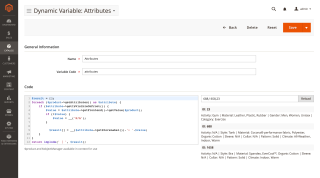
That's not everything: the module is also amazingly versatile! There's a wide variety of product filters available. Patterns, dynamic attributes and dynamic variables offer unprecedented customization opportunities. You can export any product's attribute, alter prices, remap categories, automate generation and delivery, and use built-in analytics.
And when the problem is the product data itself rather than the feed structure, AI profiles rewrite titles and descriptions, map Google categories and fill missing attributes, on your own AI key and without slowing generation down.
Effortless Feed Setup
Launch in minutes with curated presets
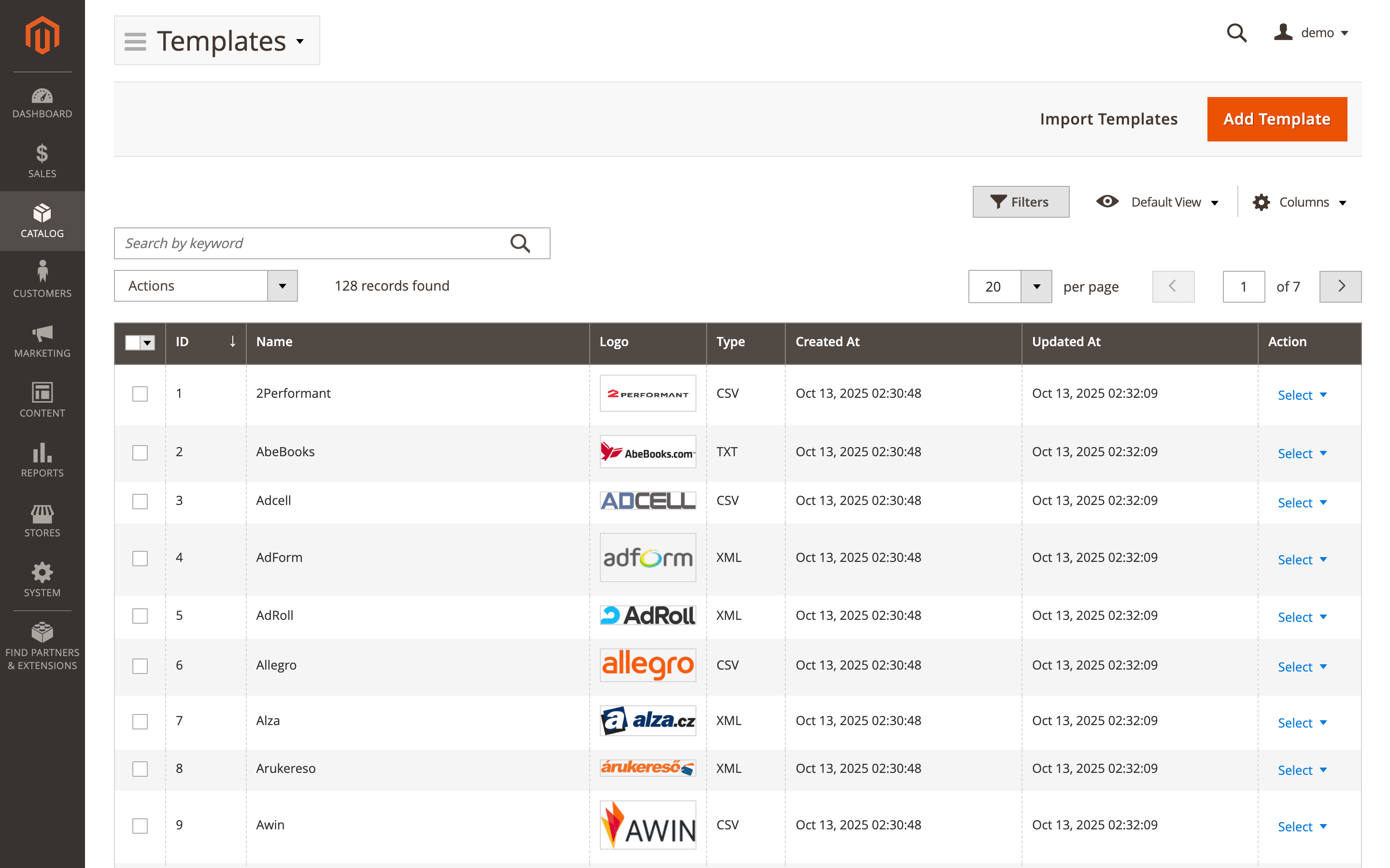
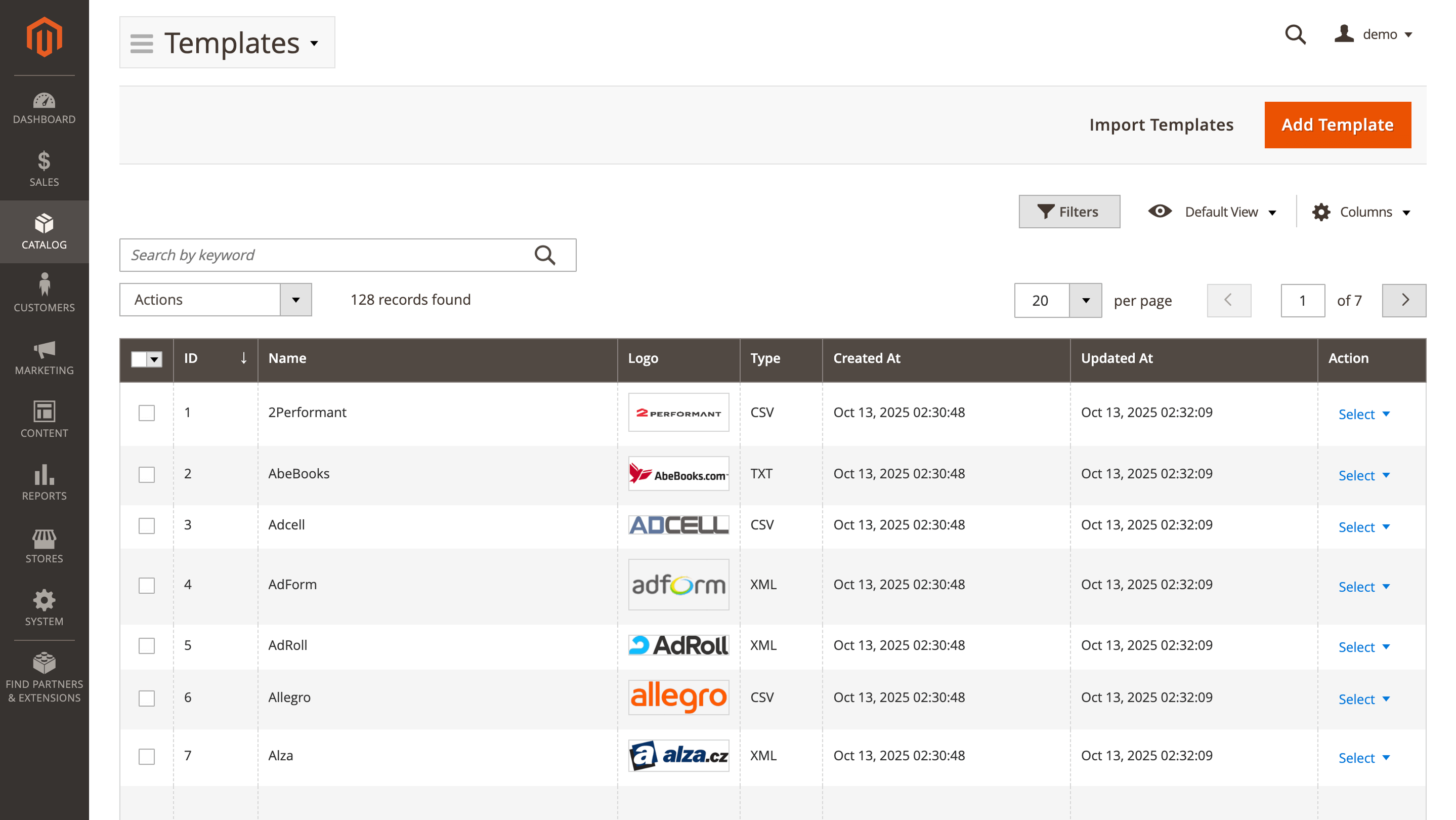
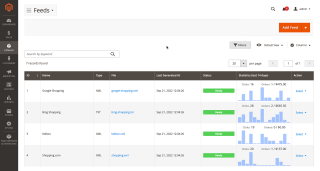
The Magento 2 product feed extension includes 130+ templates for Bing, eBay, TikTok, Pinterest, Instagram, and many other search engines and marketplaces. Of course, our module allows you to generate a Magento Google product feed for a Google Shopping service.
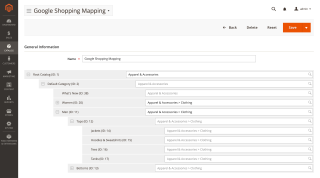
The list keeps up with where shopping is going: there is a ready ChatGPT template for OpenAI's commerce platform, alongside the marketplaces and price comparison engines you would expect.
The ChatGPT template follows OpenAI's product feed specification, including the search and checkout eligibility flags, prices with the currency code and your store name as the seller, so you only fill in your terms and target countries. Here is how to plan a ChatGPT feed for a Magento store.
Generate a Magento 2 Facebook product feed with this extension in order to attract an audience from the most popular social media in the world.
Every template is preconfigured with all required variables, so no manual setup is needed. To reuse a configuration for similar channels, duplicate a template and keep the original unchanged.
Templates are ready to use right after installation. Each feed can be generated for any store view individually.
If your channel requires a unique structure, you can also create a fully custom feed from scratch instead of using a template.
Find the right starting point faster
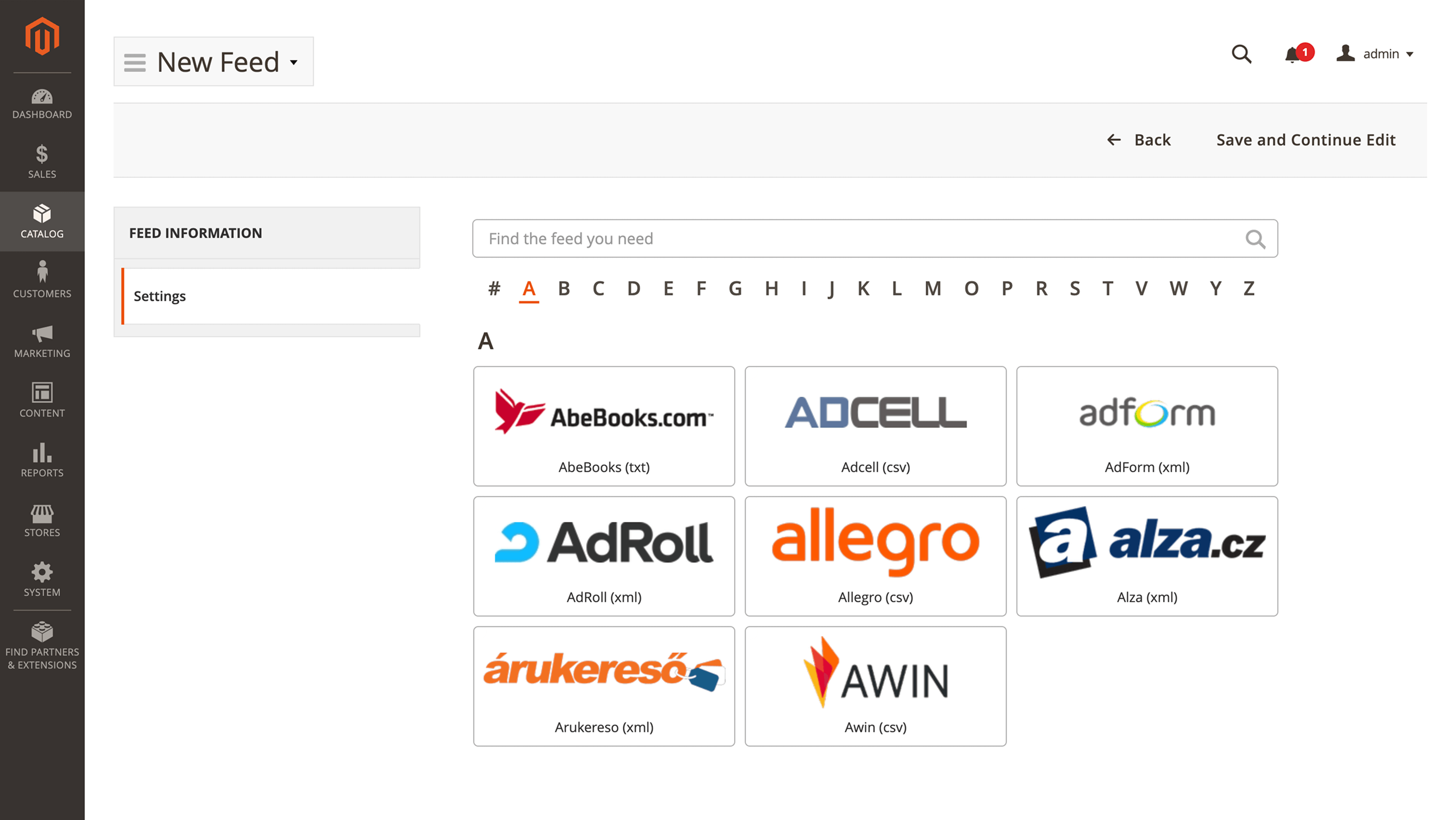
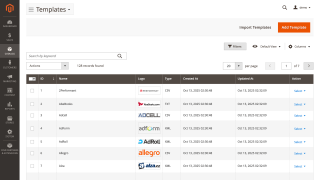
Begin on a home screen with a curated list of popular marketplaces and shopping engines. Use the A–Z index as a quick filter or type a template name to jump straight to the one you need.
Clear grouping of actions keeps navigation simple, so choosing a preset and moving into configuration stays straightforward even with large catalogs.
AI Feed Optimization
Complete Control
You can change anything
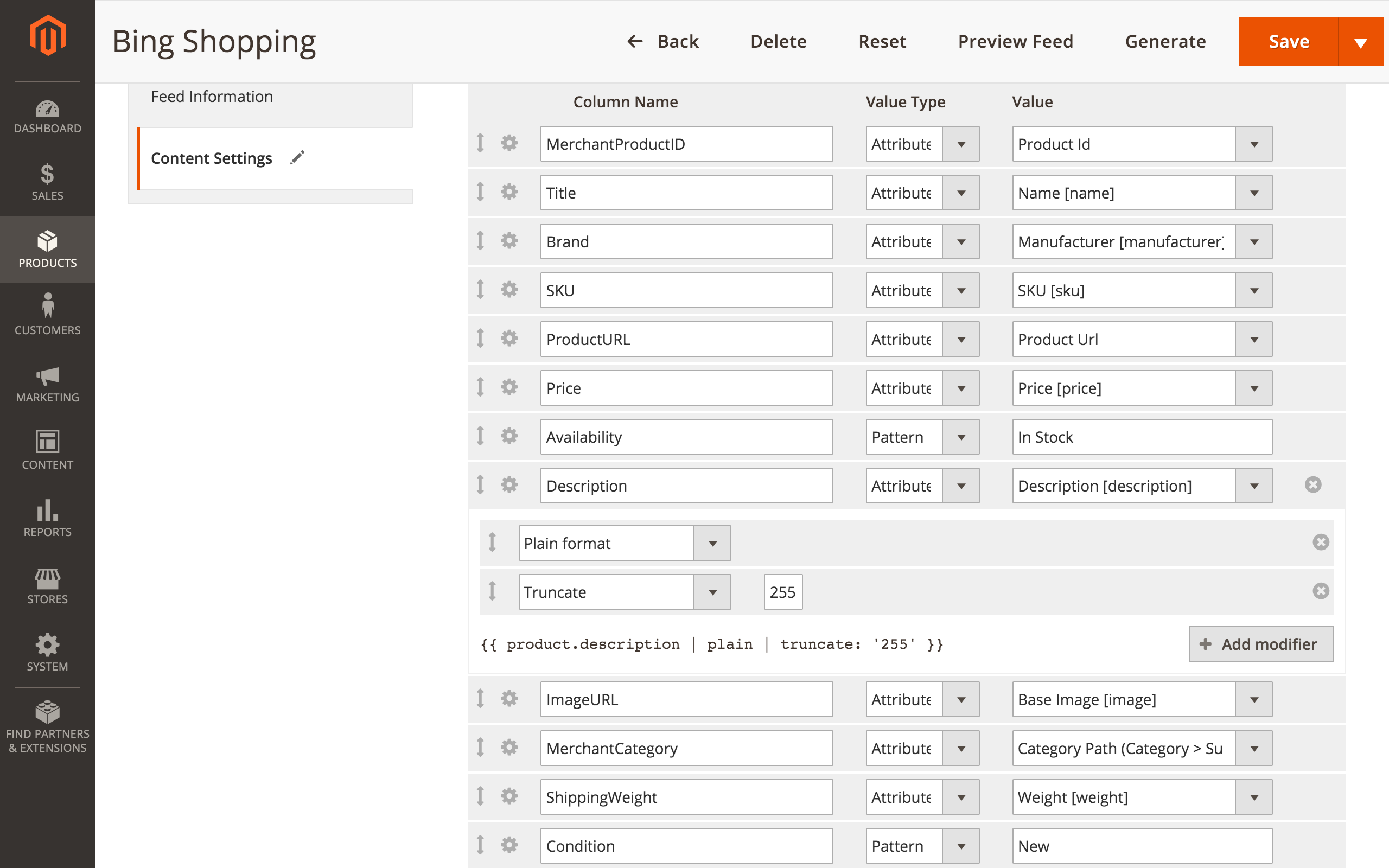
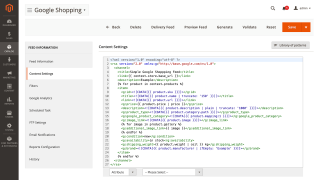
There's no limit to how many fields you can add to the feed. Easily edit new fields from a drop-down menu or directly modify the code of the fields.
This applies to both the templates and the feeds you create yourself.
Use existing feeds as a configuration template. Duplicate and modify them to your needs.
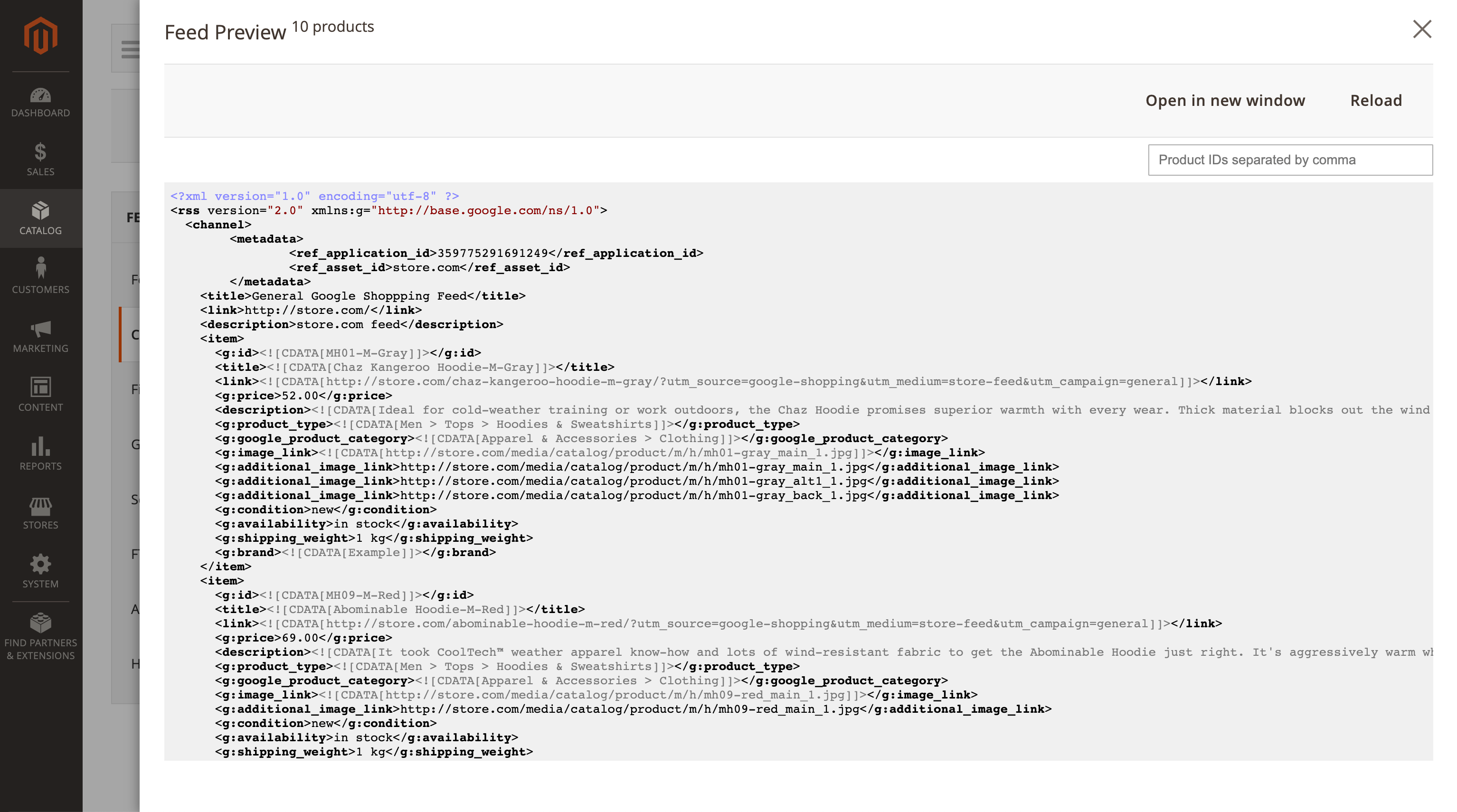
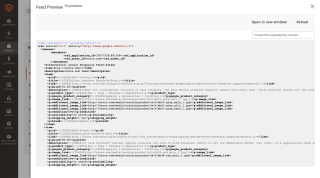
Preview your feed before synchronizing it with the shopping engine.
Easy Configuration Management
Backup and restore product feeds configuration
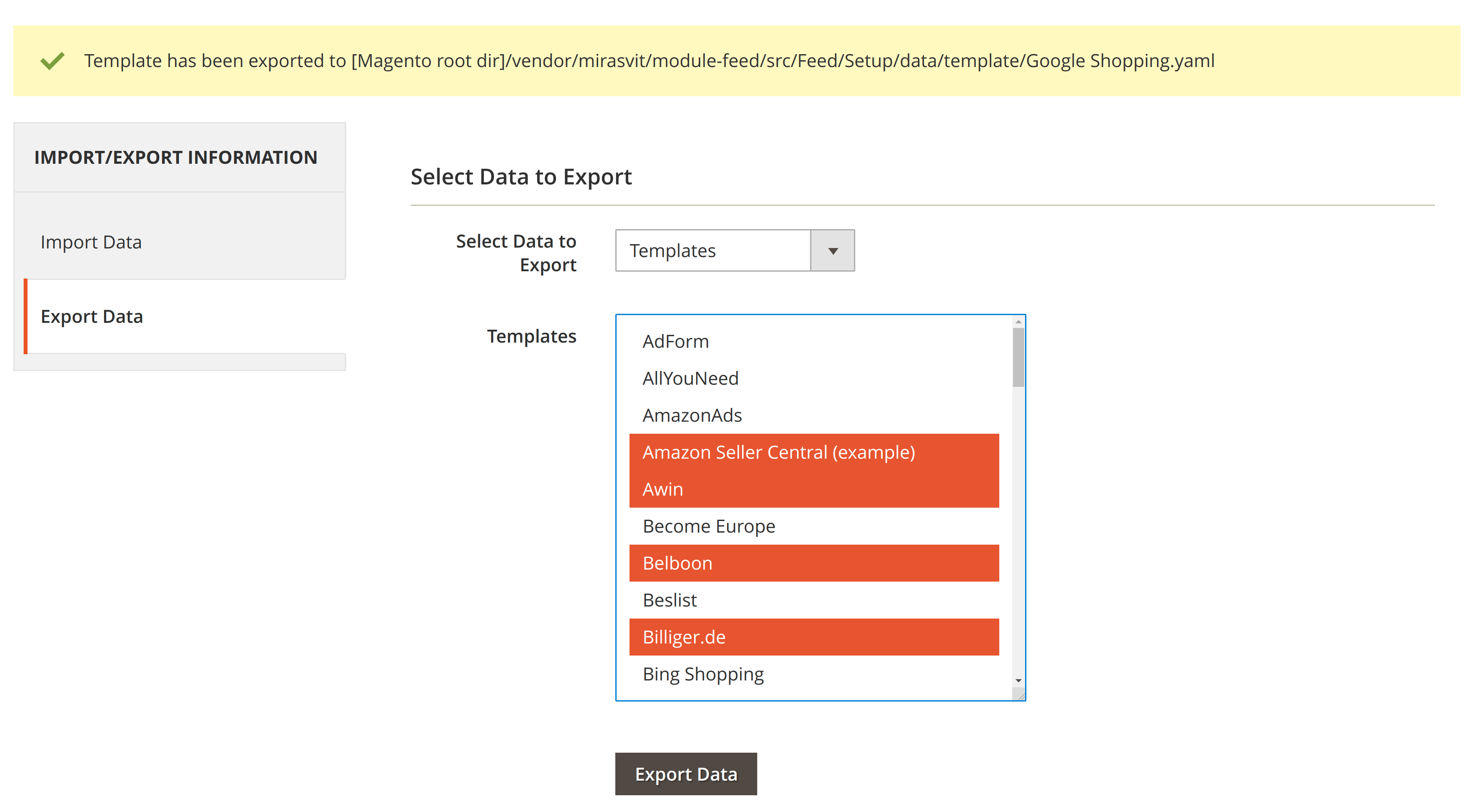
Quickly import and export the feeds configuration. The extension allows you to export and restore information on the following objects:
- Templates of the feeds
- Created filters
- Dynamic attributes
- Dynamic categories
- Dynamic variables
The Magento product feed export extension can export all configuration to YAML files. You can keep them as a local backup in your Magento root directory. Alternatively, copy those files to another location.
Speed up the setup process of your stores with this feature.
Flexible Filters
Export only necessary products
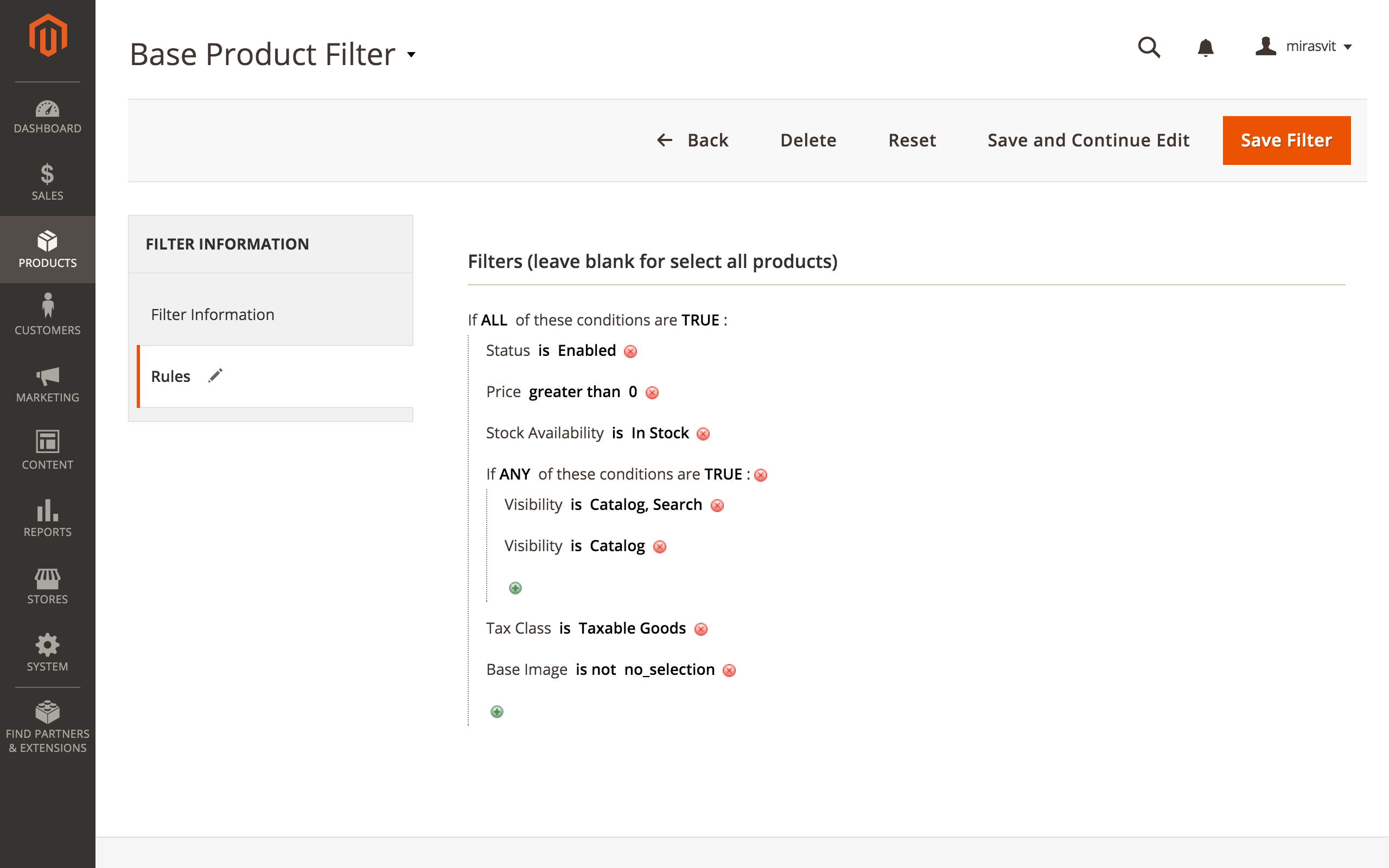
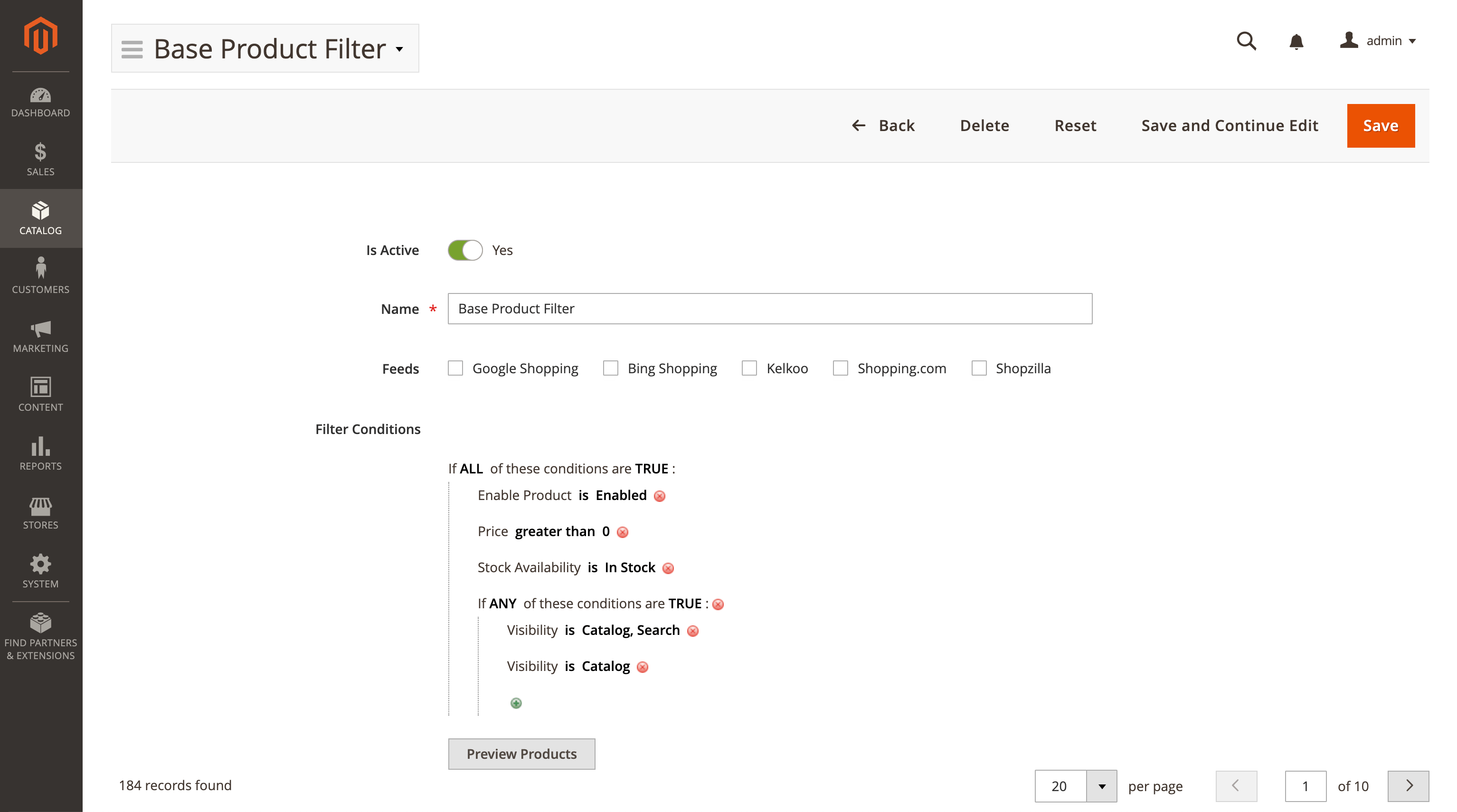
The module gives you unlimited filtering options of exported products. For instance, you can:
- Filter by price.
- Hide out-of-stock products.
- Filter by parent categories.
- Filter by SKU.
- Hide products without images.
- Filter by any other attribute, like color or manufacturer.
- Filter by parent product attributes if the product is configurable, grouped or bundled.
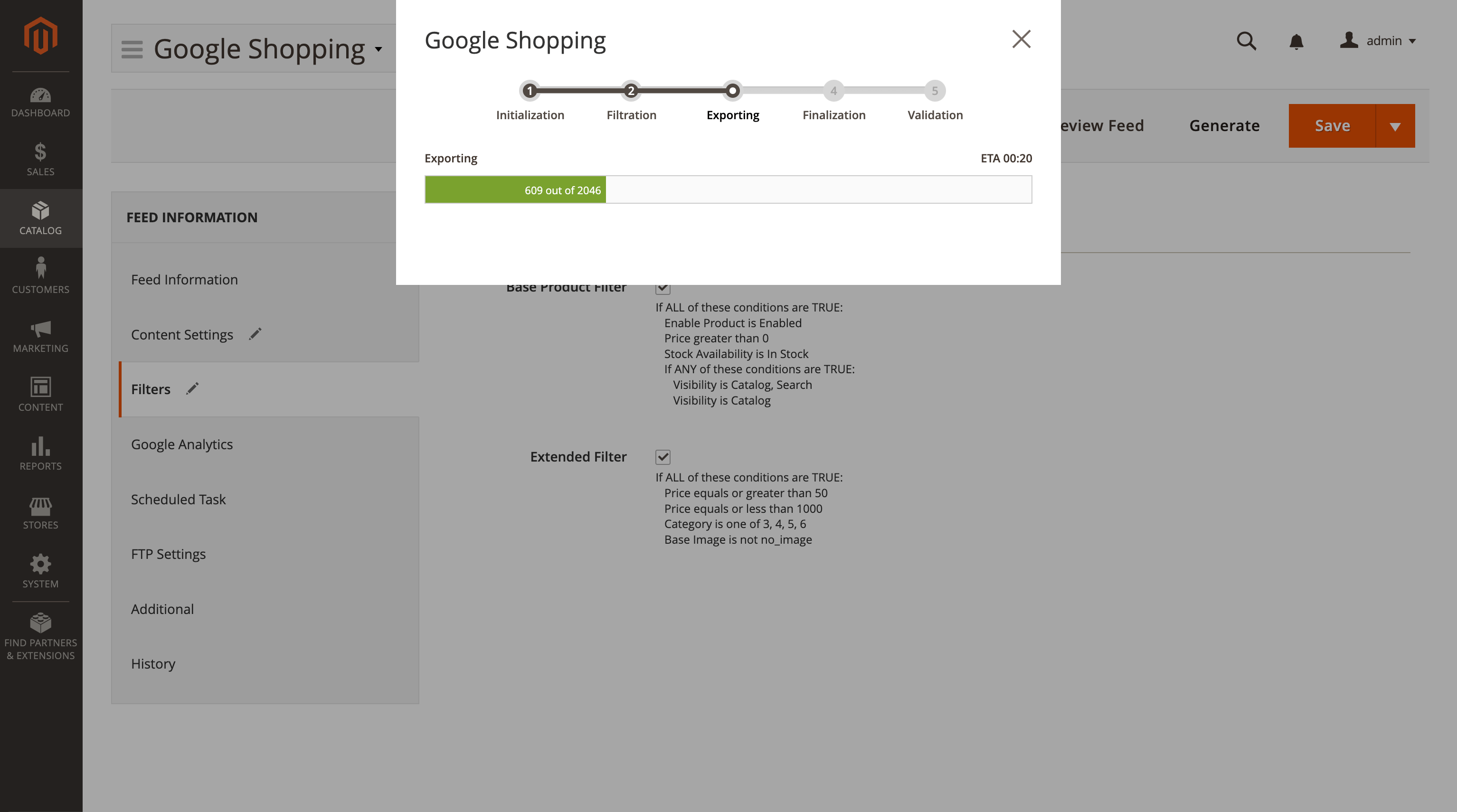
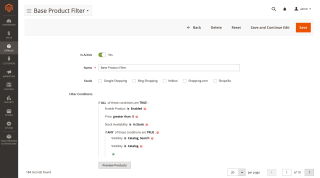
Create conditions that fill the feed with products that you need. For example, export to the feed only such products that have a higher price than a certain value.
Use filters to avoid exporting to the feed all the products that you do not want to promote, like those that have no listed price, are out of stock, have no images, etc.
Each channel gets its own feed with its own filters, so your Google Shopping and Meta catalogs can follow different rules while both come from the same Magento data. To segment campaigns inside a channel, fill the custom label fields of the Google and Meta templates from any attribute, such as a price band, stock level or seasonal collection, and build product groups or product sets on them.
Exceptional Customization Options
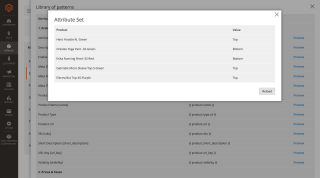
Pattern Library
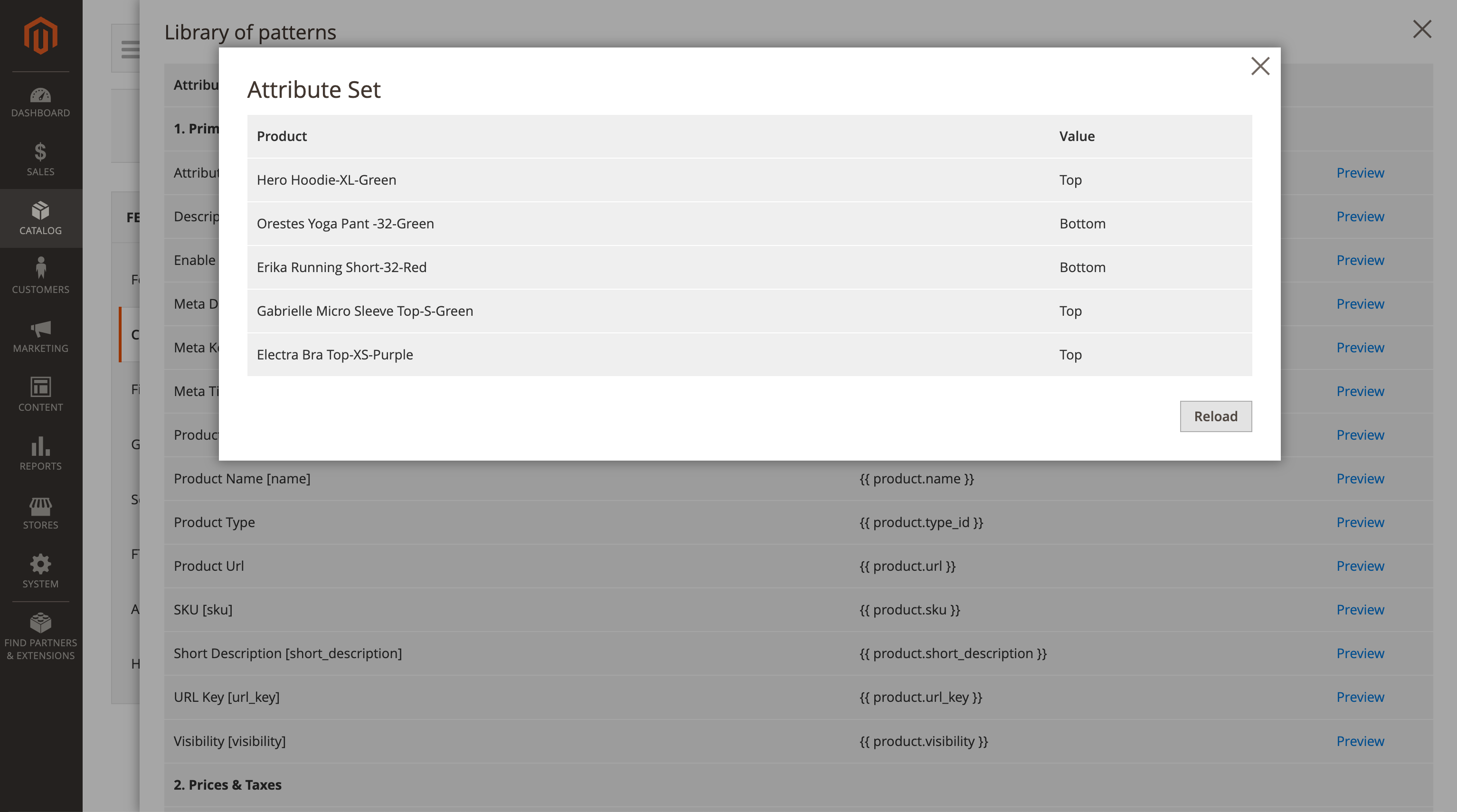
The module lets you customize the output of your product feed with programmatic patterns. These patterns are shortcodes for calling and editing attributes from your Magento database.
Magento Advanced Product Feeds extension provides two general types of patterns for attributes and product values. When using them, you can apply attribute code, filters, basic php functions, calculations and links to parent products within those patterns.
Build your feed with patterns by selecting them from a drop-down menu. Use the pattern preview button available in the pattern library to get a glance on the output you will get when using the particular pattern attribute.
With the help of patterns, make your product feed to stand out in shopping search engines and marketplaces, attracting even more customers to your online store.
Fine Tune Your Feed
The most common way to use patterns is to fetch specific values within configurable products. For example:
- Return the parent product's value.
- Export simple products with the 'not visible individually' attribute.
- Export simple products with the link to a parent product.
They also come in handy if you need to alter the variables. For instance:
- Show the 1.5x price of your products in shopping search engine feeds.
- Make shipping free for products that cost more than 1000 USD (or any other price).
- Manage product inventory numbers.
Feed Automation
Catch issues before export
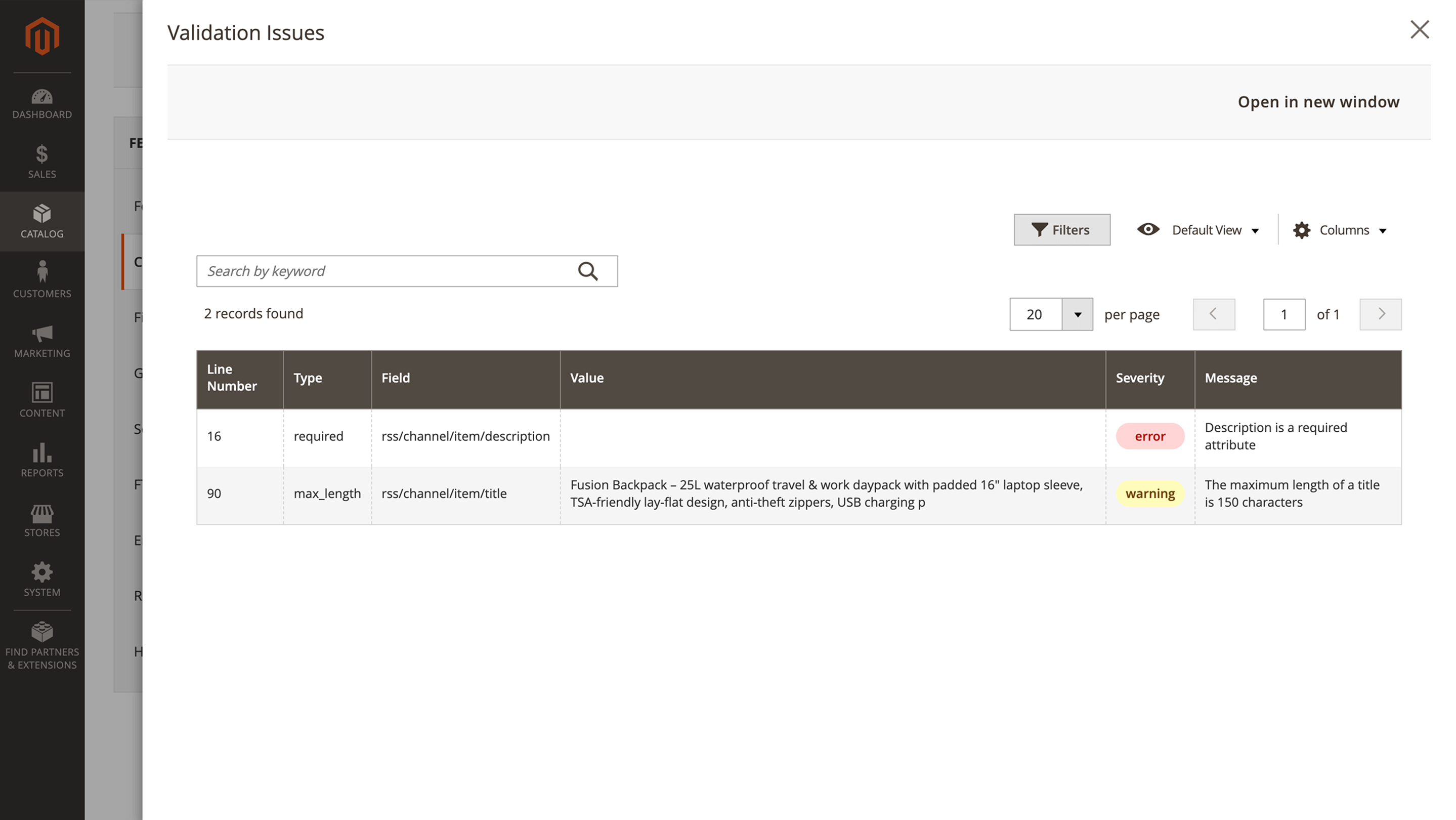
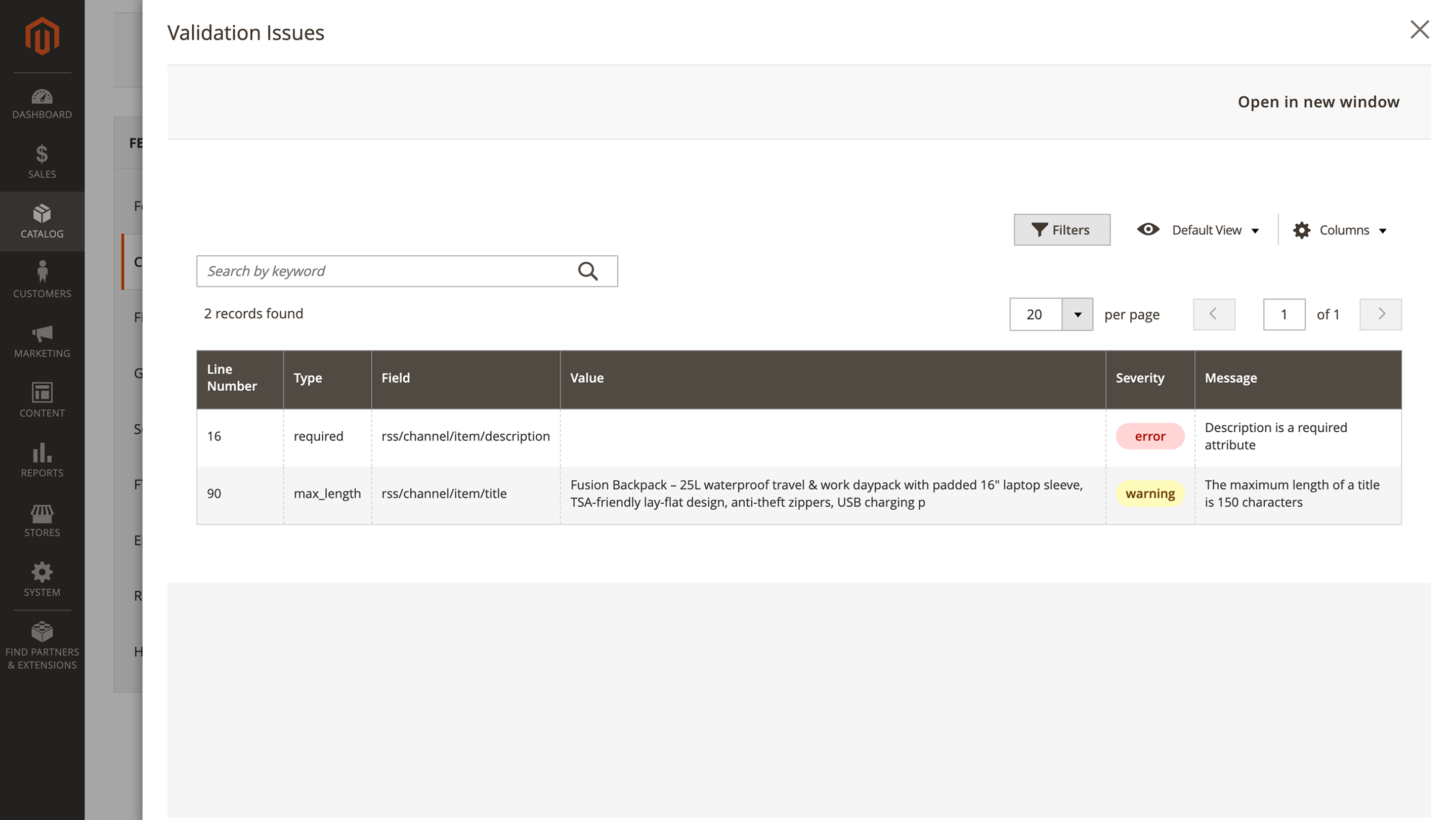
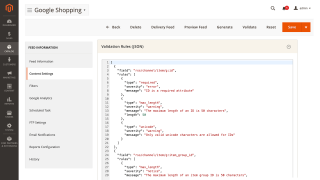
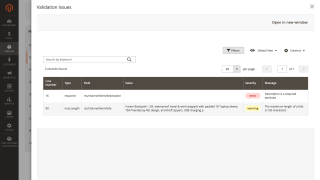
The validator checks any feed against defined validation rules and shows a clear report, helping you meet marketplace requirements.
Set rules in the feed editor at Content Settings > Validation Rule. Typical checks include title length, presence of required fields, character encoding, expected value types or formats, etc.
If a rule is present, validation runs automatically after generation, and a Quality Control status appears on the Feed Information tab. You can also run validation manually to review errors with line numbers, correct product data, and regenerate the data.
Your feed will always be up to date
Our extension supports several ways of updating the product feed and one of them is done automatically via cron job. You can set up the feed generation schedule at any time or day of the week.
Let's say you need to renew your Magento 2 Google product feed on Mondays and Wednesdays at 7AM. The Product Feed Magento extension can perform this automatically on schedule, making the process much more efficient.
Access any feed by its unique URL
Every generated product feed in your store gets its own unique link for access. Use this link for tracking purposes, for example, in Google Analytics. The extension can automatically add Google Analytics parameters to the product feed URL.
Depending on the shopping engine, this link can contain a txt, csv or xml file. The latter one can be used as a Magento rss product feed.
Send feeds straight to Google Merchant Center
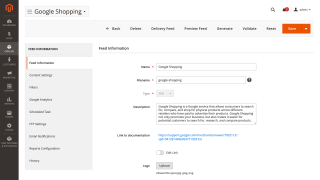
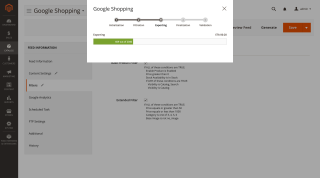
You do not have to upload a file anywhere. Configure your Merchant ID and service account key once, switch Merchant Center on for a feed, and the extension submits it through Google's Merchant API.
Every feed carries its own settings: target countries, content language, feed label, how often Merchant Center re-fetches it on its own schedule, and whether the upload fires automatically after each generation or only when you press Submit.
Products are not the only thing you can send. Pick the content type on the feed and submit supplemental data, local and regional inventory, promotions, product reviews or merchant reviews. Feeds created from a built-in Google template arrive with the right type already selected.
The Google Shopping Promotions template publishes your active cart price rules, so percentage discounts, fixed discounts, free shipping and free gifts appear next to your products in Shopping results. For everything specific to that channel, see our Magento 2 Google Shopping feed page.
Merchant Center upload needs PHP 8.1 or newer and Google's own SDK installed alongside the extension. When the SDK is missing, the admin shows you the exact command to install it and cron skips the upload step rather than failing the whole export.
You can schedule the upload
Automate the delivery of your product feed to the shopping engines. Get the service's FTP, FTPS or SFTP credentials, add them to the feed, set the transfer mode and you're good to go. The extension will automatically deliver the files of the product feed.
Use the Test Connection button to verify the correct communication of your store with the servers of the shopping engine.
Remain in control
The extension can send an email after each successful feed generation and delivery, or after multiple failed ones. You won't have to sacrifice control for convenience.
Full Feed History
Always know your feeds have synchronized successfully
In addition to notification emails, on feed generation you can get detailed information on it in a feed history tab. Track when the feed update was created, what source triggered the update, see the type of action that was made to the feed and general details of the process.
Product Analytics
Command Line Interface Support
Work with your product feeds in the terminal
Our Magento product feed extension provides two ways of managing your feeds. You can do it in the backend admin panel of your store or using the command line interface.
With the command line interface, you get the possibility to take the following actions in your product feeds:
- Generate all active feeds
- Generate feed with a specified ID
- Make a delivery of all active feeds
- Make a delivery of the feed with a specified ID
- Validate the file a feed actually produced, in plain text or JSON
- Run AI optimization until the catalog is covered
The validation command is built for automation: it reports every check with the number of products examined and exits with an error code when one fails, so you can wire it into a deployment or monitoring script and find out about a malformed feed before the marketplace does.
Full Template List
Here is every template that ships with the extension, 130+ of them, from Google Shopping and ChatGPT to the regional price comparison engines that matter in one country and nowhere else. Find the one you need with quick search, an A–Z index, or the curated list of popular marketplaces on the home screen.
- 2Performant
- AbeBooks
- Adcell
- AdForm
- AdRoll
- Allegro
- Alza
- Arukereso
- Awin
- Bantoa
- Bazaraki
- Become
- Beslist
- BidOrBuy
- Billiger
- Bing Feed (Microsoft Advertising)
- Bol
- Bonanza
- Cdon Availability
- Cdon Media
- Cdon Price
- Cdon Product
- Ceneje
- Ceneo
- ChatGPT
- Check24
- Ciao
- CJ
- Compari
- Comparis
- Criteo
- Custom CSV
- Custom TXT
- Custom XML
- Domodi
- Drezzy
- eBay
- eMAG
- Facebook Dynamic Ads
- FashionChick
- FashionUp
- Faslet
- Favi
- Fishpond
- Fnac
- Fruugo
- Fyndiq
- Geizhals
- GetPrice
- Glami
- Google Shopping
- Google Shopping (configurable products)
- Google Shopping CSV Feed
- Google Shopping Local Inventory Feed
- Google Shopping Promotions
- Google Shopping Regional Inventory Feed
- Google Shopping Review
- Google Shopping TXT Feed
- Google Shopping Update
- Guenstiger
- Hepsiburada
- Heureka
- Hotline
- Houzz
- Idealo DE
- Instagram (XML)
- Joom
- Kaufland
- Kelkoo
- Klaviyo
- Kogan
- KuantoKusta
- Kurpirkt
- Kwanko
- Lamoda
- Le Guide
- Marktplaats
- Miinto
- Okazii
- Okazje
- OnBuy
- Overstock
- Pigu Product
- Pigu Stock and Prices
- Pinterest (XML)
- Price.ro
- PriceGrabber
- PriceMe
- PriceRunner
- PriceSpy
- Prisjakt
- Rakuten
- Rozetka
- SALESmanago
- Salidzini
- ShareASale
- Shopbot
- Shopee
- Shopenauer
- ShopMania
- Shopping24
- ShopPrice
- Shopzilla
- Skapiec
- Skroutz
- Snapchat
- Spartoo
- Storefront Social Facebook
- Stylight
- Target Circle
- TikTok
- TikTok (XML)
- TradeDoubler
- TradeTracker
- Trovaprezzi
- Trovaprezzi (XML)
- Tweakwise
- Twenga
- Vergleiche
- VidaXL
- Walmart (Inventory)
- Webgains
- Webgains (XML)
- Wine-Searcher
- Wish
- Yahoo! (formerly Yahoo! Gemini)
- Yatego
- Zalora
- Zbozi
You are not limited to the predefined list of comparison shopping engines. Create your own templates for any marketplace you need.
Still comparing product feed extensions? Our comparison of the main Magento 2 product feed extensions puts Mirasvit, Amasty, Mageplaza and Wyomind side by side on price, templates, AI optimization and large-catalog performance, including where another one is the better fit.
There are prebuilt templates for major services, and they can be customized extensively instead of forcing your catalog into a rigid, predefined format. It can support connections for Google Merchant Center and Google Ads, Microsoft/Bing, Facebook, TikTok, affiliate networks, and many other e-commerce services.
The extension has worked reliably with everything we have tried, and its flexibility becomes increasingly valuable as your catalog and marketing channels become more complicated.
For an e-commerce business distributing product data to multiple outside platforms, I consider this a must-have extension.
We recently switched to Advanced Product Feeds and the move made sense straight away. The upgrade via Composer was smooth, no issues after deployment, and everything worked as expected. The extra control over feed rules and structure is a big plus, especially when dealing with larger or multi-store catalogs.
From a Magento 2 developer point of view, it feels like a mature module built by people who actually understand real-world Magento setups. So far, we’re very happy with it.
----------------
Llevamos años utilizando el módulo Google Shopping Product Feed de Mirasvit en varios proyectos Magento 2 y siempre ha sido una solución muy estable, sin sorpresas en producción y fácil de mantener.
Hace poco dimos el salto a Advanced Product Feeds y la decisión fue bastante natural. La actualización vía Composer fue limpia, no hubo incidencias tras pasar a producción y el módulo empezó a funcionar desde el primer momento. La flexibilidad extra a la hora de definir reglas y feeds se nota, sobre todo en catálogos grandes o multi-store.
Desde la experiencia de un desarrollador Magento 2, se nota que es un módulo maduro y bien pensado para entornos reales. De momento, muy satisfechos con el cambio.
Save time by starting your support request online and we'll connect you to an expert.
Does the extension submit feeds to Google Merchant Center automatically?
Yes. Configure your Merchant ID and service account key once, switch Merchant Center on for a feed, and the extension submits it through Google's Merchant API. No file uploads, no FTP.
Each feed sets its own target countries, content language, feed label, how often Merchant Center re-fetches it, and whether the upload runs automatically after every generation or only when you press Submit. Besides the products feed you can send supplemental data, local and regional inventory, promotions, product reviews and merchant reviews.
Merchant Center upload requires PHP 8.1 or newer and Google's own SDK installed alongside the extension. If it is missing, the admin shows the exact install command and cron skips the upload step instead of failing the export.
Which marketplaces and channels have ready-made templates?
130+ templates ship with the extension, covering Google Shopping, Bing, eBay, TikTok, Pinterest, Snapchat, Instagram, Facebook, Criteo, Klaviyo, ChatGPT for OpenAI's commerce platform, and a long list of regional price comparison engines: Ceneo, Heureka, Glami, Skroutz, Kaufland, Allegro, eMAG, Idealo, Kelkoo and others. The full list is on this page.
For a channel with no ready template, build one with the Custom CSV, TXT or XML template and the pattern library. Any structure a marketplace asks for can be produced that way, and you can save it as your own reusable template.
Can I list my Magento products in ChatGPT shopping?
Yes. The extension ships a ChatGPT template that follows OpenAI's product feed specification: it includes the search and checkout eligibility flags, sends prices with the currency code and fills in your store name as the seller. You add your terms of service and target countries, and the feed regenerates on your schedule like any other.
The feed is only half of it: OpenAI onboards merchants to ChatGPT shopping through its own approval, so apply there as well. Our guide on selling products through ChatGPT covers the rest of the setup.
Can I control automatically which products reach my Meta or Google catalog?
Yes. Every channel gets its own feed with its own filters: by price, stock, category, SKU, images, any attribute, or the attributes of a parent product. Out-of-stock items, products without images or a whole category can stay out of Meta while still going to Google, with no per-product work.
Feeds regenerate on a cron schedule, so the rules apply to new and changed products automatically, and validation rules plus email alerts tell you when a feed comes out wrong. To segment campaigns, fill the custom label fields of the Google and Meta templates from any attribute and build product groups or product sets on them.
What does AI optimization actually change in my feed?
It changes the product data, not the feed structure. An AI profile targets one field and does one of three jobs: rewrite text such as a title or description, map your store category to a Google product category, or fill structured attributes like color, size and material from what the catalog already knows.
Assign a profile to a feed and every reference to that attribute picks up the optimized value, with no edit to the feed template. Where a profile is off or has no value for a product yet, the feed emits the original value exactly as before.
Does AI optimization slow down feed generation?
No. Optimization runs in the background on cron and every result is stored, so feed generation reads ready-made values and never waits on an AI call. Exports take exactly as long as they did before you added a profile.
When you need coverage before a campaign rather than on the background schedule, run the mirasvit:feed:ai:optimize command to work through the catalog on demand.
How much does AI optimization cost, and how do I keep it under control?
It runs on the AI provider you already configured in Mirasvit Core (OpenAI, Claude or Gemini), so you spend on your own key. There is no separate subscription and no markup from us.
Before enabling a profile, preview it on real products: you see the values it would generate, the token estimate, and how many calls the full run takes. Once it runs, the profile list shows coverage as a percentage next to the tokens spent.
Category mapping is cheaper than catalog size suggests. Products are grouped by the prompt they render, so cost follows the number of distinct category and attribute-set pairs: a store with 300 categories costs roughly 300 calls whether it holds 3,000 products or 300,000.
Can I review AI-generated values before they reach a live feed?
Yes. Set a profile to manual approval and generated values are held until you approve them, while the live feed keeps serving the previous value in the meantime.
The results grid shows the original and the optimized value side by side, with the state and tokens used for each. Approve them in bulk, override any single value by hand, or send one back for re-optimization.
Can I export to a channel that has no ready template?
Yes. Start from the Custom CSV, TXT or XML template and build the structure the channel asks for. Patterns let you call any attribute, apply filters and basic PHP functions, run calculations, and pull values from a parent product, so the output can match almost any specification.
Dynamic attributes and dynamic variables cover the rest: conditional values, shipping rules, GTIN lookups, stock totals across sources. Save the result as your own template and reuse it for similar channels.
pub/media, and that stale picture could come back on the next upload; the old file is now deleted. This works on remote media storage such as Amazon S3 too. ([#758]()){% capture %} block that loops over context.products now renders its content. A product loop placed inside a {% capture %} (for example, to compute a timestamp shown in the feed header) was mistaken for the feed's main product loop: once it had gone through the products it stopped the whole export, so the captured value and everything after it came out empty on every run. JSON Lines feeds built from column patterns were hit the same way, because each column is wrapped in a capture. Loops inside a capture now run through to the end and the rest of the feed renders normally; the main product loop works as before. ([#747]())var/log/exception.log) for your developer. Messages that explain what to fix in the form or template, such as "Choose a kind before previewing", are still shown as before. The new messages are translated into all 15 bundled languages.xsi:type sets a value's JSON type (number, boolean, …), xsi:nil writes null, xsi:list makes an array, xsi:name sets the key, xsi:omitEmpty drops empty values, and xsi:record="true" marks the element that repeats once per product. Numbers keep exactly the digits your template produced, so a price of 34.00 is not cut to 34, and a value with broken characters is cleaned so the file still parses. If the template has no record element, has more than one, has more or fewer than one product loop, or has a key with an apostrophe, you get a plain message saying what to fix. ([#796]()).json for one document, .jsonl for one object per line. Templates keep this setting when exported and imported. ([#796]())0. The feed preview lists each one (key, declared type and value), and the feed validation results name them too. Validation reads the feed using the framing set on the feed, so a one-record document and a one-line JSON Lines file are both checked correctly. The preview lays out a one-document JSON feed in readable, highlighted form without changing any value. ([#796]())json_framing (varchar(16), default document) in the mst_feed_feed and mst_feed_template tables. Run bin/magento setup:upgrade after updating.Mirasvit_Feed::feed_import), which the Import/Export page itself already checks. So any admin user who could log in could reach them directly, whatever their role. They now check it, and admins without it are refused.Blog

 Andriy Kovalenko
 Oleksandr Drok
We are committed to being open and transparent with our customers. When you purchase our module, you automatically receive one year of free support service and free updates.
Why is this important?
- Seamless Installation and Configuration: We understand that setting up a new module can take time to configure according to your specific needs. That’s why we offer a full year of free support. Our experienced team is here to assist you with installation, configuration, and any questions you might have. We're eager to share our expertise to ensure you get the most out of your purchase.
- Stay Updated with Magento (Adobe Commerce) Releases: Magento releases new versions approximately every three months. These updates can sometimes introduce compatibility challenges. To keep your store running smoothly, we provide a year of free access to the latest versions of our modules, ensuring that you can upgrade Magento and our modules without encountering any obstacles.
- Subscription Included: Renewing your subscription ensures continued access to the latest updates and support from our team. This means you can be confident that any issues you encounter with the extension will be resolved quickly and efficiently. You can cancel your subscription at any time without any additional fees.
These are our primary. A major portion of our new clients come from referrals from our existing clients. Our professional team of developers, marketers and support staff have invested the best knowledge and experience in the field into our work, so you know you can come back to us again and again.
One year free and high quality support. We go to great lengths to provide maximum satisfaction with every module you have purchased in our store. By helping you with installation, configuration, answering your every question, we do all our best to eliminate any possible problems.
30-days money back guarantee. If you are not satisfied with our extension performance for any reason, we provide a full refund.
We constantly add new features to all our modules, and are always interested in hearing your opinion and implementing your suggested features in our future developments.
We provide an expanded user guide for every aspect of our extension, so you can find answers for all your burning questions.
You can customize extension according to your needs and requirements.
The Module is easy to install and upgrade, just follow our step-by-step user guide. Additionally, the extension is ready to use with the Hyvä theme.
No core modifications. The extension has been tested in a Magento Cloud environment and is fully compatible with it.