Feed information
This is the first tab you meet when you open a feed, and it answers the basic questions: what is this feed called, what format does it produce, who is it for, and is it switched on.
Find your feeds at Catalog -> Advanced Product Feeds -> Feeds.
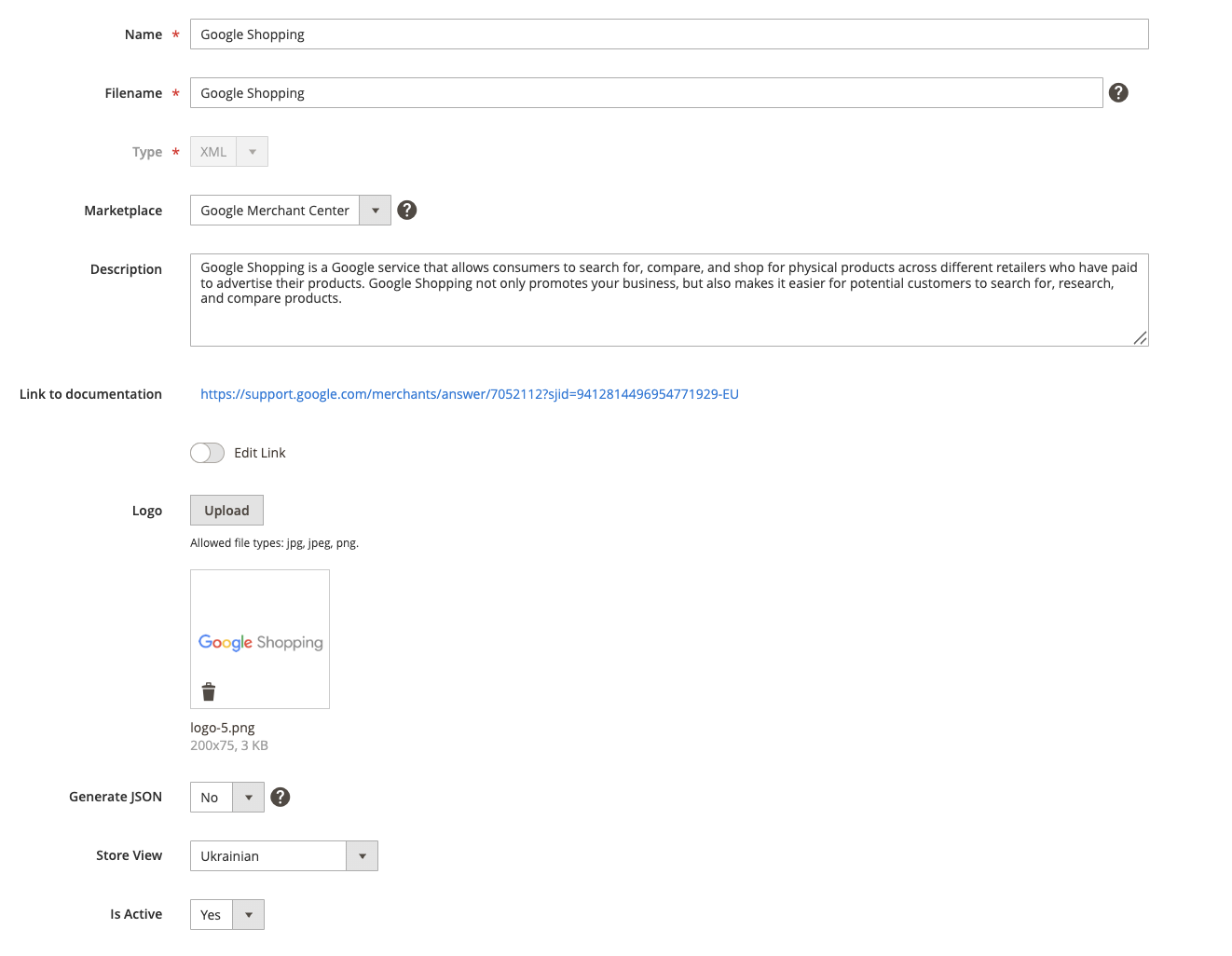
- Name: set a unique name for the feed.
- Filename: define the file name for the generated feed (e.g., products.xml). Liquid variables are accepted - for example,
{{ context.time | dateFormat: "Y-m-d H:i" }}embeds the generation timestamp into the filename. - Compress output (gzip): (CSV and TXT feeds only) gzip-compresses the generated file and appends
.gzto the filename - useful for data pipelines that expect compressed input. This changes the feed's public access URL, so update anything that already links to the old one. - Type: (cannot be changed after creation) the output format (XML, CSV, TXT, etc.).
- CSV: a comma-separated file where each product appears on a new line. (.csv extension)
- TXT: same as CSV but with a .txt extension.
- XML: uses structured tags (
<product>,<price>) to define content. (.xmlextension)
- Marketplace: declares which marketplace this feed targets. Currently the only option with a direct API integration is Google Merchant Center; selecting it exposes the Google Merchant API tab on the feed edit page. Leave on -- None -- for feeds that you only download manually or deliver via FTP. Feeds created from a Google Shopping template come with this value pre-filled.
- Description: optional free-text notes shown in the admin grid. Useful for explaining the feed's purpose to teammates (e.g., "Google Shopping - UK market").
- Link to documentation: optional URL to the marketplace's own feed-specification page. Click Edit Link to toggle between the rendered link preview and the input field. Pre-installed templates ship with this filled in - for example, Google Shopping points at the Google Merchant feed specification.
- Logo: optional image displayed next to the feed in the admin grid for quick visual identification. Allowed formats:
.jpg,.jpeg,.png. - Generate JSON: (XML feeds only) if enabled, a
jsonversion of the feed will be generated alongside thexmlfile. The link to thejsonfeed will be available next to the Feed access URL. Values are strings unless the template says otherwise - see JSON output for declaring numbers, booleans and nulls. - JSON Extract level: (visible when Generate JSON is Yes) depth at which the export into JSON begins.
0exports the full feed content; higher values skip the outer wrapping tags and emit only the nested data. See Extract level for an example. - Store view: select which store's data will be used in the feed.
- Is active: determines whether the feed is currently enabled and functioning.
Once it has run
The same page then becomes your status board. After the first generation these fields tell you whether the feed is healthy at a glance:
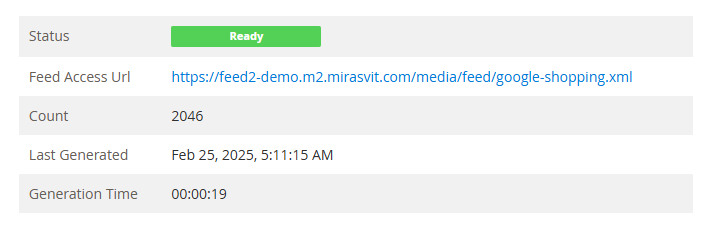
- Status: indicates whether the feed is active and generated or disabled.
- Disabled: the feed is turned off and not being generated.
- Not generated: the feed has not been created yet.
- Warning: an error or warning occurred during feed generation.
- Processing: the feed is currently being generated.
- Ready: the feed has been successfully generated and is ready for use.
- Feed access URL: the direct link to download or share the feed file. This URL can be used to integrate with external platforms.
- Count: displays the total number of products included in the generated feed.
- Last generated: shows the date and time when the feed was last updated.
- Generation time: indicates how long it took to generate the feed during the last update.
Count is worth a second look every time. A number that drops sharply usually means a filter is excluding more than you intended, or products went out of stock - and it is far cheaper to notice here than after a marketplace rejects the file.
Statistics
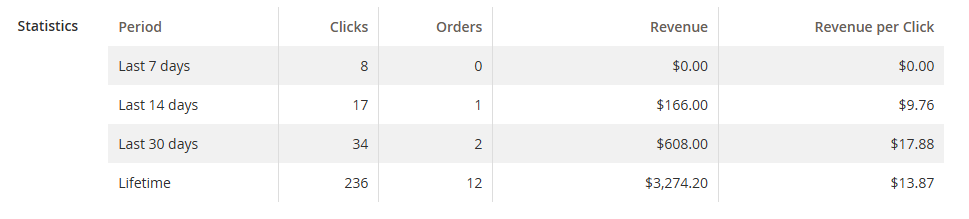
Generating a feed is easy. Knowing whether it earns anything is the useful part. The Statistics table shows how this specific feed performed over different time periods.
-
Number of clicks: the number of times a customer is redirected from the marketplace to your site.
-
Number of orders: the number of orders placed after the customer was redirected from the marketplace.
-
Revenue: the total revenue generated from those orders.
-
Revenue per click: the average revenue generated for each individual click, calculated as Revenue ÷ Number of clicks.
-
Quality control: the results of the last validation run - the errors and warnings a marketplace would otherwise find for you.
Use Revenue per click to compare this feed against your others. It is the number that tells you whether a channel deserves more of your attention, and the full picture lives in the feed report.