79% of Magento Stores Are Invisible to AI: A 5,470-Site Audit
-
 Oleksandr Drok
- E-commerce Tips & Best Practices
- Aug 21, 2026
- 10 min read
Every year, we run a scan of the tech stack and practices that thousands of stores actually use. In August 2026, we scanned more than 30,000 stores across platforms (Magento, Shopify, WooCommerce), and 5,470 of them were running Magento (Adobe Commerce). This year, the focus was squarely on AI-readiness.
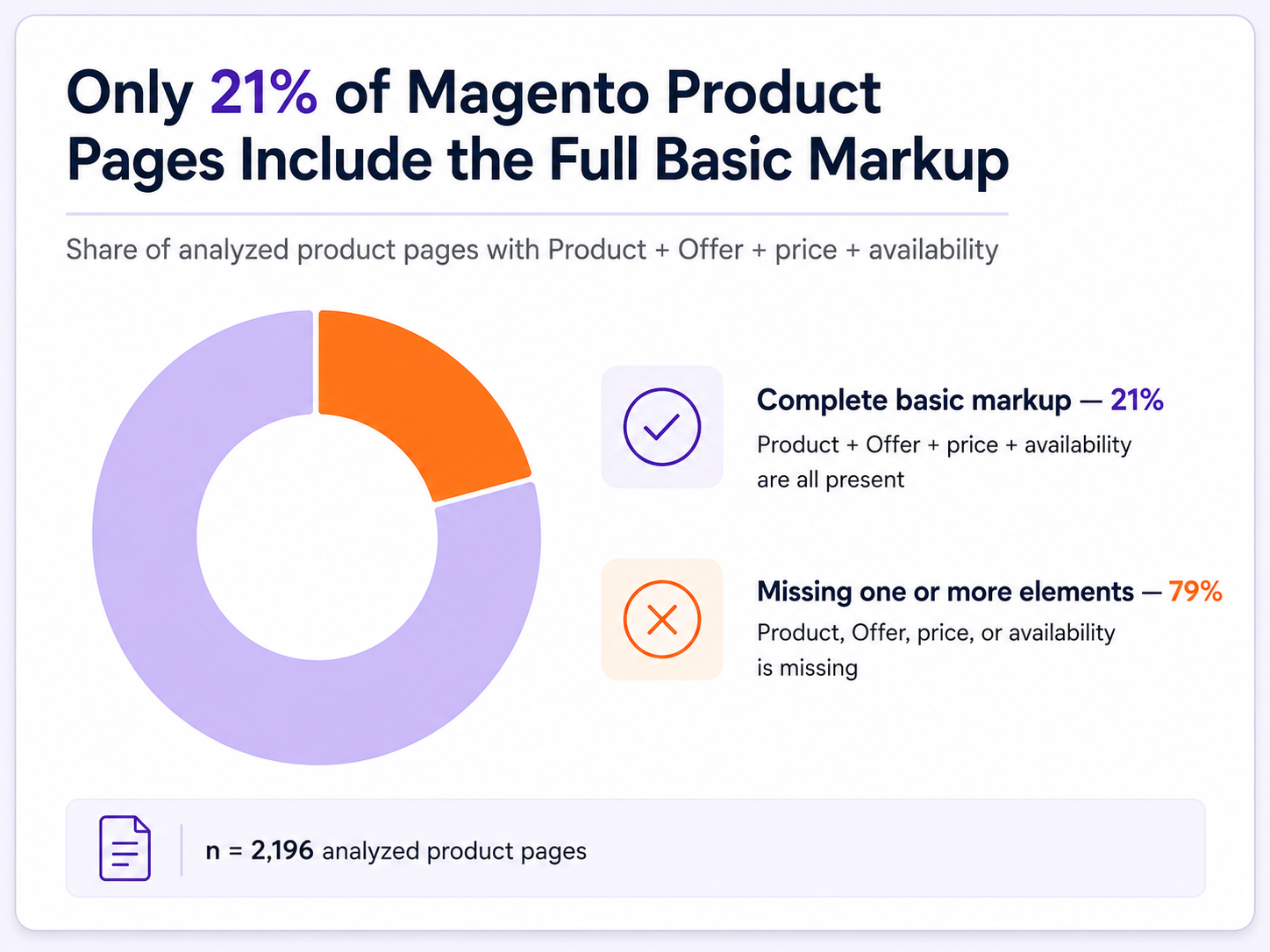
So, 79% of product pages don't ship a full set of structured data. That means four out of five online stores are losing customers right at the Google search results page. And for AI agents, autonomous bots, and the new algorithms reshaping online shopping, these sites are a blind spot altogether.
Below, we'll break down exactly what's missing on the product page, why default Magento doesn't save you, and what the 21% who are already ready do differently.
Table of Contents
- Key Takeaways
- The Door Before the Storefront
- What Our Audit of 5,470 Magento Stores Found
- Why Default Magento Fails 4 Out of 5 Stores
- What This Actually Gets You Today, and Where Fact Ends and Forecast Begins
- The 96% Failure: Why the Market Ignores Shipping and Return Markup
- What Sets Ready Stores Apart
- Who the Champions Really Are
- The Inconvenient Truth: Markup Is a Multiplier, Not a Standalone Task
- Who Joins the Next 21%
Key Takeaways
- 79% of Magento product pages don't ship a full set of structured data: no price, no availability, no shipping info AI can read.
- Only 21% of stores serve the complete set (Product + Offer + price + availability).
- The sharpest gap in the whole study: only 4-5% of stores mark up shipping and returns.
- 20% of stores block bots that train AI models, but only 3% block the bots that actually bring shoppers in from AI search.
- AI-readiness climbs with catalog size: from 6% for small stores to 28% for enterprise.
- The market's champions aren't richer. They're the ones who actually keep track of what Google and AI require.
The Door Before the Storefront
We checked 5,470 live Magento domains. Compared to last year's scan, 85% of them stayed on Magento, and the drift to other platforms is tiny: of the 102 stores that migrated away, almost all went to Shopify (77), with the rest scattered across WooCommerce (16), PrestaShop (5), and BigCommerce (4). At the same time, 89 new stores showed up on Magento, 67 of them coming over from Shopify.
Before worrying about what AI sees on the product page, there's a simpler question: does it even get in?
The robots.txt file tells bots where they're allowed to go. 20% of stores use it to block bots that train large language models: GPTBot, ClaudeBot, CCBot. The logic is simple: nobody wants a product description or photo feeding someone else's model.
But here's where it gets confusing. The bots that train models have nothing to do with the ones that bring shoppers in from AI search, even though the names sound alike. PerplexityBot or OAI-SearchBot (ChatGPT's search tool) don't train anything: they show up exactly when a real person is searching for something, and that visit can lead straight to your product.
Block one of those bots, and you've blocked a shopper who was already halfway to checkout. The industry is defending itself en masse against yesterday's threat, one it can't do much about anyway, while missing the opportunity knocking on that very same door.
20% vs. 3%. 20% of stores block bots that train AI models. Only 3% block the "useful" bots that bring shoppers in from AI search.
On that note, it's worth mentioning llms.txt: a new file that acts as a kind of sitemap for AI, and one that's been getting a lot of attention lately.
llms.txt: only 7%. The file meant to serve as AI's sitemap is still more of an experiment than a standard: only 7% of Magento stores have one. Not a reason to panic, but a clear sign of how early the industry still is on the road to an AI-friendly site.
But even an open door guarantees nothing. The next question is simple: what does AI find once it actually lands on the product page?
What Our Audit of 5,470 Magento Stores Found
On the 4,196 product pages we could actually open, we dug into the microdata line by line. Here's what we found:
| Structured data signal | Share of sites |
|---|---|
| Full PDP data set (Product + Offer + price + availability) | 21% |
| Basic product markup (Product) | 29% |
| Explicit price in markup | 26% |
| Availability information | 22% |
| Breadcrumbs (BreadcrumbList) | 44% |
| Site search block for Google (SearchAction) | 21% |
| Ratings and reviews (AggregateRating) | 9% |
| Shipping details (OfferShippingDetails) | 5% |
| Return policy (MerchantReturnPolicy) | 4% |
Source: Mirasvit's audit of 4,196 Magento product pages, August 2026.
Even the cheapest signals fall short. Breadcrumbs, which cost almost nothing to add, show up on just 44% of pages, and ratings and reviews, the markup AI answers love to cite, appear on only one page in nine.
The main takeaway is simple: most e-commerce projects build for human eyes and forget that a robot always reads the product page first.
Being honest about the limits of these numbers. We define AI-ready (21%) as stores with the full set: Product, Offer, price, and availability together. This is our own customer base, not the whole Magento market.
Why Default Magento Fails 4 Out of 5 Stores
Why is this so widespread? There's no single cause. It comes down to a mix of things.
First, store owners and developers quietly assume that everything works right out of the box. It doesn't. Magento's core does ship some product markup, but it's minimal, and it falls short of what Google expects today.
Second, and this is the bigger issue: the markup itself is invisible. The owner opens the page in a browser, sees a clean layout, the price, an "Add to Cart" button. To them, everything looks perfect.
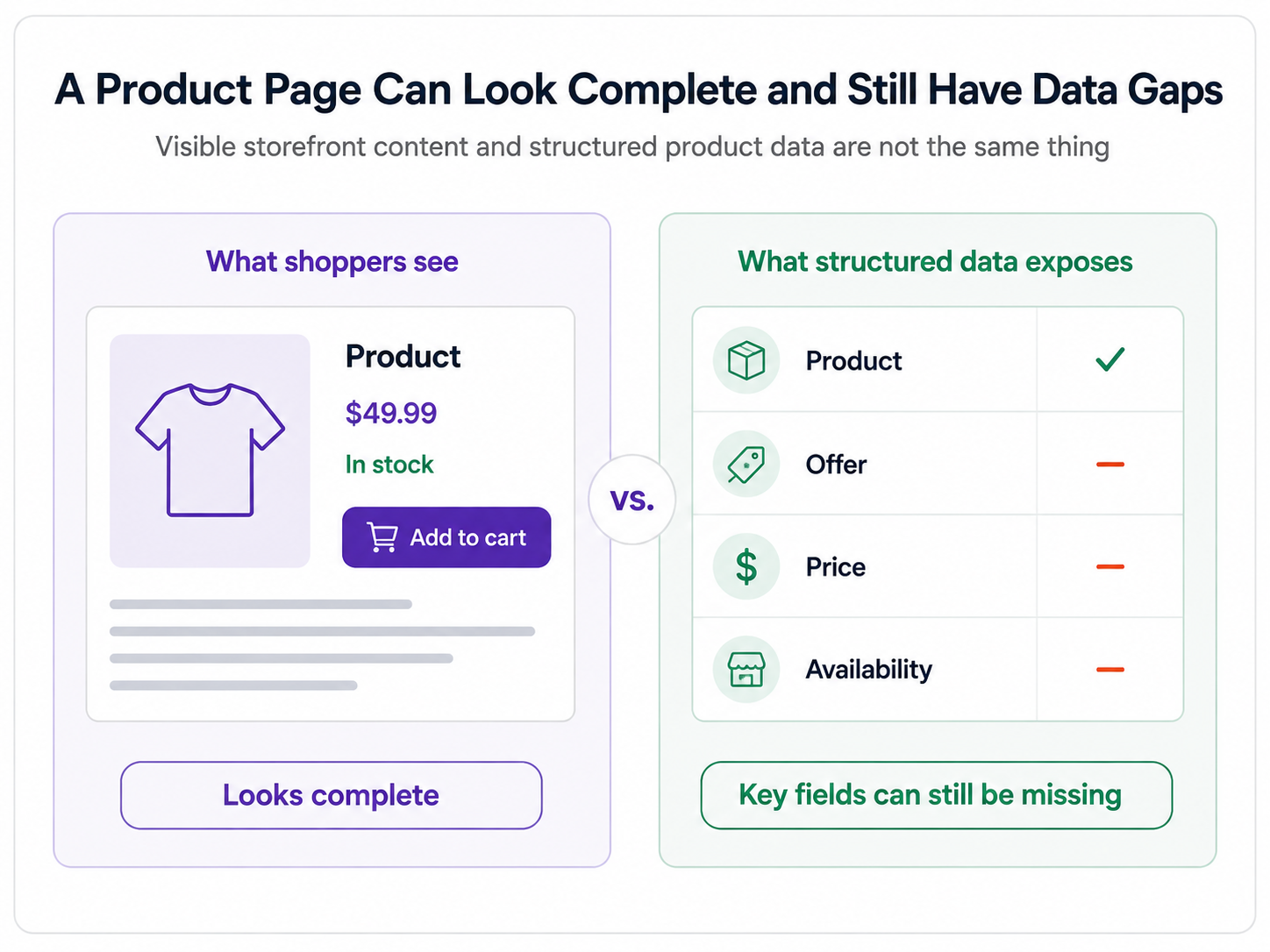
But a search crawler or an AI agent only reads the source code. If the right tags aren't there, the algorithm either misreads the page or skips the product entirely.
So the problem isn't that owners are ignoring this on purpose. Most of them genuinely can't tell whether they're fine or not, because there's no signal on the page that would tip them off.
What This Actually Gets You Today, and Where Fact Ends and Forecast Begins
Markup is worth thinking about in two timeframes: what it delivers right now, and what it only promises down the road.
Today, that's mostly Google's rich results: star ratings, an in-stock badge, the price shown right in the search listing. Shoppers see this before they even click, and it genuinely affects whether they open your site at all.
How serious is this? Google's John Mueller put it plainly (a personal opinion, not an official company stance): pricing, shipping, and availability for shopping are "basically impossible to read in high fidelity and accurately from a text page." A machine has a far easier time parsing structured data than parsing page text, which could be in any of 7,000+ languages (Search Engine Roundtable, January 2026). Without markup, in other words, the algorithm isn't guessing about availability: it simply doesn't see it.
With AI shopping, it's only fair to stay cautious. Nobody can say for certain how the rules will shift. Neither we nor anyone else has direct access to how AI agents' algorithms actually work.
But the trend is clear. Models find it easier and more reliable to work with structured data than to guess at the content of an arbitrary page, and microdata plus the new agentic protocols are exactly what's driving that shift right now.
Picture a typical shopper's request to an AI agent: "Find men's black leather boots, size 10, under $200, with free shipping and a 14-day return window." The agent doesn't scroll pages or glance at banners. It reads structured code. Without the right parameters, the product simply doesn't exist for it.
The 96% Failure: Why the Market Ignores Shipping and Return Markup
The single biggest gap in the whole study is right here: only 5% of sites state shipping terms (OfferShippingDetails) in a machine-readable way, and only 4% state return terms (MerchantReturnPolicy).
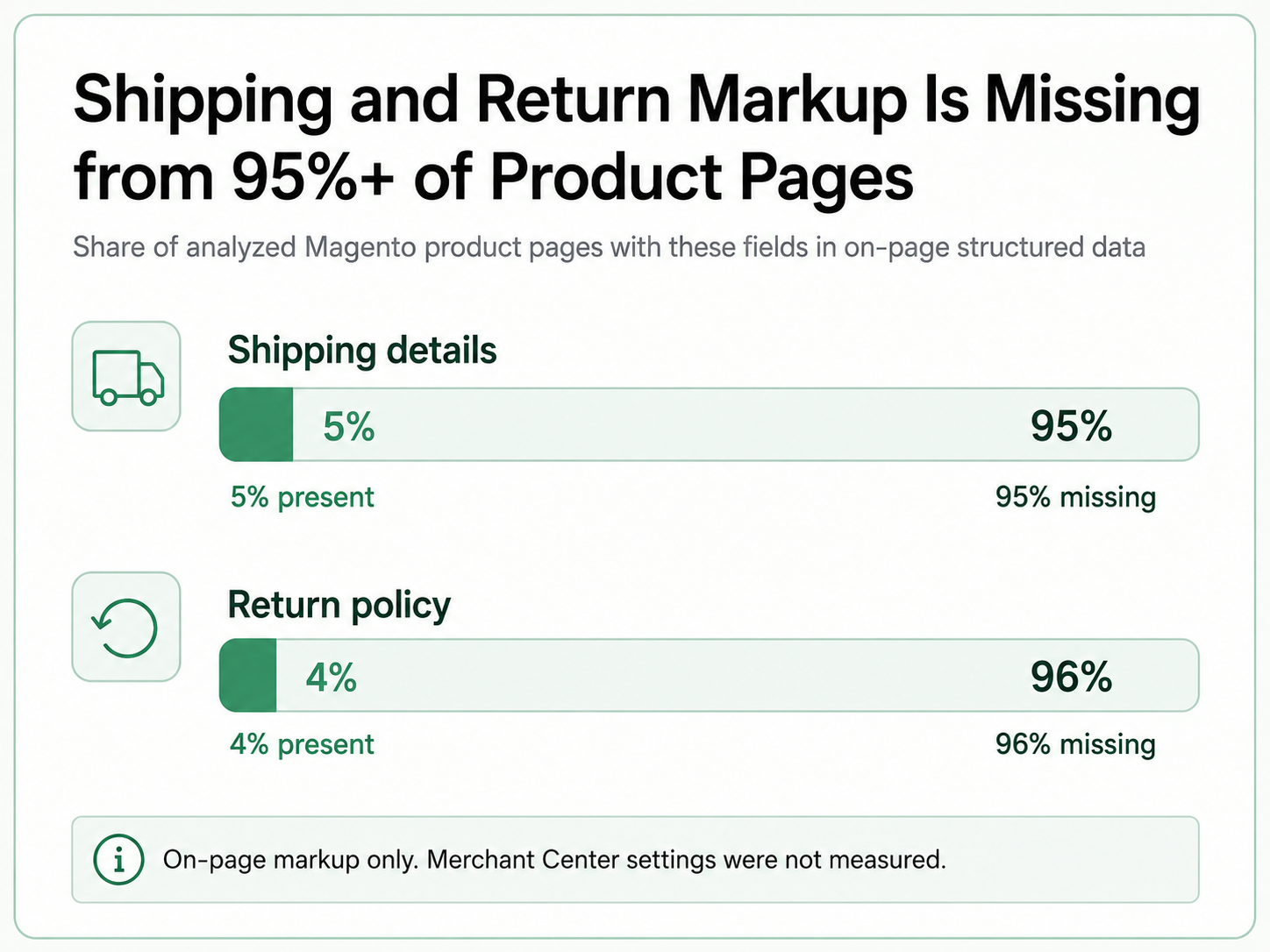
Why so few? The explanation is simple. It's a relatively new rule, and Magento doesn't add it out of the box. Someone has to deliberately add the markup, and not many people even know the requirement exists.
There's another common mistake: assuming it's enough to set shipping and return terms once in your Google Merchant Center account and call it done. But that setting is visible to Google alone. It's invisible to Bing, to AI agents, to any third-party price comparison service.
Markup right on the product page works differently: it's an open, universal passport for your offer, readable by anyone, Google, an AI bot, or a third-party service. That 4-5% is the honest measure of AI-readiness, not just a checkbox ticked in one dashboard.
What Sets Ready Stores Apart
We compared the 21% of stores with a full markup set against the rest of the market. The gap wasn't just in the markup itself:
| Signal | AI-ready (21%) | Everyone else (79%) |
|---|---|---|
| Shipping markup (OfferShippingDetails) | 10% | 3% |
| Return markup (MerchantReturnPolicy) | 14% | 1% |
| CDN usage | 55% | 49% |
Source: Mirasvit's 5,470-store Magento audit, August 2026.
One more cut: catalog size. The more products a store carries, the more likely it is to be AI-ready:
| Catalog size | AI-readiness |
|---|---|
| Small | 6% |
| Medium | 14% |
| Large | 21% |
| Very large (enterprise) | 28% |
Source: Mirasvit's 5,470-store Magento audit, August 2026.
That's almost a five-fold gap between the smallest and largest stores. A clue to who's actually investing systematically in staying visible.
Who the Champions Really Are
You'd expect ready stores to simply have bigger budgets or more sophisticated dev processes. The real reason is different, and less obvious. Our team sums it up in one line: "It's not about budget. It's that some people keep track of this, and others don't."
Investment and team size aren't the deciding factor. What matters is a habit: noticing technical details nobody can see with the naked eye, and checking regularly that everything still works.
Where should an average store start if it's among the 79%? Understand what you need and what's missing first. Implementation comes after.
What UCP is. Universal Commerce Protocol: a new, not-yet-settled standard that lets AI agents search for and buy products on their own, without a human at the browser. If an owner doesn't even know what UCP or microdata is, that's already the first gap, and it's where the lag begins.
The Inconvenient Truth: Markup Is a Multiplier, Not a Standalone Task
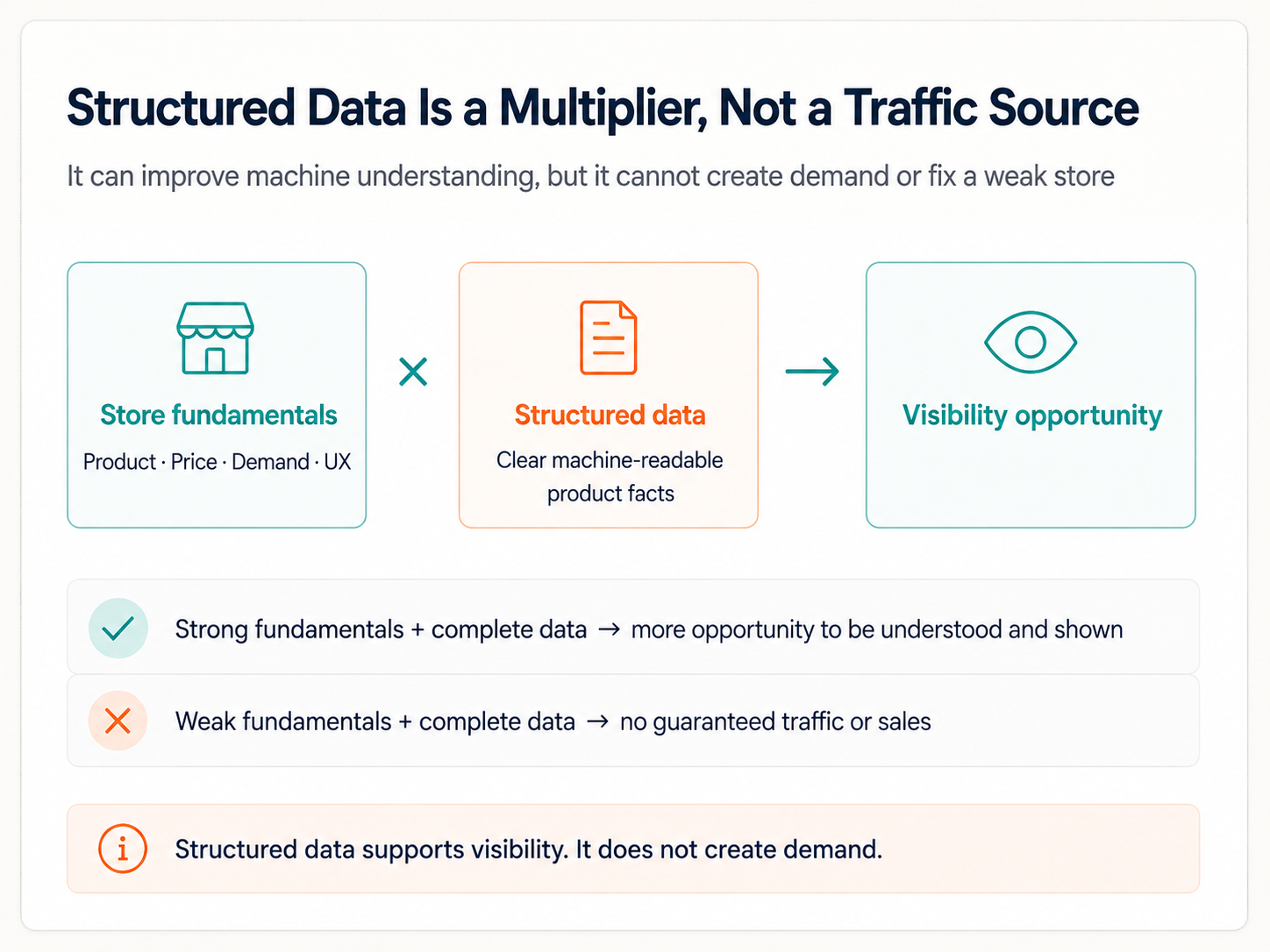
Here's something you won't always hear from an SEO agency: microdata by itself won't earn you a single extra dollar.
It won't fix a clunky site, won't speed up a slow server, and won't make anyone buy at an inflated price. Think of it as a small multiplier, not a cure-all.
You can multiply by a thousand, but if the result is zero right now, it stays zero. Markup amplifies what already works. It doesn't create value where none existed.
Which points to another common mistake: treating on-site markup and the product feed for Google Merchant Center or other ad platforms as two separate jobs.
They're not. It's one job: making the product machine-readable everywhere AI or Google can read it.
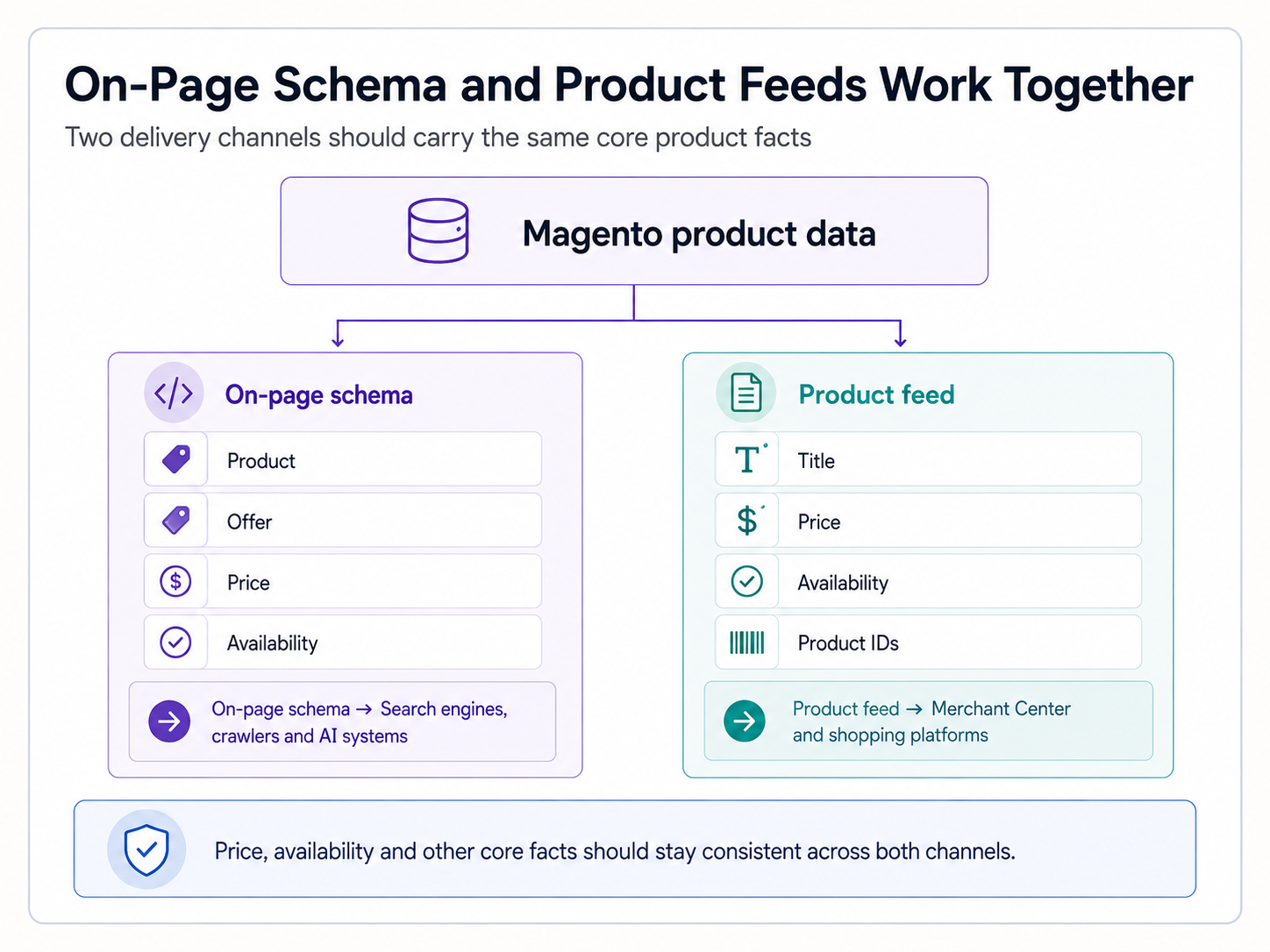
If the feed shows one price and the page shows another because of a cache delay, the algorithm will spot the mismatch and reject the product rather than trust both sources at once. Google Merchant Center calls this Price Mismatch: the product simply disappears from free listings until the mismatch gets fixed.
Better to duplicate the data than leave a gap. Redundancy is safer than a hole.
For what it's worth, the product feed is where we've built up the most hands-on experience: our Advanced Product Feeds module for Magento has spent years closing this exact gap for customers. So this isn't just theory for us.
Who Joins the Next 21%
AI doesn't read your site the way a person does. It reads code, and right now the code on most Magento stores barely tells it anything. You don't need a full technical audit to figure out where yours stands.
Start by opening yourdomain.com/robots.txt in a browser. If PerplexityBot, OAI-SearchBot, or Claude-Web are blocked there and that wasn't a deliberate call, you're cutting off your own AI traffic.
Next, paste any product page URL into the free Google Rich Results Test. If you see Product, Offer, price, and availability show up, you're in the 21%. If not, you're in the 79%.
One last check: test a few different products, not just one. If markup shows up on some pages and vanishes on others, you don't have a systematic fix. You have manual patches that will eventually fall apart. That's exactly the gap our catalog-size table showed above: where checks are systematic, readiness is higher.
Start with the biggest gap, not everything at once. The biggest hole in the market is shipping and return terms. Almost nobody has done this, so any presence here instantly sets you apart from competitors.
79% of Magento stores are invisible to AI right now, and yours might be one of them. But just like with our champions, the edge won't go to the biggest budget: it'll go to whoever spots the gap first and closes it. Next time we scan the market, these are the stores that will join the ranks of the ready.
FAQ
What percentage of Magento stores are ready for AI shopping?
In our audit of 5,470 live Magento stores, only 21% of product pages ship the full structured data set AI needs: Product, Offer, price, and availability together. The rest are missing at least one of those signals, which makes them effectively invisible to AI shopping agents.
Should I block AI bots like GPTBot or ClaudeBot on my Magento store?
That depends on which bots you mean. Bots that train AI models (GPTBot, ClaudeBot, CCBot) are a separate group from bots that bring shoppers in from AI search (PerplexityBot, OAI-SearchBot). In our data, 20% of stores block the training bots, but only 3% block the search bots, even though the names are easy to confuse. Blocking a search bot by mistake blocks a shopper who was already looking for your product.
Why don't more Magento stores mark up shipping and return terms?
Only 4-5% of the stores we audited had machine-readable shipping (OfferShippingDetails) or return (MerchantReturnPolicy) markup. It's a relatively new requirement that Magento doesn't add out of the box, and setting shipping terms once in Google Merchant Center isn't enough: that setting is invisible to Bing, AI agents, and third-party services that only read the page itself.
How do I check if my Magento product pages are AI-ready?
Paste a product page URL into the free Google Rich Results Test. If Product, Offer, price, and availability all show up, you're in the ready 21%. Test a few different products, not just one: markup that appears on some pages and not others means you have manual patches, not a systematic fix.
What is UCP (Universal Commerce Protocol)?
UCP is a new, not-yet-settled standard that lets AI agents search for and buy products on their own, without a human at the browser. If you haven't heard of UCP or structured data before, that unfamiliarity is itself the first gap to close.
Head of Product at Mirasvit
Promote your products and achieve higher sales by using the power of marketplaces and comparison shopping engines with magento data feed extension. You can automatically generate and deliver feeds of your product catalog to those services with Magento Product Feeds extension.
This tool is unbelievably quick to use and is also outstandingly flexible. It's compatible with all major shopping and advertising services, including Google Shopping.
Feeds go straight to Google Merchant Center through Google's API, and AI profiles can rewrite titles, map Google categories and fill in missing attributes before your catalog ever reaches a marketplace.
Simply install the module, generate your very own product feed, present your catalog to a wider audience, and boost your sales right now!