Magento AI Chatbot: Myth or Real Value? 3 Months of Production Data
-
 Oleksandr Drok
- E-commerce Tips & Best Practices
- Updated: Oct 5, 2026
- 12 min read
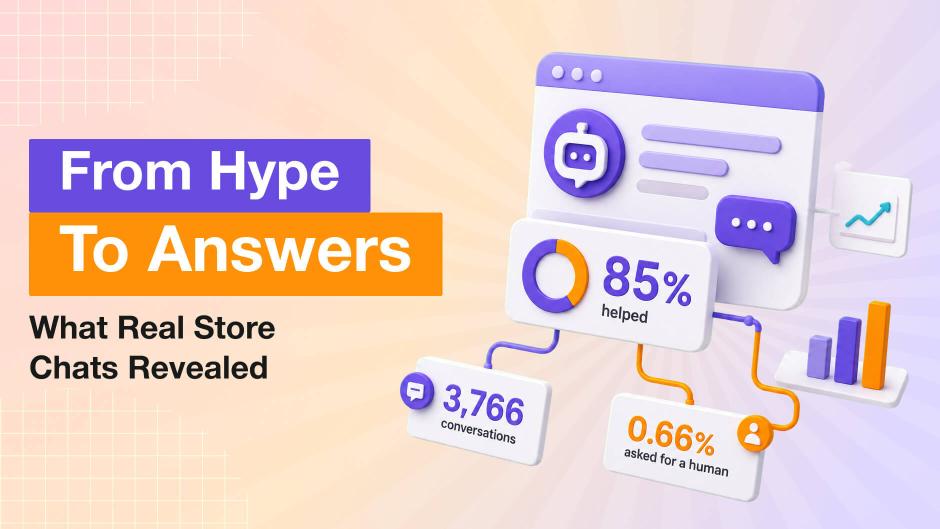
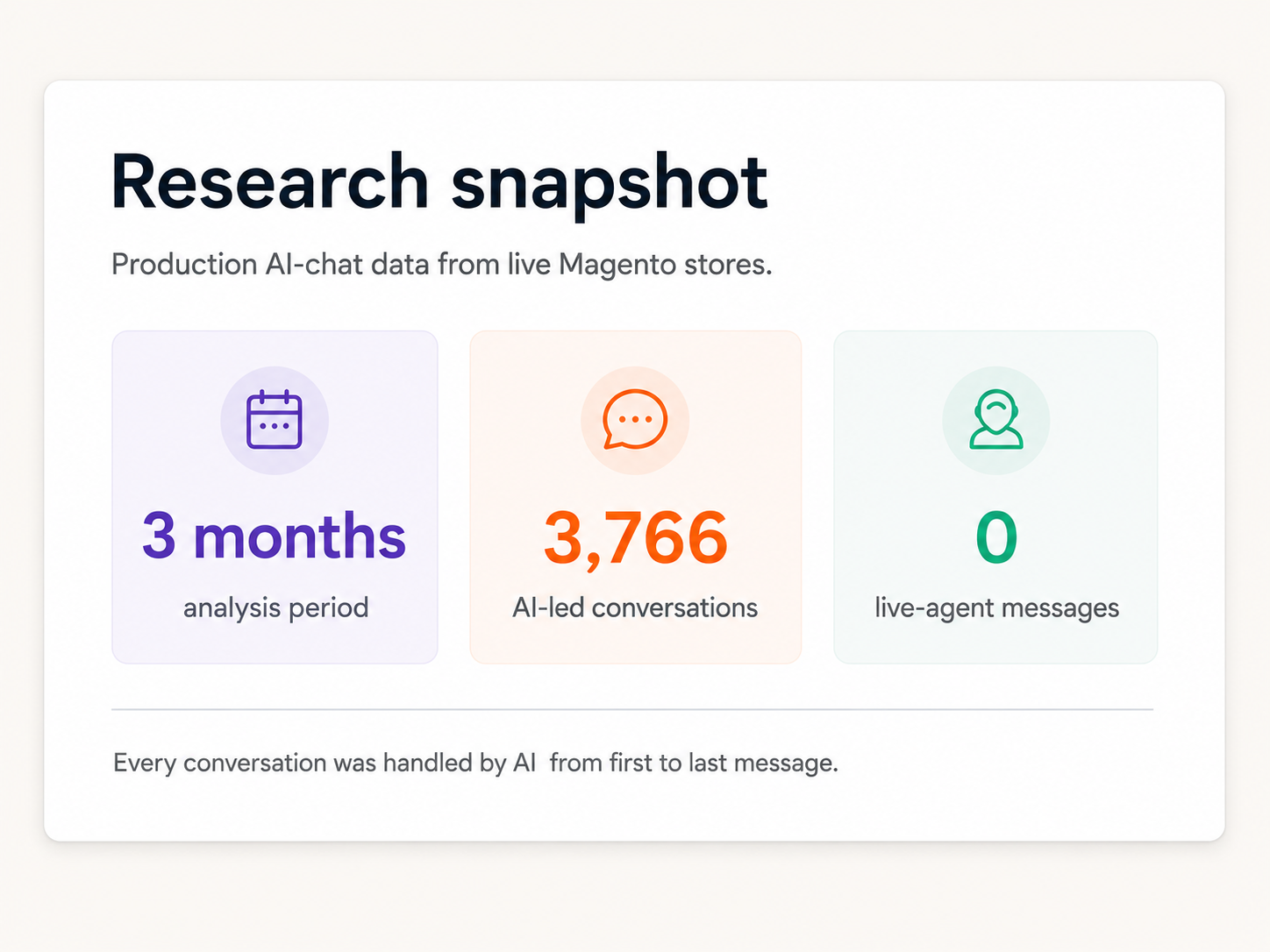
Over three months, an AI chat handled 3,766 conversations across dozens of live Magento stores - entirely on its own, with no human agent behind it. We analyzed every one. The short answer: the value is real, but it doesn't come from "AI magic." It rests on two unglamorous things.
The first is how complete and readable your store's content is, so the bot can actually find an answer in it. The second is how reliable the infrastructure around it is. Below is what the production data actually shows, including the parts most vendors stay quiet about.
Table of Contents
- Key Takeaways
- Where the Data Comes From
- Three Months Without a Single Human Message
- Why the Bot Escalates: A Limit on Authority, Not Understanding
- What Shoppers Actually Ask (It's Not Order Status)
- Did the Bot Actually Help?
- What Kills Results: Boring Infrastructure, Not "Dumb AI"
- Hallucinations: A Systemic Reaction to a Content Gap
- The Knowledge Base: Over 90% Is the Catalog
- The Economics: 3 Cents per Conversation
- The Verdict: Myth or Real Value?
Key Takeaways
- 3,766 conversations, dozens of live Magento stores, three months, fully autonomous - no human agent behind any of them.
- Only 0.66% of substantive conversations asked for a live person.
- Products dominate, not order status: 38% of first messages are product questions, 8% order status.
- Roughly 50% of conversations fully resolved, about 85% fully or partially.
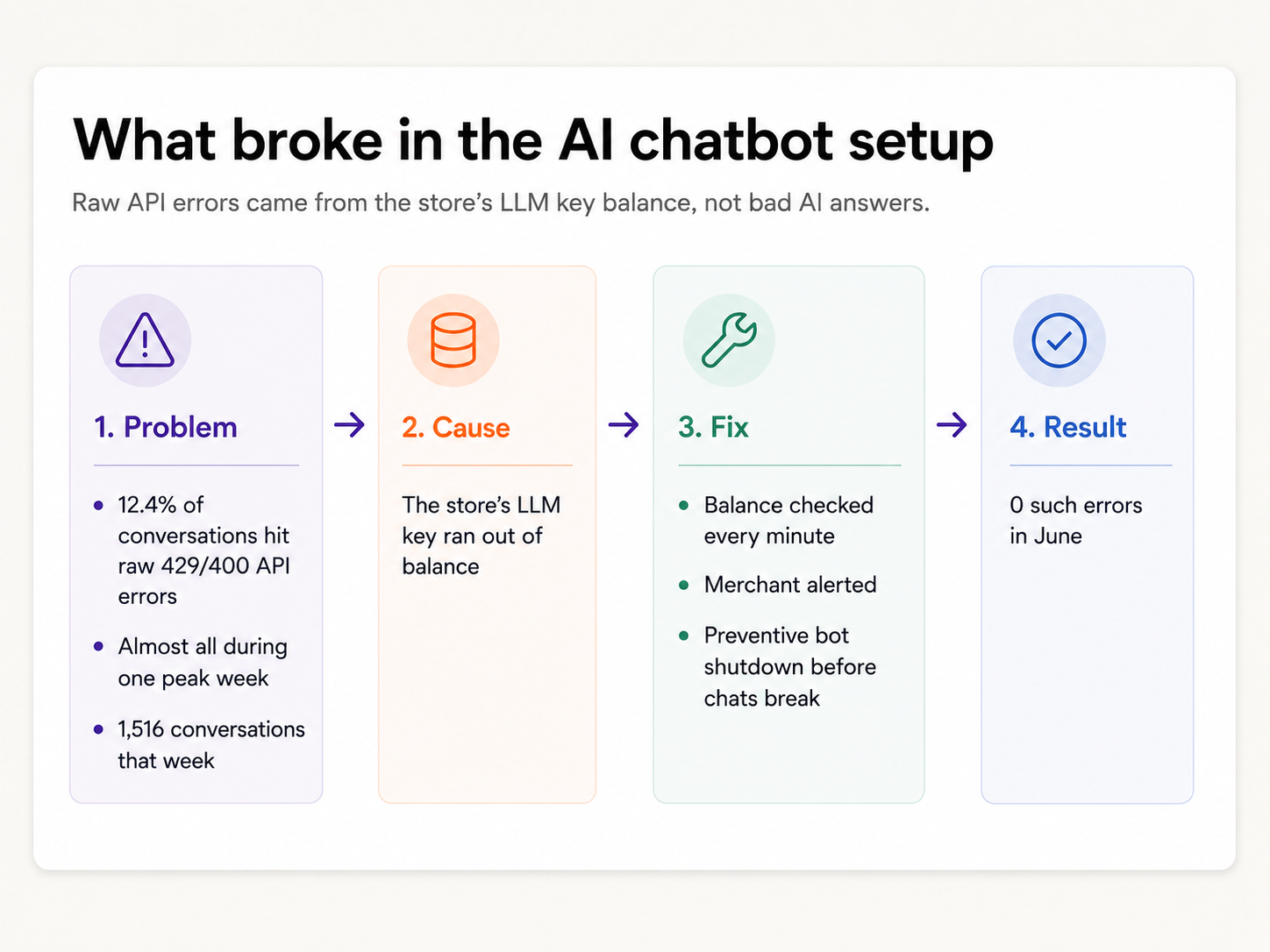
- The worst failure was infrastructure, not AI: 12.4% hit raw API errors in one peak week, when a store's LLM key ran out of money.
- Median conversation cost: $0.028.
Where the Data Comes From
The stores in the sample cover most of the types that run on Magento - fashion, auto, food, adult - with catalogs ranging from a few hundred products to several hundred thousand. This isn't a lab test or one convenient store, but a cross-section of how an AI chat behaves across a typical Magento landscape.
In total, the analysis covers 3,766 conversations from stores that had explicitly opted in to allow their chat data to be used for product analysis. The AI handled each conversation from the first message to the last.
One honest methodological caveat up front: no one read these conversations by hand. Each dialogue is scored automatically by a separate, more capable LLM about a day after it ends - what went well and what didn't.
In only about 5% of cases did the customer explicitly write that the bot had helped. The model assigned the rest of the helped / not-helped ratings. Keep that in mind as you read the numbers below. Conversations that can't be judged from the text alone were left unrated: no one counted them as successes.
Three Months Without a Single Human Message
Across the entire period, not a single message in these chats came from a human agent. This isn't an accident but a deliberate design: human participation here isn't even technically possible. When a customer needs a person, the bot follows the rules: it points them to support or explains how to get in touch.
And here's the number that made this worth checking: out of 2,432 substantive conversations, only 16 contained a request for a live person. That's 0.66%.
Why so few? In our view, the main reason is the format itself. The chat button says it's an AI chat. People open it already knowing they'll be talking to a machine, so they simply ask their question instead of demanding an operator.
We hold a firm position here: you must not pass a bot off as a human. It destroys trust both in these systems and in the store itself. All the more so in 2026: most active shoppers already use ChatGPT, so talking to a bot inside a store feels familiar.
Does this mean any store can replace live chat with a bot? No. If your chats are complex and unique, or your staff actively sell through chat, today's LLMs don't reach the level of human communication. But if most requests come down to finding information and handing it to the customer, a bot can fully replace live chat.
There's also a distinct request coming from the stores themselves: not constant supervision of the bot, but the ability to step into any conversation when needed and carry it on. Not because the bot fails, but to keep control on hand - a safety net for the non-standard case.
When the bot hits its limit, it doesn't go silent - it escalates. And that's where the most interesting part of our data hides.
Why the Bot Escalates: A Limit on Authority, Not Understanding
An analysis of all 133 escalations over three months reveals a pattern that seems counterintuitive at first. Mostly, the bot escalated not where it failed to understand a request, but where it structurally had no right to carry it out.
The thing is, the bot is limited by two things: the information it holds and its set of tools. Four base tools are available by default:
- create a ticket
- get order status
- get tracking
- pull an invoice for printing
Custom ones can be added on top for a specific store. Anything beyond these limits requires an action from the store itself, and that's an escalation by definition.
The classic example is a product return: the bot can't process it. All it does is lay out the return terms and explain how to request one. It understood the customer perfectly. It simply has no authority to act on the store's behalf.
This matters for anyone who reads an escalation rate as a measure of how smart the bot is. A high escalation rate here isn't a sign of dumb AI, but the boundary of what is allowed - a boundary you draw yourself. The tool set is fixed, but the prompt and the escalation rules (scenarios, in our case) are configured by the store owner. The administrator describes a trigger situation and what to do when it occurs. An unhappy customer - end the conversation and route to support, create a ticket right away, or approach from another angle. Someone asks for contacts - hand over the contacts.
When an escalation does happen, the bot doesn't toss the person into nowhere. Over three months it created 133 tickets on its own. The mechanics are almost fully autonomous: the bot confirms the email, pulls the request text, context, and order number from the conversation itself, verifies the details, and creates a ticket on the customer's behalf. The support person receives a prepared case, not a "hi, I have a problem."
What Shoppers Actually Ask (It's Not Order Status)
The main surprise for anyone who thinks "chatbot = offload support":
| First-message topic | Share |
|---|---|
| Products: selection, specs, compatibility | 38% |
| Greetings / small talk / general conversation openers | 25% |
| Order status and delivery details | 8% |
| Other topics (policies, returns, contacts, etc.) | 29% |
Each category reflects the customer’s first message in the conversation, before any follow-up questions or clarifications.
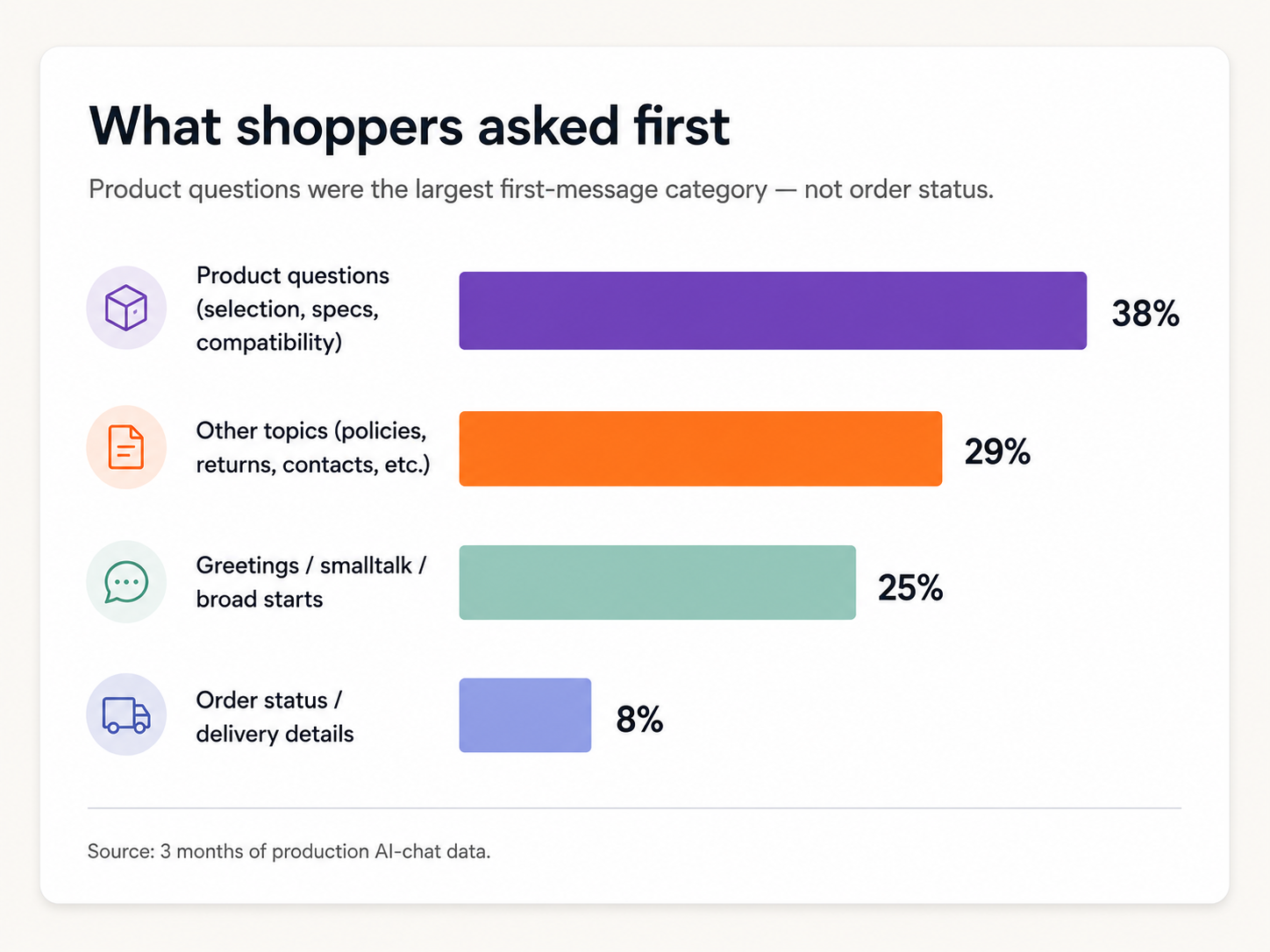
Only 8% of conversations start with order status, and that's a healthy picture, not a failure. A logged-in Magento shopper needs two or three clicks to check status. Those who do ask are usually after what's hard to find in the account: a tracking number, an estimated delivery date.
The 25% of small talk isn't noise either. People greet bots the same way they say "hi" to ChatGPT. It's a normal, polite start to a consultation.
The main takeaway hides in that 38%: the chat works as a product-consultation channel, not only as support. And here we'll be honest about the limits. We see the bot's role as an information helper, not a sales consultant. Selling is emotion, psychology, the argument for why this particular product. A human is still stronger at it.
If you have a live sales chat today and you replace it with a bot, that's a real risk. If there was no live chat at all, there's nothing to lose: no one was doing sales in this channel anyway, and now at least someone answers product questions at three in the morning.
And one more production fact: the bot worked in 30+ languages with no configuration at all. The language is detected from the customer's first word, and the whole conversation runs in it, even if the entire catalog and knowledge base are in English. Type "Guten Tag" in a Spanish store, and the whole exchange goes on in German. For multilingual stores, this removes an entire hiring problem.
Did the Bot Actually Help?
The LLM evaluation shows two numbers: the bot fully resolved roughly 50% of conversations, and fully or partially - about 85%.
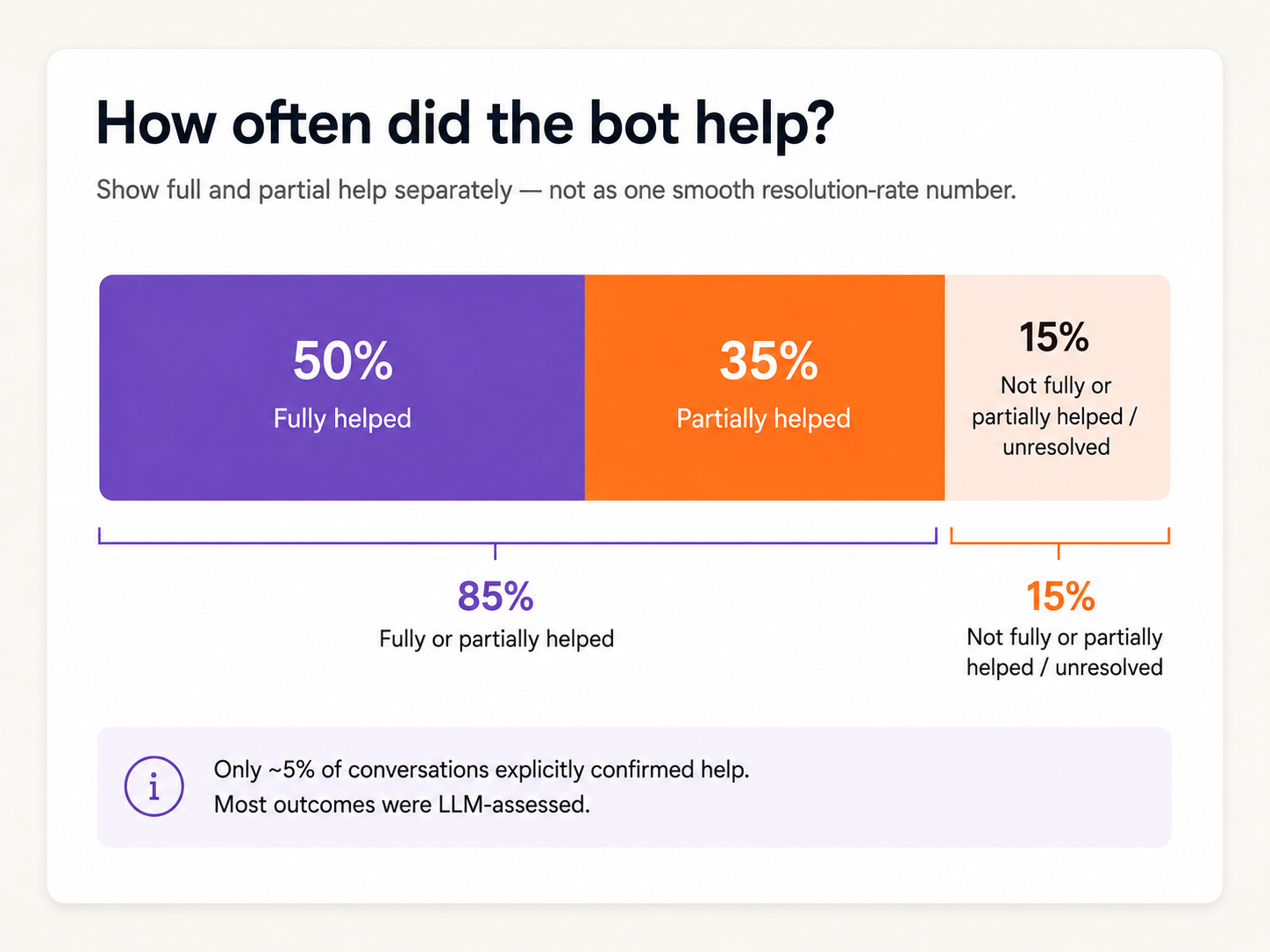
Which of these two numbers is the real one? Both, if we label them honestly: full resolution is one thing, partial help is another. We deliberately don't collapse this into one smooth "resolution rate," because even the definition itself is debatable. If a bot (or even a live agent) answered and the customer asked a follow-up, was the first answer full? Anyone who quotes you a single percentage is leaving something out.
What Kills Results: Boring Infrastructure, Not "Dumb AI"
The most uncomfortable number in the whole analysis, and we're not hiding it: 12.4% of conversations got raw 429/400 errors from the API, almost all of them during a single peak week with 1,516 conversations.
And this wasn't an AI failure at all. The chat runs on the store's own LLM key, and during the peak week one store's key simply ran out of money. Conversation after conversation failed with raw errors instead of a normal message.
What we changed after that week: an automatic check now monitors the key balance every minute. If the balance isn't enough for active conversations, the merchant gets a notification and the bot shuts down preemptively until it's topped up. An honest "chat unavailable" instead of errors mid-conversation. In June there were no such errors. Zero.
The takeaway for any store choosing any chatbot: ask the vendor what happens when the LLM API goes down, gets rate-limited, or the key runs out of money. The answer to that question matters more than the demo.
Hallucinations: A Systemic Reaction to a Content Gap
In our data, hallucinations aren't random noise. They are what the bot does when there's a gap in the knowledge base: unable to find the information, the model may start filling it in.
Instructions alone don't fix this. The system prompt explicitly forbids inventing URLs and facts. That helps, but it gives no guarantee: this is how any LLM works. So the architecture has to plan for failure up front.
In the system our data comes from, the LLM's answer doesn't go to the customer directly - it passes through an additional guard layer that checks the facts in the answer against the knowledge base. And even that layer isn't perfect: in production it lets a false answer through roughly once every thousand conversations. We would rather name that number than pretend it is zero.
But the most useful mechanism for a merchant is the feedback loop. Every question the bot couldn't answer (or whose answer the guard killed) is logged into an "unanswered FAQ" queue. Once a week or a month, the owner reviews it, groups similar questions, and answers once. The knowledge base grows exactly where shoppers actually hit gaps, not where someone assumed something might be needed.
The Knowledge Base: Over 90% Is the Catalog
Across the stores in our analysis, over 90% of the bot's knowledge is the catalog itself. Only about 10% comes from all other sources: CMS pages and content the merchant added deliberately.
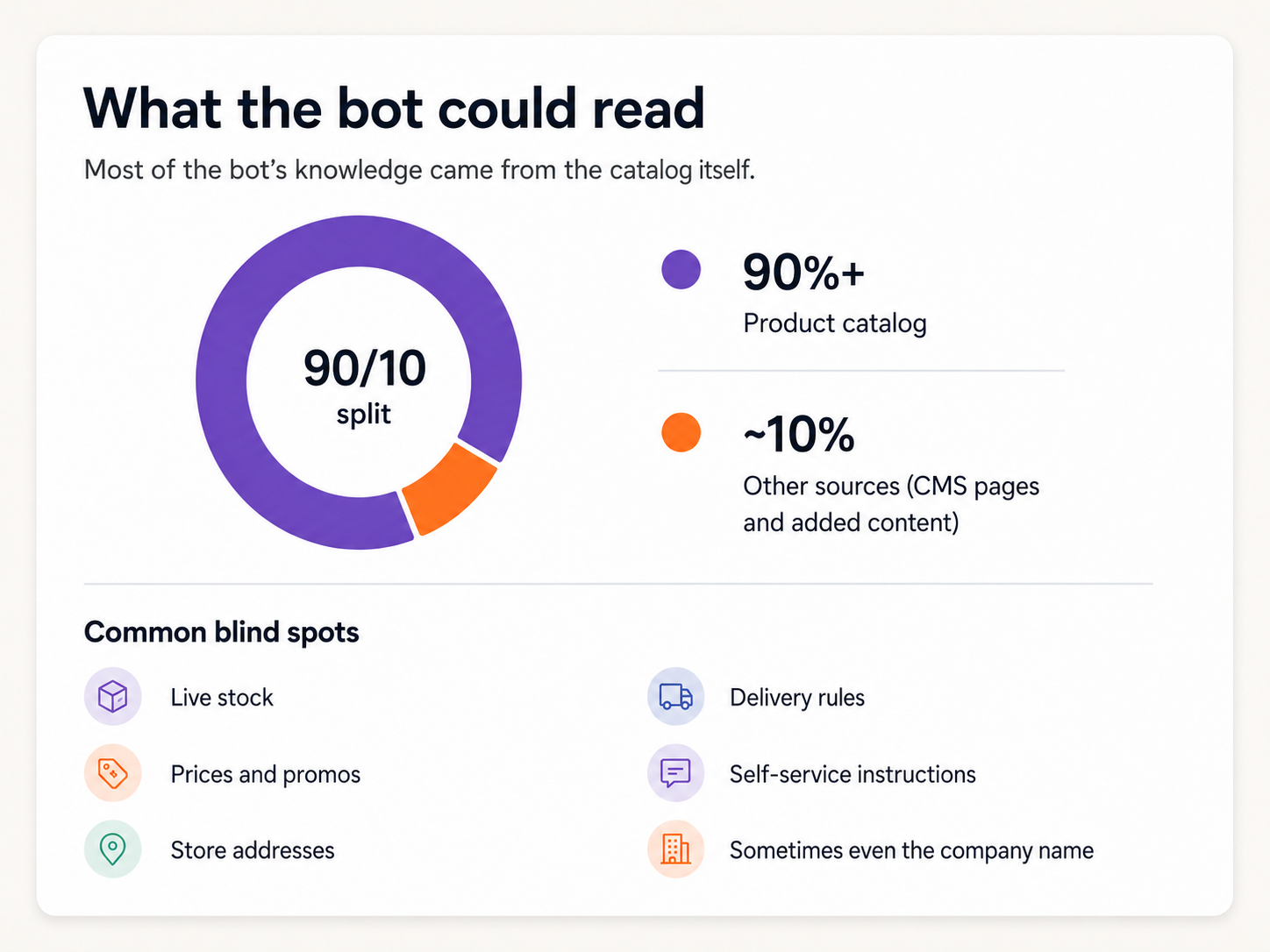
That's exactly why the list of information most often missing is so unglamorous:
- live stock
- prices and promos
- store addresses
- shipping terms
- self-service instructions
- sometimes even the company name
How does a chat end up not knowing the store's name? Easily: it lives in the logo in the header and nowhere in the data the chat actually reads. The system knows exactly what sits in the database and not a word more. These aren't AI blind spots but the store's blind spots, which the system simply makes visible.
How much knowledge-base work does it take before launch? It comes down to two questions a merchant can answer in an evening: what do customers ask about most, and is the answer already in the admin panel? If products have complete, detailed descriptions, preparation may not be needed at all. But if support answers customers from a source that isn't on the site, that source has to make it into the bot's knowledge before launch, not after.
The Economics: 3 Cents per Conversation
The median conversation, which is usually 3-5 question-answer pairs, cost $0.028.
The cost is driven not by message length but by how much information the bot has to analyze to answer. The most expensive conversation in our data cost $6.89: just 16 messages, but 63 LLM calls. One user question isn't one call. For a complex product question, the bot searches, reads a page, realizes it doesn't answer, reads the next one, comes back to compare. A human researches a topic the same way, except a human isn't billed per token.
Tellingly, the most expensive conversation was also a sales consultation - exactly the scenario you least want to cut off. So we don't recommend putting a cost cap on a conversation: even the worst case is six dollars. Abuse is a separate problem with a separate solution. Dedicated layers catch those who dump huge texts into the chat or pull the bot away from the store's topic, and cut such conversations off.
The Verdict: Myth or Real Value?
Real value. Not for every store, and not unconditionally. For some of the stores in our data, the bot worked perfectly from day one; others first had to fix knowledge-base problems that the bot ruthlessly highlighted. But the technology is moving in exactly this direction, and ignoring it at this stage means ignoring progress itself.
It's most likely too early for you to launch a chatbot if:
- Your store has almost no traffic. A chatbot multiplies conversations that are already happening; it doesn't create visitors.
- Most customer questions can't be answered from your existing content. If the answers live in support's heads or in files the site has never seen, the bot will expose that gap within a week. Content first: detailed product descriptions, policy pages, a basic FAQ or knowledge base.
If neither point is about you, give it a try. The honest bottom line of three months in production: the AI works. The only question is whether your content can carry it. And in 2026, a month of standing still is already a very long time.
If you're still choosing between an AI chatbot, live chat and a SaaS widget, here's how the Magento 2 options compare.
FAQ
Can an AI chatbot fully replace live chat on a Magento store?
Sometimes. In our data only 0.66% of substantive conversations asked for a live person, so if most requests come down to finding information and handing it to the customer, a bot can fully replace live chat. But if your chats are complex and unique, or your staff actively sell through chat, today's LLMs don't reach the level of human communication.
What do shoppers actually ask a Magento AI chatbot?
Product questions dominate. Across 3,766 conversations, 38% opened with product selection, specs, or compatibility, 25% were greetings and small talk, 29% were other topics like policies and returns, and only 8% started with order status. The chat works as a product-consultation channel, not only as support.
How much does an AI chatbot conversation cost?
The median conversation (usually 3-5 question-answer pairs) cost $0.028. Cost is driven by how much information the bot has to analyze, not message length - the most expensive case in our data was $6.89 for 16 messages that triggered 63 LLM calls, and it was a sales consultation.
Why does an AI chatbot hallucinate, and how is it controlled?
Hallucinations are mostly a reaction to a gap in the knowledge base - unable to find the information, the model starts filling it in. A guard layer that checks the answer's facts against the knowledge base helps, but it isn't perfect: in production it still lets a false answer through roughly once every thousand conversations.
What do I need to prepare before launching a Magento chatbot?
Mostly content. Over 90% of the bot's knowledge is the catalog itself, so answer two questions: what customers ask about most, and whether the answer is already in the admin panel. If products have complete descriptions you may need no prep; if support answers from a source that isn't on the site, that source has to reach the bot's knowledge before launch.
Head of Product at Mirasvit
Keep Learning