Mirasvit Latest Updates - August 2026
-
 Andriy Kovalenko
- Our News & Updates
- Aug 3, 2026
- 14 min read

What a month. Our team just set a new record: 79 features and fixes shipped across 23 extensions, almost double the usual pace. Some of it changes how you'll configure your store today. Some of it is the quiet, ongoing kind of work you only notice when it's missing. Here's what matters most first, working down to the smaller stuff that still counts.
Table of Contents
- Advanced SEO Suite
- Agentic Commerce
- Fraud Detector
- Reward Points and Loyalty Program
- Google Page Speed Optimizer
- Blog MX
- Layered Navigation
- Social Login
- Advanced Product Feeds
- Search Ultimate
- Order Management
- Automatic Related Products
- Inventory Planner
- Promo Banners
- Smaller Wins, Same Momentum
Advanced SEO Suite
Organic search is still the cheapest traffic a store gets. The Advanced SEO Suite module got the most attention this month, and two changes are worth knowing about even if you never open its settings.
First: what happens when you discontinue a product. Disable or delete one, and its old URL just dies. Anyone who bookmarked it, or found it through an old Google result, hits a 404.
Easy to forget. It happens to every store sooner or later.
The module now handles this automatically, sending shoppers and Google from the dead URL to the product's category, a page you choose, or the homepage. A discontinued product stops costing you the search ranking you built for it.
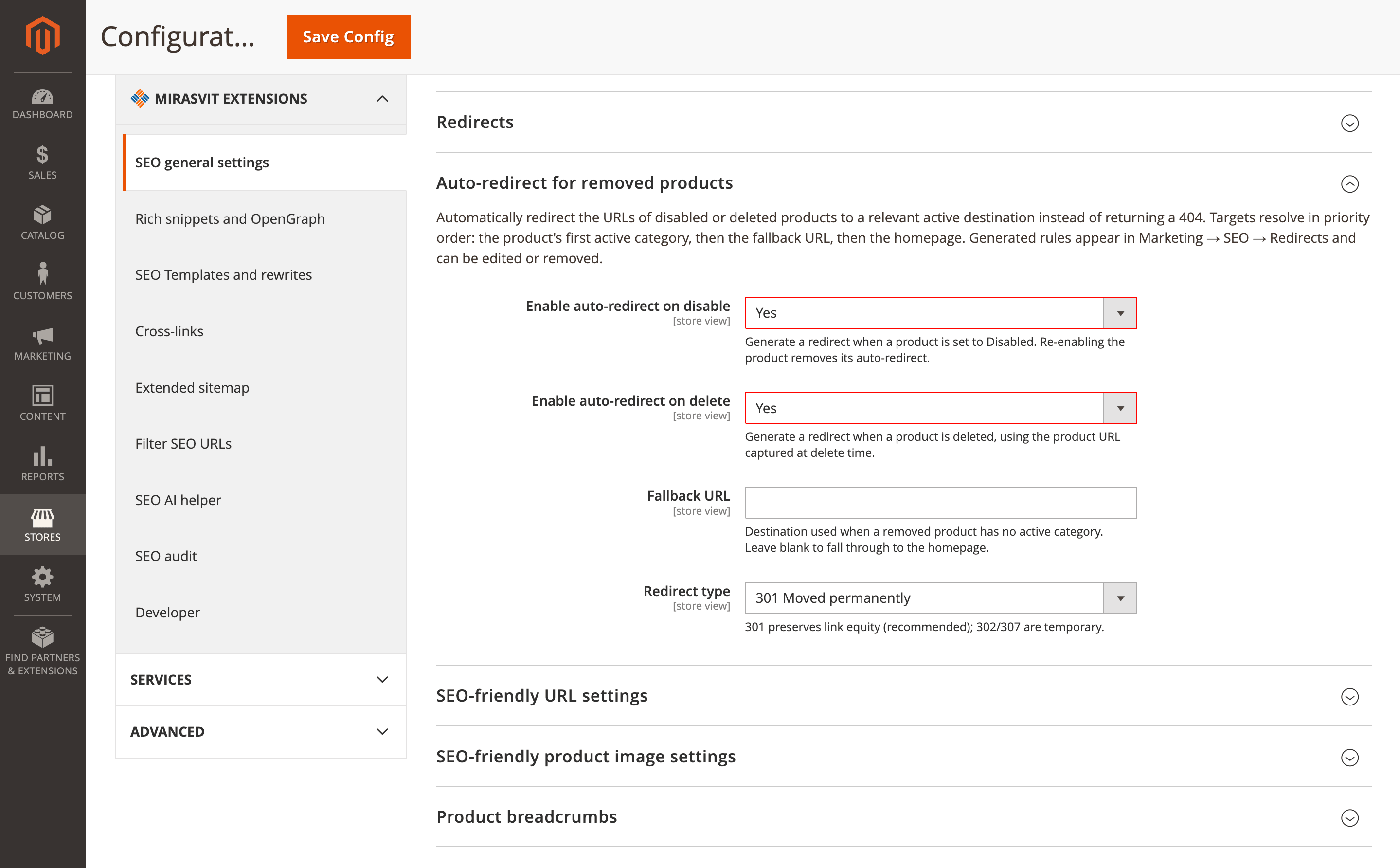
Turn it on under Stores → Configuration → SEO general settings → Auto-redirect for removed products. Check what it generates under Marketing → Advanced SEO Suite → Redirects.
Second, and bigger: your site can talk to AI directly.
When someone asks ChatGPT or Perplexity "does this store have it in stock, and how much is it," those tools read structured data on your pages the same way Google does, provided that data actually hangs together as one page. Scattered across disconnected fragments, it's easy for an AI to misread, or miss entirely.
A new opt-in setting links it all into one coherent profile. An AI answer engine finally sees a product page as one whole thing, not a pile of disconnected pieces.
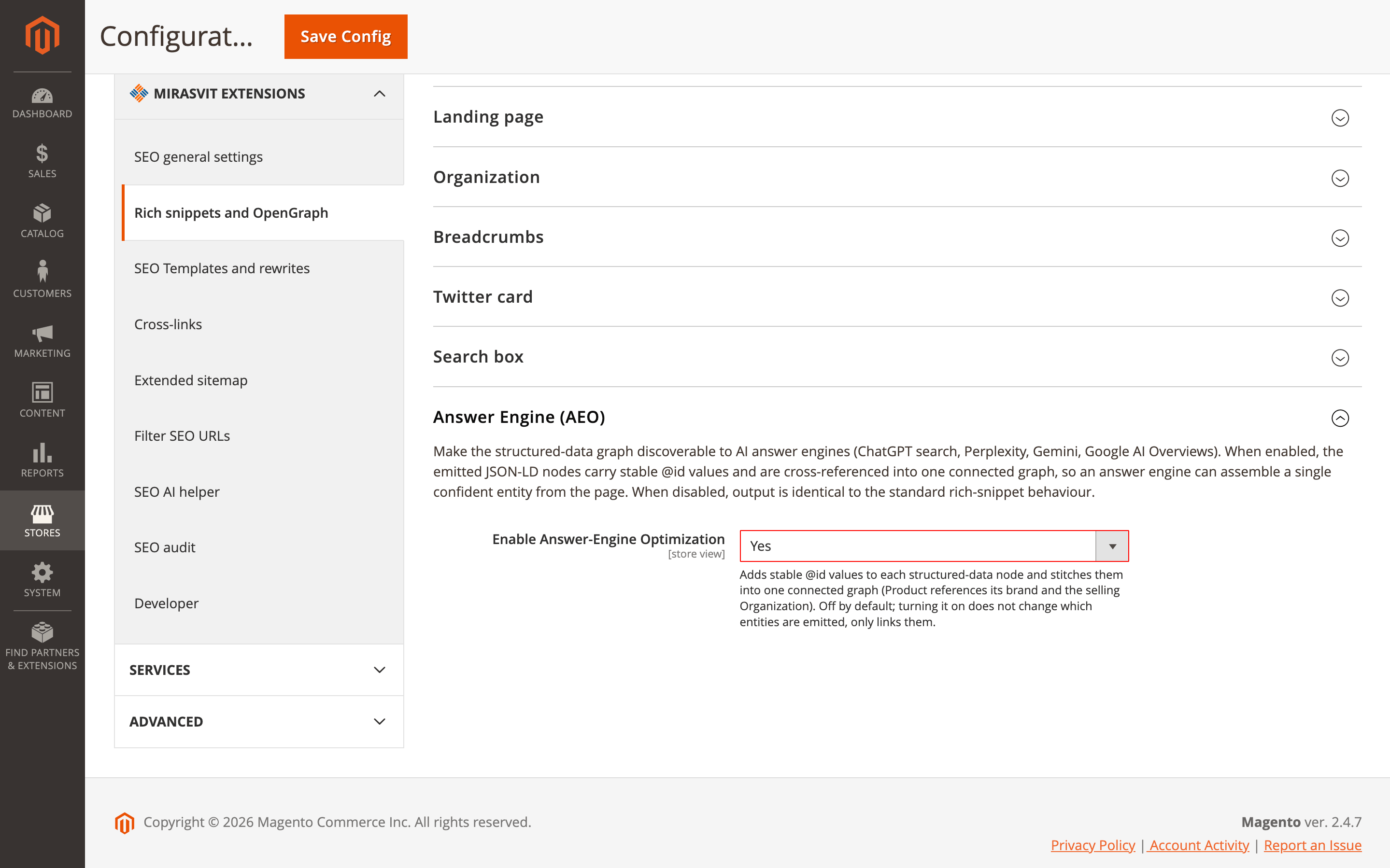
It's off by default, and changes nothing about how your site looks in regular search. Enable it under Stores → Configuration → Rich snippets and OpenGraph → Answer Engine (AEO) whenever you're ready to be found by AI, not just Google.
The built-in SEO Audit got sharper too. It catches thin, near-empty content wherever it actually renders, including content built with Page Builder, which this kind of check couldn't see before. It flags any page missing a canonical tag, and checks whether your structured data has what Google requires for rich results.
A problem that once surfaced only as a slow ranking drop shows up in your next audit instead.
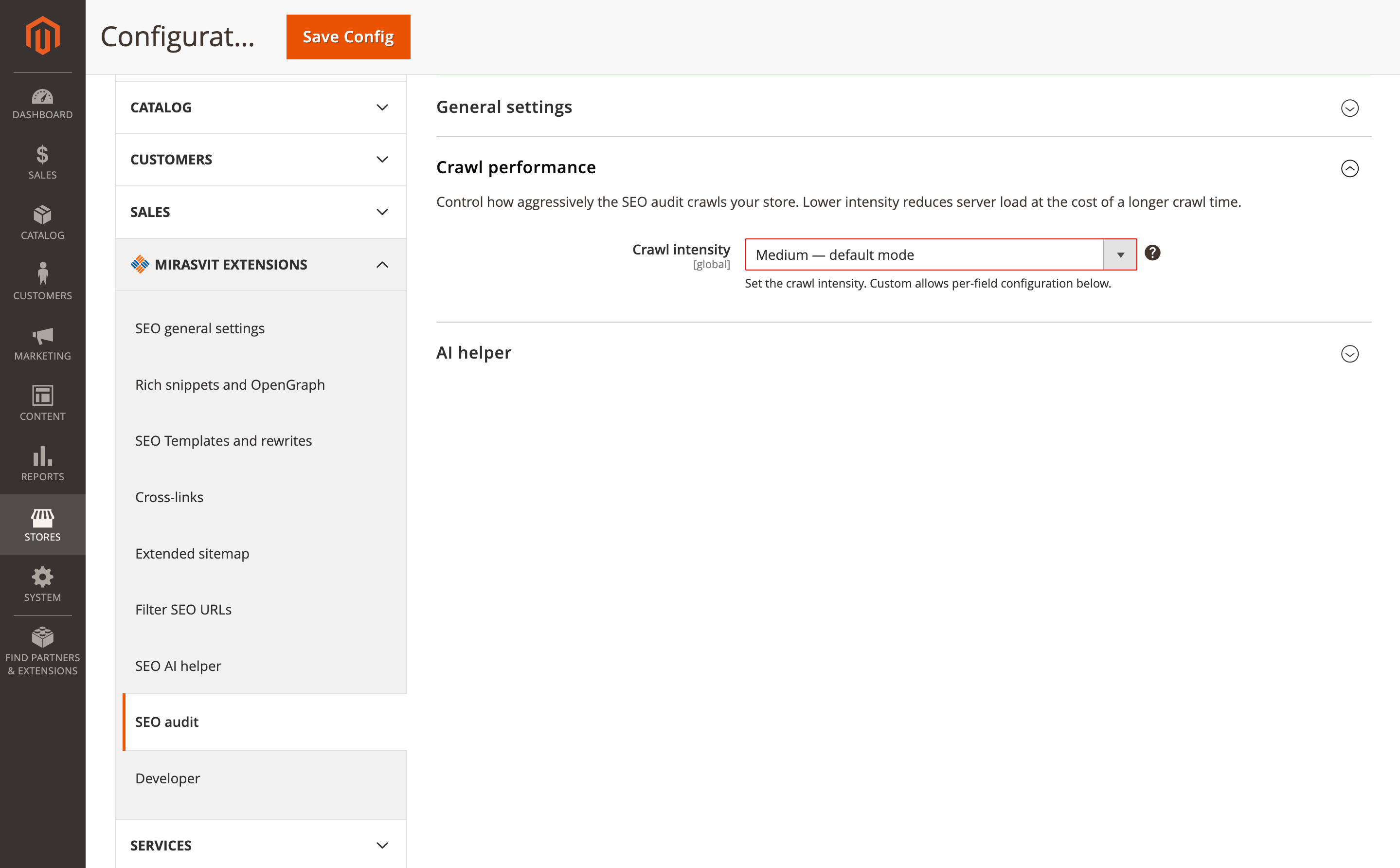
Running audits on a budget host? New Low, Medium and High presets mean you no longer have to guess at safe crawl speeds. And if your catalog includes product videos, they're added to your sitemap automatically, giving them a shot at Google's video results with zero extra setup.
Agentic Commerce
If Advanced SEO Suite teaches your product pages to speak clearly to AI, Agentic Commerce goes a step further. This extension lets AI agents actually shop your store, not just read about it.
Picture a shopper's browser assistant being asked to "find a size 10 in this style, in stock." With WebMCP support enabled, that assistant can query your catalog directly: search, look up a product, check what's actually in stock, straight from the source rather than guessing from whatever text happens to be on the page.
The feature works identically on Luma and Hyvä. And it's read-only: it can look, never touch the cart.
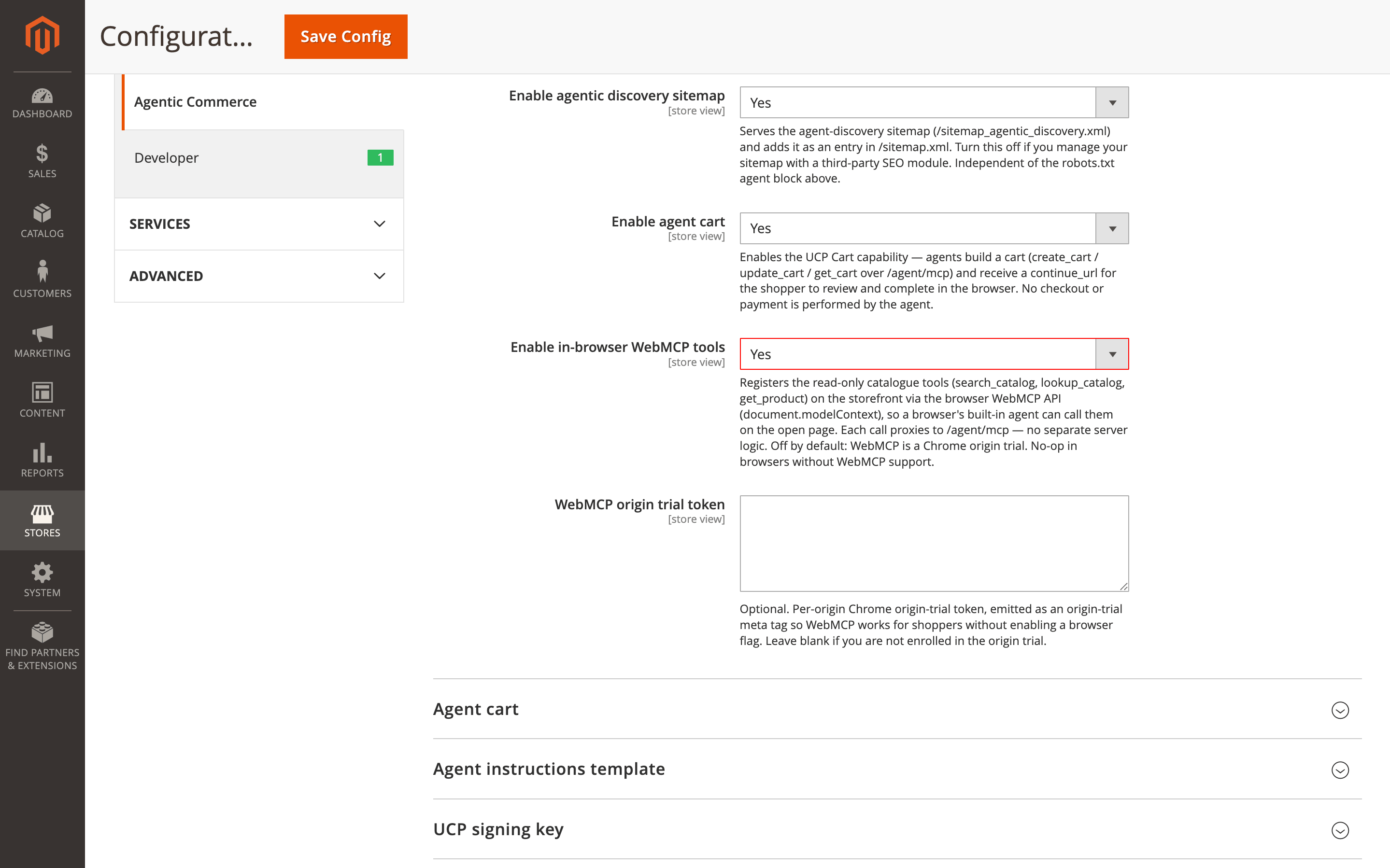
Turn it on under Stores → Configuration → Agentic Commerce → HTTP Surfaces → Enable In-Browser WebMCP Tools.
Worth checking once it's on: which text an agent actually reads as the product's description. A new Description Field Priority list lets you set the fallback order, Description, then Short Description, then Meta Description by default, or add your own custom attributes and reorder them. If your best product copy actually lives somewhere other than the standard Description field, this is what stops an agent from answering "what's this made of" with nothing instead of the real thing.
Opening a public endpoint to bots always raises a fair question: what stops someone from abusing it?
This release answers that too. The public agent cart endpoint limits how many carts one client can spin up, caps line items and quantities per request, and clears out abandoned agent-built carts automatically after 24 hours.
A curious shopper's assistant works exactly as before. A script trying to flood your store with junk carts gets stopped at the door.
There's a similar security upgrade for stores publishing a UCP merchant profile. You can view, regenerate, or recover its signing key from Agentic Commerce → UCP signing key, instead of needing a support ticket if it ever goes missing.
Most of the rest of this month's work is invisible by design: fewer database queries behind every agent search, cached responses for repeat questions, faster rendering of the discovery files (/llms.txt, /agents.md) that AI crawlers read first.
None of it changes what shoppers or their agents see. All of it means your store keeps up as agent traffic grows. It doesn't fall behind.
Fraud Detector
Fraud Detector checks a new order's IP address against your past orders, looking for the kind of pattern a fraudster leaves behind. This month gives you control over how far back that check looks.
The default lookback is 365 days. Sitting on years of order history? Narrow that window, say to 90 days, so the check stays fast even as your order table grows. More worried about fraud rings that resurface months later? Widen it instead, and catch a fraudster reusing an IP from an order placed 200 days ago that a shorter window would have missed entirely.
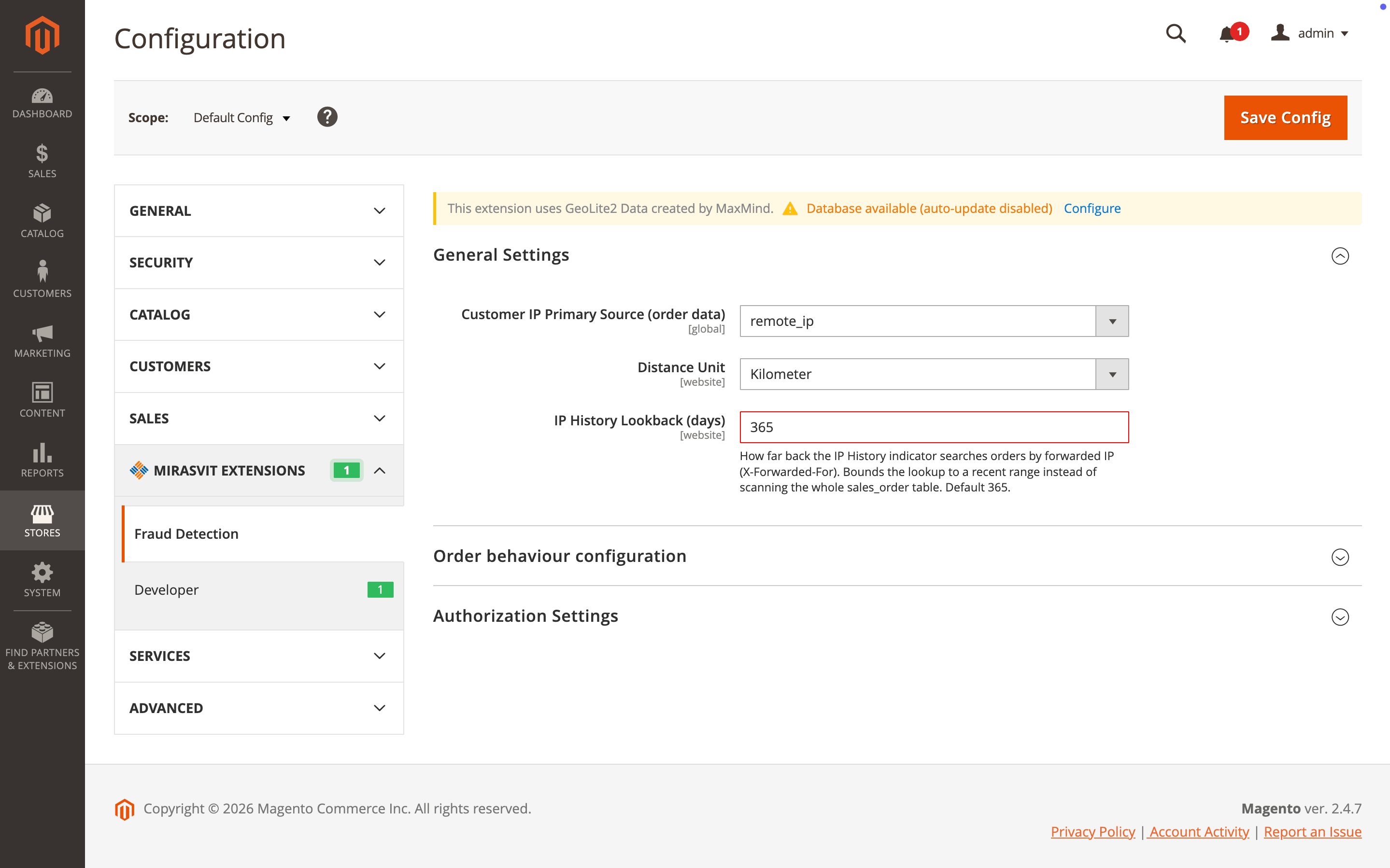
Set it under Stores → Configuration → Fraud Detection → General Settings → IP History Lookback (days).
Reward Points and Loyalty Program
Not every loyal customer looks the same on paper. Some spend a lot in one order and disappear for months; others come back every few weeks and spend modestly each time. Until now, Reward Points and Loyalty Program only recognized the first kind: tier thresholds were set purely by amount spent, so a frequent small-order shopper could out-loyalty a big one-time buyer and still sit in the bottom tier.
A new order-count qualification method fixes that. Set a tier to unlock after, say, ten orders, and it no longer matters how much each one was worth: showing up counts. Configure it under Marketing → Reward Points → Tiers, on the Minimum number of orders to reach the tier field.
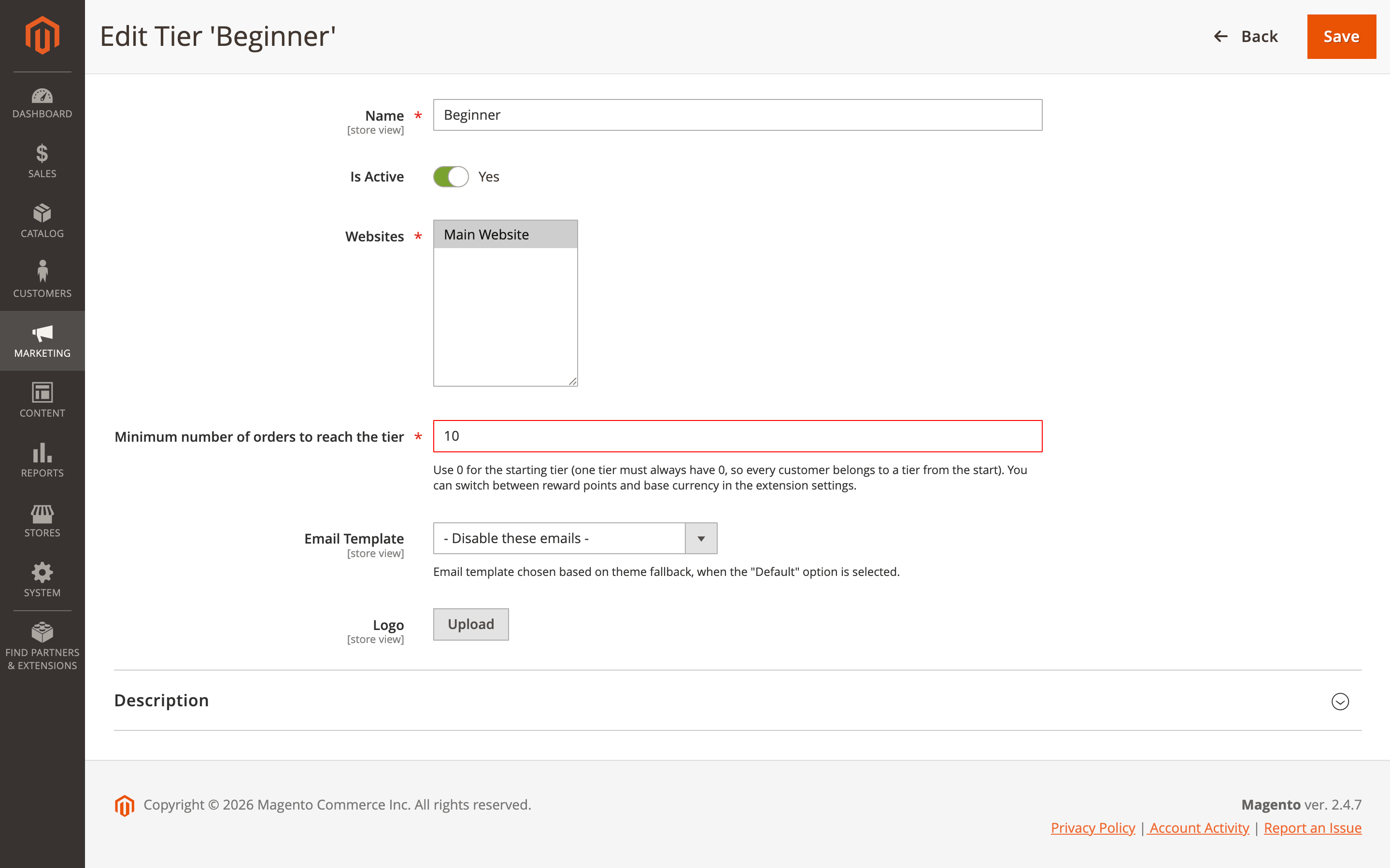
Option System → Configuration → Mirasvit Extensions → Reward Points → Tiered Rewards Program → Switch between tiers based on must be set to Number of orders first.
Two smaller changes tighten up the program elsewhere. Manually granted points can now carry their own expiration date, handy for a goodwill gesture you don't want to become a permanent balance. And points earned through a referral finally wait out the same pending period as a normal purchase, so a canceled order can't leave a customer with points it never should have granted.
One more is worth flagging on its own, because it's less minor than it sounds: the admin now shows a banner the moment your store has no active rule letting customers actually spend their points.
Miss that, and shoppers keep earning a balance they can never redeem, exactly the "why can't I use my points" complaint that quietly sours people on the whole program. Now it gets caught before a shopper ever notices.
Google Page Speed Optimizer
Every third-party script on a page, tag manager, chat widget, review plugin, competes with your actual content for the browser's attention the moment the page loads. That's exactly what tanks Core Web Vitals scores, and it's what Google Page Speed Optimizer's biggest change this month goes after directly: those scripts can now wait until a shopper actually clicks, scrolls, or taps something, instead of racing to load the instant the page opens.
The framework code that runs your storefront (RequireJS, jQuery, Knockout, Magento UI, Hyvä's Alpine) is never delayed, so nothing about how the site works changes, only when the extra scripts show up. Set your patterns under Stores → Configuration → PageSpeed Optimizer → JavaScript Optimization, and run Dry Run first to see the effect before it goes live.
A second change works alongside it: critical, above-the-fold CSS can now be defined and auto-extracted per page type, so a category page's content starts painting before the rest of its stylesheet even finishes loading. Capturing that CSS does need Node.js and Chrome available somewhere in your stack, but only to run the extractor now and then.
The storefront itself stays plain PHP the whole time, so nothing about how pages get served changes. Between the two, if you're chasing a better PageSpeed Insights score, and the ranking and Ads Quality Score that ride on it, you've got two real levers to pull, not just one.
Blog MX
A blog with a few hundred posts accumulates a few hundred small problems: a broken outbound link here, a stretch of thin content there, and nobody's going to find them by rereading every post. Blog MX's new Content Checker does the reading instead, scoring every post for exactly that: thin content, dead links, images that no longer load, all in one grid instead of a manual audit. Turn it on under Content → Blog → Content Checker (a dedicated permission gates who sees it), and you get a punch list instead of a guess.
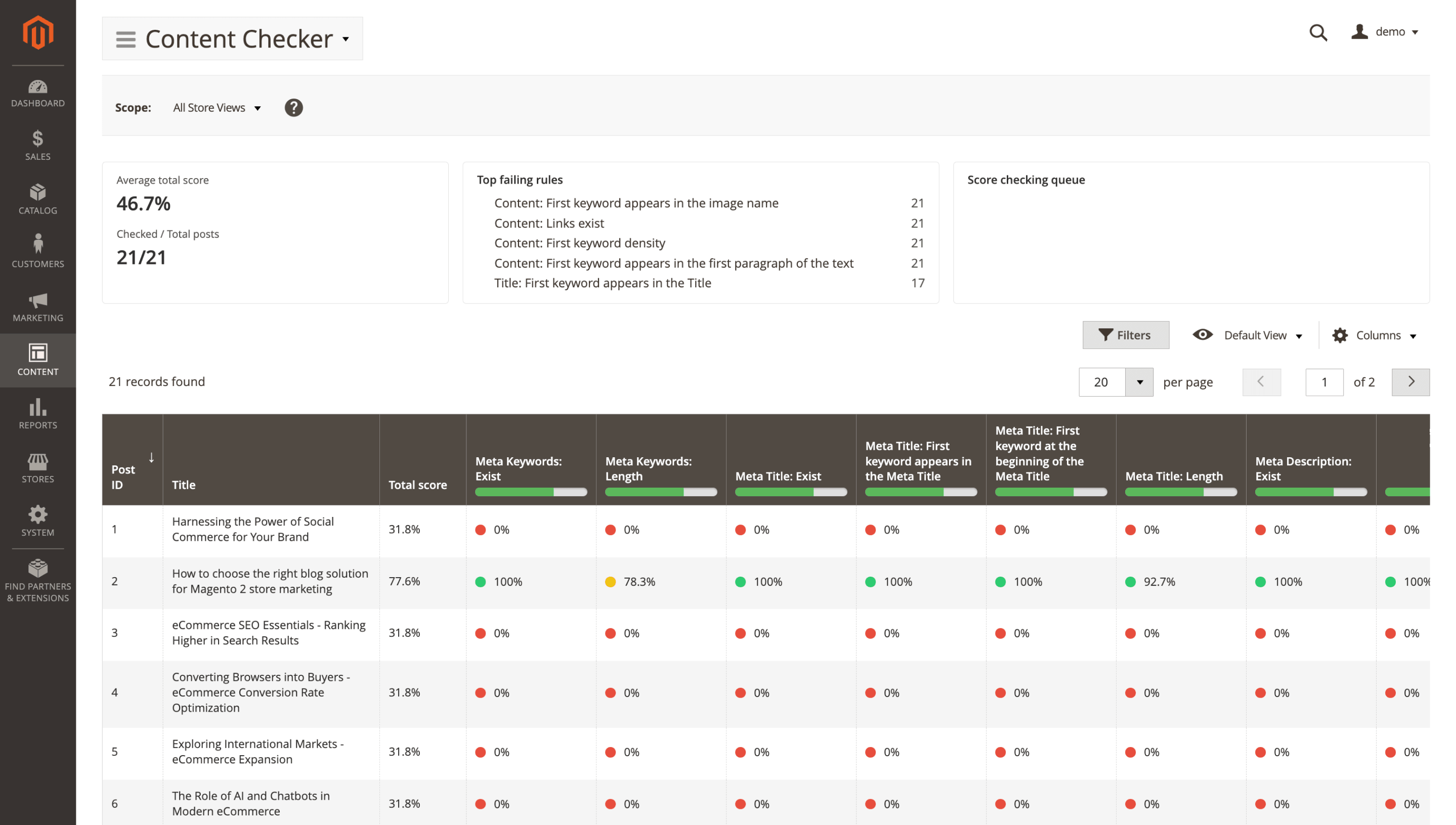
The other change worth knowing has nothing to do with SEO and everything to do with your nerves: deleting a post no longer deletes it. It goes to a new Trash section first, recoverable with one click, so an editor's accidental delete stops being an incident and starts being a two-click fix.
A smaller convenience ties the blog closer to the rest of the site: a new widget lets you drop any existing CMS Static Block, a newsletter signup, a shipping-promo banner, straight into the blog layout through the Layout Editor. Whatever you already maintain sitewide now shows up on the blog too, without keeping a second copy of it just for posts.
Layered Navigation
Somewhere in your category page's filter panel is a combination shoppers reach for constantly: "Red" plus "In Stock", say, or one specific size. Layered Navigation now lets you turn that combination into a clickable card sitting right at the top of the page, so a shopper lands on exactly the filtered view they wanted without touching the filter panel at all. The suggested combinations aren't guesses either. They're pulled from real filter-usage data the module already tracks, so the cards you build are the ones shoppers were already reaching for.
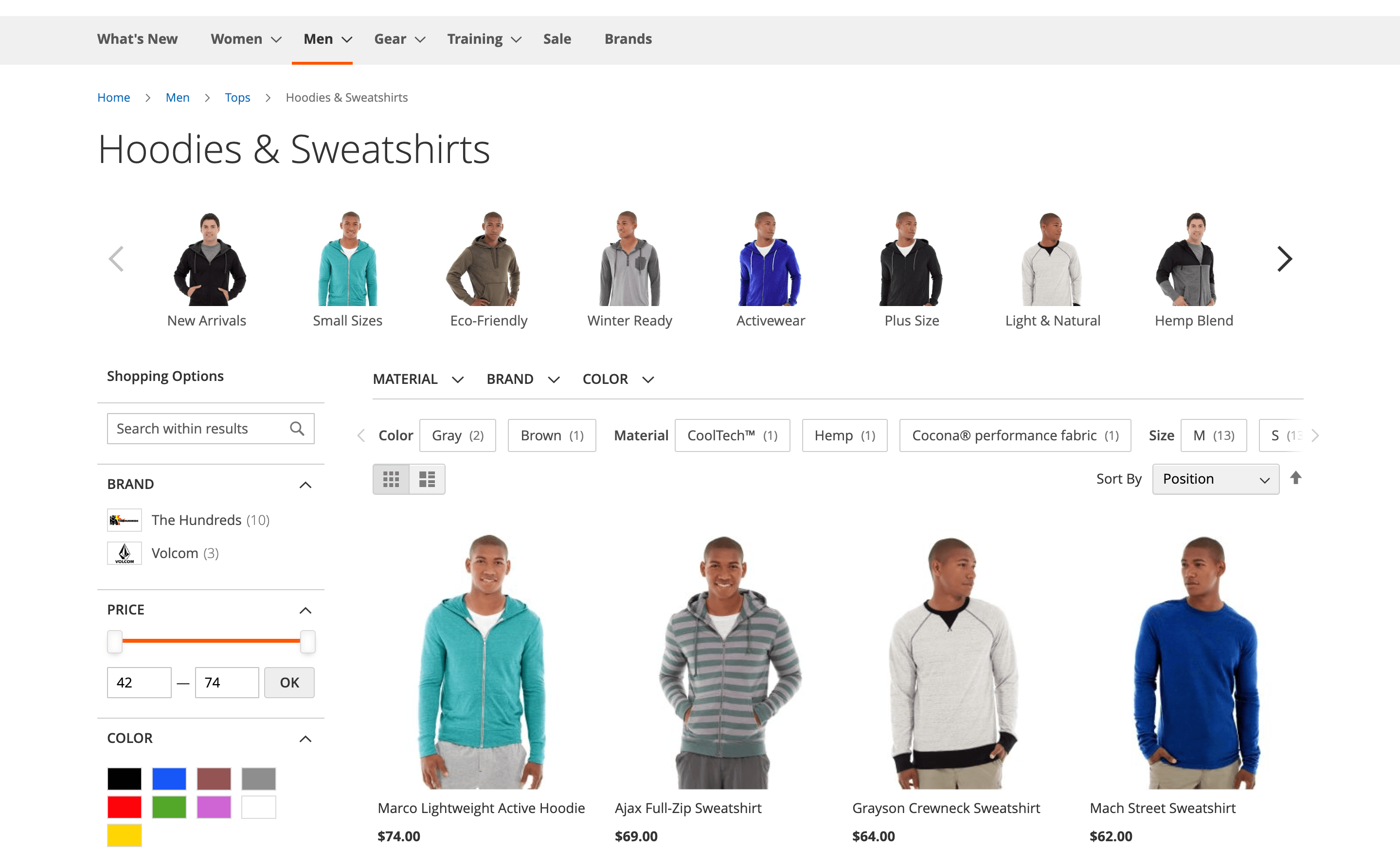
Build them under Content → Layered Navigation → Smart filters, once filter-combination tracking is switched on under Stores → Configuration → Layered Navigation → Analytics.
Social Login
If your storefront runs on a PWA or another headless setup, Social Login had nothing for it until now. Google and Facebook sign-in only worked on the standard Luma-style frontend. A new GraphQL query and mutation change that: a headless storefront can now list enabled providers, send a shopper through the provider's login flow, and exchange the resulting code for a customer token, the same account linking the standard storefront has always done. It's an API rather than a drop-in button, so wiring it into your headless frontend is still a developer task, but the sign-in experience shoppers get on the other end is identical either way.
Advanced Product Feeds
A Google Shopping feed that quietly drops a tier price, or fails to read a Merchant Center key, doesn't announce itself. It just underperforms, and leaves you guessing why. Advanced Product Feeds now writes exactly that kind of failure to a log file (var/log/mirasvit/feed.log) instead of swallowing it, so a feed that looks off comes with an actual reason attached. The feed edit screen also got a redesign, with a status bar putting generation time, product count, and any validation issues front and center instead of buried in a form.
Search Ultimate
Running two store views that sell somewhat different things? Search Ultimate's search reports finally know the difference. Top Search Queries and Search Volume now record which store view a query came from, so "winter boots" trending on your EU store and "sandals" trending on the US one show up as two distinct signals under Reports → Search Ultimate, not one blended average that hides both. A query that looked flat in a combined report can turn out to be a clear regional trend once it's split apart, exactly the kind of signal that decides what gets restocked where.
Order Management
If you tag orders automatically by customer behavior, lifetime spend, order count, newsletter status, review count, your store used to recalculate all of that from scratch for every single tag on every single order save. Order Management now computes it once per order and reuses it, with no change to which tags actually get applied. Barely matters for a one-off save. Reprocess a few hundred orders overnight with several customer-behavior tags configured, though, and doing that math once instead of repeatedly adds up to real time saved.
Automatic Related Products
Running Automatic Related Products on Hyvä with blocks set to a non-slider layout? You may have hit a quiet problem: those blocks sometimes just didn't render. That's not a cosmetic bug. A cross-sell block that silently fails to show up is a cross-sell it was never going to make, and the extra revenue that block exists to capture disappears with it. The block-selection logic behind related, up-sell, and cross-sell placements is now unified across every theme, Hyvä included, so the block you configured is the block that actually shows up.
Inventory Planner
Inventory Planner adds a Stock Value by Supplier grid, SKU count, units on hand, and total value, broken out per vendor, so you can see that $120,000 of stock sits with one supplier before deciding whether that's a relationship worth renegotiating. Find it under Catalog → Inventory Planner → Stock Value by Supplier.
Promo Banners
Banner performance used to live in its own little silo. Promo Banners now reports impressions and clicks straight to Mixpanel, once you've connected the Mixpanel Analytics extension, so your homepage banner's numbers can sit inside the same funnel as everything else a shopper does on the way to checkout, instead of living or dying by a stat nobody outside your merchandising team ever looks at.
Smaller Wins, Same Momentum
Not every update this month needed its own headline. Mixpanel Analytics is the one genuinely new name in the list: a first-party integration that pushes ecommerce events, customer identity, and even refunds into Mixpanel the moment they happen, server-side, reusing the same Tag Manager data layer that already feeds other Mirasvit integrations, and working on Hyvä without a separate compatibility purchase. If Mixpanel already runs anywhere else in your stack, this is what finally lets your Magento data join it, instead of living in its own spreadsheet.
The rest is smaller, and still worth thirty seconds:
- Mass Product Actions - now tells you the moment a background bulk price or stock update fails partway through, instead of leaving a mix of old and new prices for a shopper to discover by accident.
- GPT AI Assistant & Content Generator and AI Copilot - each gained the same kind of admin permission, letting you keep their AI buttons away from roles you haven't trained on reviewing AI output yet.
- Facebook Pixel & Conversion API - its browser-side Purchase event now carries the order ID, so it matches its server-side counterpart instead of getting double-counted in Ads Manager.
- Help Desk MX - picked up a copy-to-clipboard button next to the ticket code, the kind of thing an agent appreciates ticket after ticket, not just the first.
None of it changes what these modules are for. It's just what a store that keeps shipping every single month looks like from the inside.
That's August. If any of these modules sound like something your store doesn't have yet, the full extension catalog is worth a scroll before next month's update lands.
Mirasvit Support Engineer