Sphinx vs Elasticsearch: Which Search Engine Is Best for Magento 2
-
 Oleksandr Drok
- E-commerce Tips & Best Practices
- Updated: Dec 11, 2025
- 15 min read
When a Magento 2 store grows beyond a small catalog and a few filters, the limits of the built-in MySQL search quickly become visible.
At that point, many teams end up having the same discussion: which open-source search engine—Sphinx or Elasticsearch—will give better relevance, faster pages, and manageable infrastructure for e-commerce?
The article compares these two search backends as they are used in real Magento 2 projects, looking at performance, indexing behavior, scaling and hosting needs, and total cost.
The view comes from Mirasvit’s own search extensions for Magento 2 that support both engines, so the focus stays on practical pros and cons instead of a purely theoretical feature checklist.
Table of Contents
- Why Magento 2 Needs an External Search Engine
- Sphinx vs Elasticsearch: Overview and Key Differences
- Magento 2 Search Performance: Sphinx and Elasticsearch Benchmark
- Choosing a Search Solution for E-Commerce: Integration, Ecosystem, and Total Cost
- Conclusion
Why Magento 2 Needs an External Search Engine
Store owners who work with Magento 2 fairly quickly see how much search quality affects sales, navigation, and server load. While the catalog is small, the built-in MySQL search may look "good enough."
As the number of products and filters grows, the same database has to serve orders, reports, cache, and full-text queries at once, and sooner or later you pay with either speed or stability.
Many teams start with plain MySQL search simply because it is already there. A bit later they open the slow-query log, see search requests at the top of the list, and realize the database is doing work it was never meant to do.
Over time, Elasticsearch has become the default search choice for Magento 2. From version 2.4.4 onward, the platform has steered new deployments toward OpenSearch as the standard engine, while keeping Elasticsearch support for compatible releases.
Sphinx, in turn, remains a popular open-source alternative for stores that want to save resources and keep tighter control over their server stack.
At Mirasvit we ran into these limits early. Our first Magento 1 search extensions were built around Sphinx because the standard search could not keep up with growing catalogs.
Later, with Magento 2 and higher demands for scalability, we added Elasticsearch support and now maintain modules that can work with both engines. This hands-on experience is what we rely on in this Sphinx vs Elasticsearch comparison, not only on vendor documentation.
Sphinx vs Elasticsearch: Overview and Key Differences
Before we look at performance and cost, it helps to have a quick picture of what each engine does.
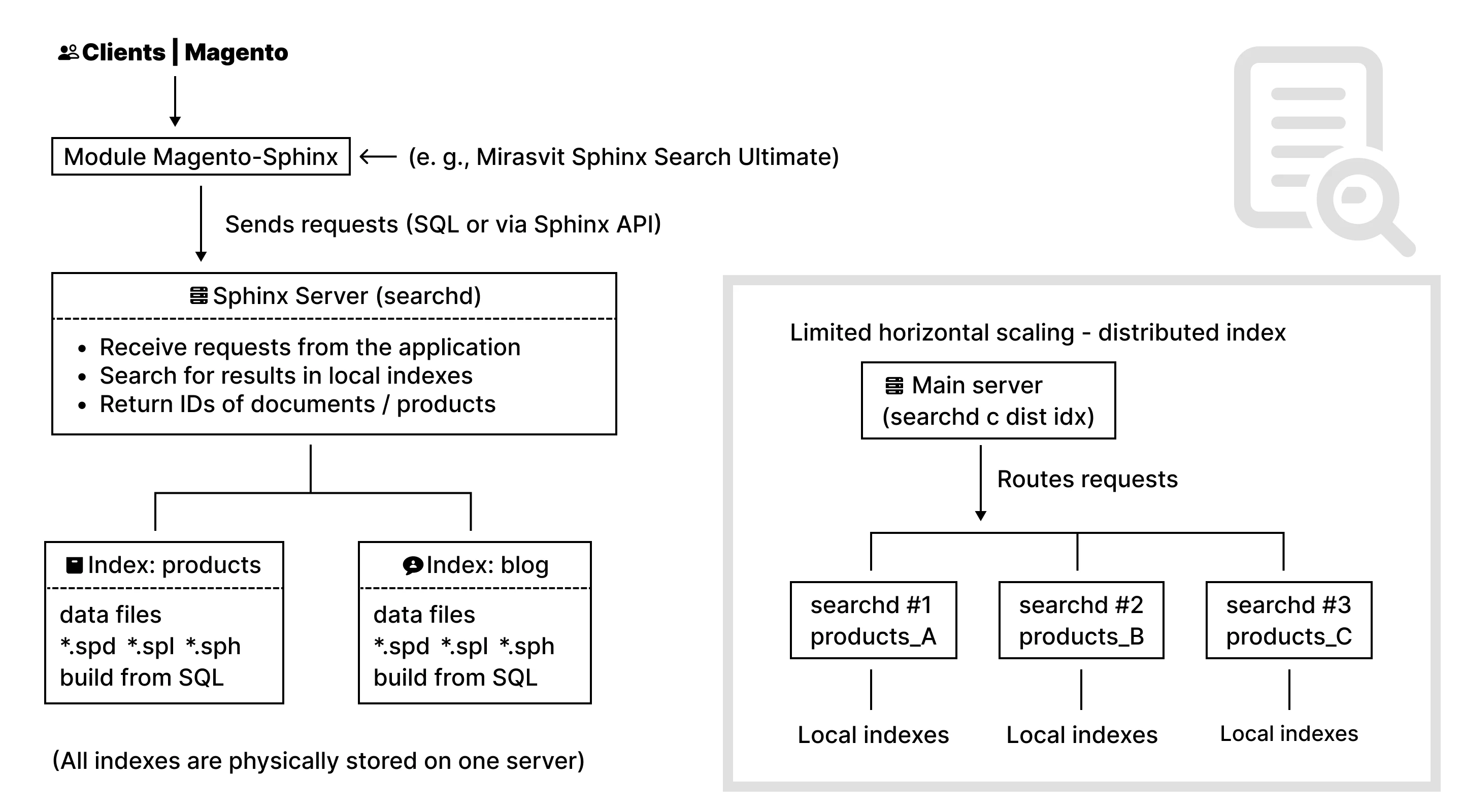
Sphinx is a lightweight C++ search daemon that, in most Magento deployments, runs on a single server alongside MySQL and other services. It reads data from SQL databases such as MySQL and can also be configured with distributed indexes for more advanced setups (see the official Sphinx Search documentation for details).
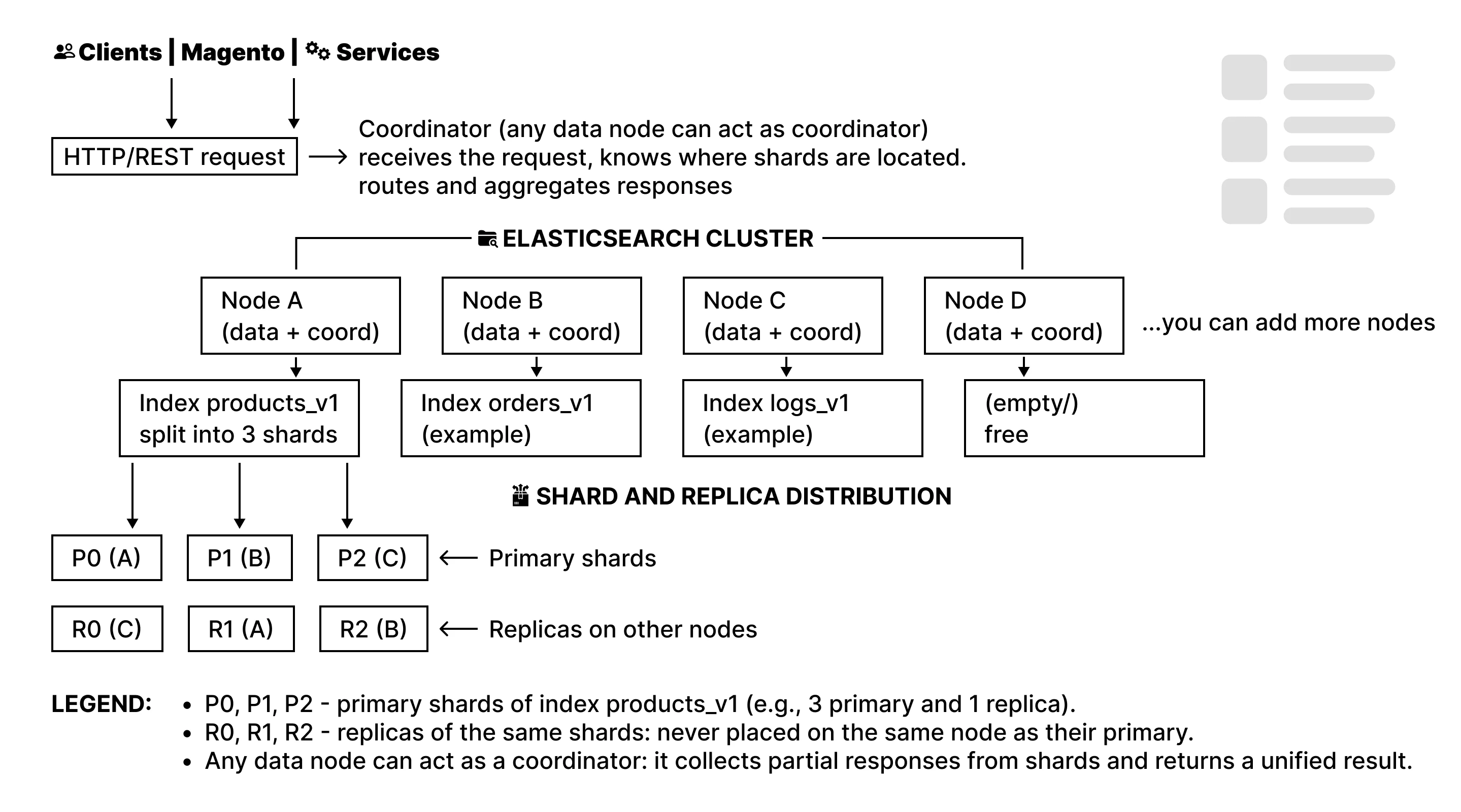
Elasticsearch, by contrast, is a distributed search and analytics engine built on top of Lucene, stores data as JSON documents, and is designed to scale across several nodes. Its architecture and configuration are described in the official Elasticsearch documentation.
In Magento 2 both are used as external search engines instead of the default MySQL search, but they integrate into the platform in different ways.
Sphinx reaches Magento through third-party extensions and is often picked when a store lives on one VPS (virtual private server, a single physical server split into several isolated virtual ones) and you do not want to complicate the hosting stack.
Elasticsearch, on the other hand, is wired into Magento 2.4+ itself: you enable it in the admin panel, it drives both catalog search and layered navigation, and most new projects start with it by default.
The table below summarizes the main Sphinx vs Elasticsearch differences that matter for Magento stores:
| Aspect | Sphinx | Elasticsearch |
|---|---|---|
| Core architecture | Single-node C++ engine over SQL data. | Distributed Lucene engine with JSON documents. |
| Performance on small/mid catalogs | Very fast; compact index; quick reindex on one server. | Fast; JVM and cluster overhead low on small catalogs. |
| Performance on large catalogs | Handles millions of docs; latency and reindex grow on one node. | Keeps latency stable on large data sets via shards and replicas. |
| Scalability | Scaling needs custom sharding; usually one host. | Built-in clustering; add nodes and rebalance data. |
| Features and relevance | Core full-text, basic stemming and synonyms, limited facets. | Rich DSL, fuzzy search, multi-language analyzers, strong facets. |
| Magento 2 support and typical use | Via third-party modules; good for tight budgets and hosting. | Official for Magento 2.4+; best for growing or high-traffic stores. |
Use this overview as a quick Sphinx vs Elasticsearch comparison; the next sections unpack performance, integration, and cost in more detail.
Magento 2 Search Performance: Sphinx and Elasticsearch Benchmark
Search speed depends mostly on how big your catalog is, how many people are online, and where the search service runs. Both engines work with full-text queries, but they react to growth in different ways.
Performance on different store sizes
On small stores (up to ~100,000 SKUs), practical Elasticsearch vs Sphinx differences are hard to notice, and both engines usually feel instant.
A single VPS can handle typical traffic with either one, and just moving search away from MySQL already makes pages load faster. At this stage, the choice of engine is rarely visible to shoppers.
As the catalog grows into the hundreds of thousands of products, a single Sphinx node starts to work closer to its limits: the index gets larger, disk I/O grows, and complex filters may need extra tuning or fall back to MySQL.
Elasticsearch, by contrast, spreads data across shards and runs queries in parallel, so search results and layered navigation filters usually stay responsive as data and traffic grow, as long as the cluster has a sensible shard layout and enough resources.
On catalogs with millions of SKUs, Sphinx is most often deployed on a single high-performance server, which can eventually become the bottleneck. Although Sphinx and its fork Manticore support distributed setups, such architectures are rarely used in this context.
Heavy queries and full reindex jobs take more time simply because all CPU and disk work happens on a single box. Some teams work around this by splitting the index and running several Sphinx processes side by side, which mirrors the single-node limits described in the Manticore Search documentation.
Elasticsearch is typically scaled differently: more servers are added to the cluster, index shards are spread between them, and search load is shared across a few machines as long as the hardware budget allows.
Indexing speed and real-time updates
Sphinx usually works with scheduled indexing jobs. New or updated products appear in search after the next index run. Real-time (RT) tables can shorten this delay, but writes still go to a single node and, under heavy load, updates are often applied in small batches rather than instantly.
For small and mid-sized stores this is usually acceptable, especially because Sphinx indices are compact and reindexing is relatively light.
Elasticsearch is oriented toward near real-time work. Product updates are sent continuously, and the index is refreshed with a short delay, so price, stock, and new items show up in search and filters soon after changes. This gives a fresher catalog, but requires more RAM, CPU, and fast storage to handle both writes and queries at the same time.
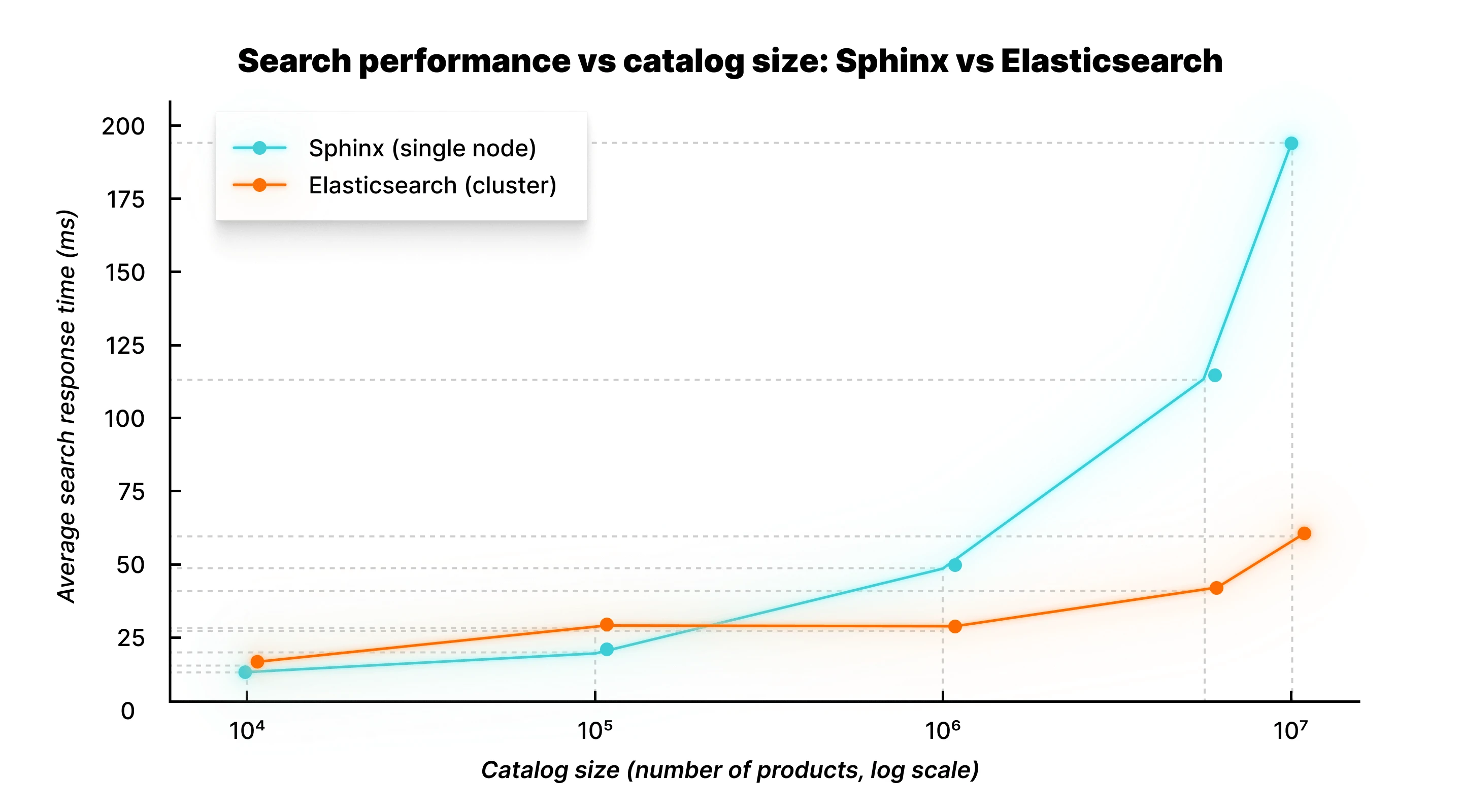
What does it mean? For a small or mid-sized store on one server, both engines can deliver very similar response times. In this case Sphinx often wins by being easier on CPU and memory, which is important on budget hosting.
As soon as you expect a larger assortment, more traffic, and active layered navigation, Elasticsearch becomes a safer long-term choice because it scales out more predictably and keeps filters responsive as the catalog grows.
Choosing a Search Solution for E-Commerce: Integration, Ecosystem, and Total Cost
Performance is only one part of the Sphinx versus Elasticsearch comparison. You also need to think about how each engine is integrated, how much ongoing attention it needs, and what this will cost over time.
Implementation and ongoing maintenance
For most developers, SphinxSearch vs Elasticsearch comparisons often start with how easy each engine is to set up. Elasticsearch is built into the platform, so once the service is running you point the store to the host and port in the admin panel, pick the version, and adjust basic relevance settings.
Many Magento-focused hosting providers already include it in their plans, and there are plenty of guides and community answers for typical setup issues.
The trade-off is that Elasticsearch is still a separate Java service that needs looking after. Someone has to watch JVM (Java Virtual Machine) memory usage, cluster health, and version upgrades, and, even with a managed Elasticsearch or OpenSearch service, keep an eye on index size, shard layout, and slow queries.
Sphinx works differently. Magento 2 does not talk to it directly, so you install a third-party module that connects the store to an external Sphinx service. In our case, this role is handled by Mirasvit search extensions: we started with Sphinx-based modules on Magento 1 and later added Magento 2 support, so the integration and indexing flow have already been exercised on many production stores.
With Sphinx you configure the search daemon, index schema, and indexing schedule on the server, then link it with Magento through the module settings. This means more manual work at the beginning and a developer who is comfortable editing configuration files. Once that is done, Sphinx usually runs for a long time with little attention apart from occasional index tuning when your catalog structure or languages change.
In real projects, many new stores go with Elasticsearch when hosting already provides it and the team knows its tooling.
Sphinx is more common in leaner setups where everything lives on one main server and search is plugged in through a reliable Magento extension instead of maintaining a full Elasticsearch cluster.
Magento 2 compatibility and search ecosystem
Since version 2.4, the platform requires Elasticsearch or a compatible engine such as OpenSearch for storefront search and layered navigation. Magento ships with a core integration module, so once the service is available on your server, you connect it in the admin panel, set host and port, pick the version, and tune relevance and indexing there.
New releases are tested against this integration, which lowers the risk of search breaking after an upgrade.
Sphinx appears only through a separate extension. Magento does not talk to it by default: a module has to catch search and indexing calls, send them to a Sphinx service, and translate responses back. More of the work sits on the server side, you run and monitor the daemon, keep its config in sync with your data model, and make sure the module stays compatible with the core version.
For layered navigation the difference between the engines shows up quickly. Elasticsearch often keeps facet data — counts by attribute, price band, and category — inside its index and returns it in the same response as the products, so category pages stay quick even when there are many filters on the screen.
Sphinx is more focused on full-text search than on faceting. In most Magento 2 integrations, layered navigation filters are still calculated in MySQL or through additional helper queries. This works well on small and mid-sized catalogs, but as both catalog size and traffic grow, the extra load on the database can turn into a bottleneck.
The surrounding ecosystem also leans toward Elasticsearch and OpenSearch. Adobe Commerce Live Search is offered as a separate SaaS-based search service powered by Adobe Sensei and Catalog Service, and when it is enabled it replaces the built-in catalog search engine.
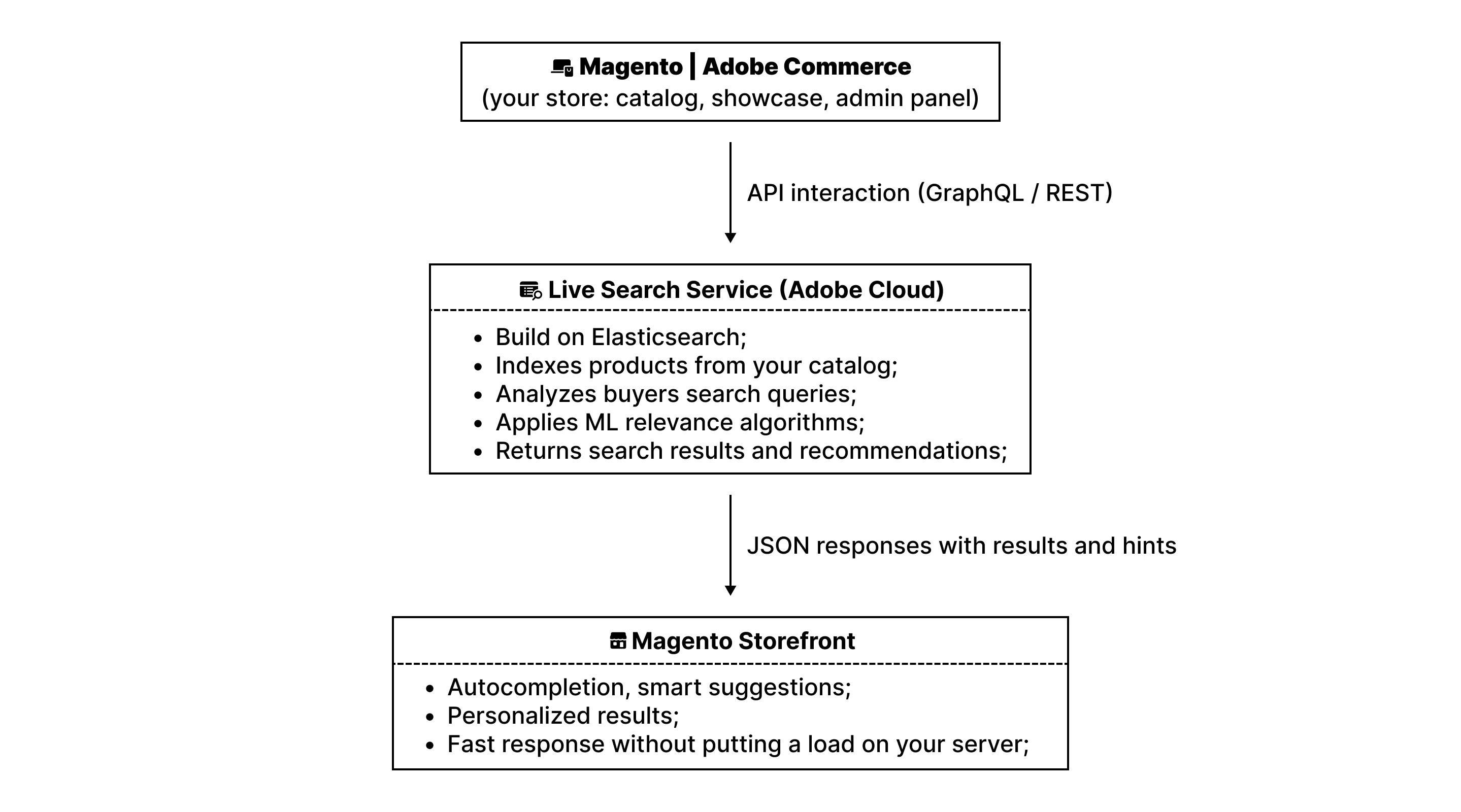
Many hosting plans still expose Elasticsearch or OpenSearch out of the box, and a lot of third-party modules and monitoring stacks assume an Elasticsearch- or OpenSearch-based setup.
Teams that prefer a compact, easy-to-manage search daemon and are comfortable relying on a trusted integration module often stay with Sphinx, while projects that want to stay close to the core platform roadmap and use features built on top of Elasticsearch usually lean toward Elasticsearch instead.
Infrastructure and total cost of ownership
Both Sphinx and Elasticsearch are open-source, so you do not pay for licenses. Most of the cost comes from hosting, hardware, and the time needed to keep the search stack in good shape.
Sphinx is on the modest side. It runs as a small C++ service, does not need Java, and can usually share a VPS with the web server and database. Because this engine adds little extra load, many stores keep their current server and only pay for a Magento module plus some developer hours to set it up.
Elasticsearch uses more resources. It runs on Java, normally needs a few gigabytes of RAM reserved for it, and works best when the index sits on fast SSDs. At first it can live on the same machine as the store, but as traffic and data grow it often moves to a separate server or managed cloud service, which adds a regular monthly bill.
Support also differs. Elasticsearch is part of the official Magento roadmap, is tested with each major release, and most agencies already know how to maintain it. With Sphinx you rely more on the extension vendor and your own team for tuning, which is fine for a stable setup but can slow down large platform changes.
The table below shows how these infrastructure and cost aspects usually compare in practice.
| Aspect | Sphinx | Elasticsearch |
|---|---|---|
| Infrastructure footprint | Runs on a modest VPS, can share a server with Magento. | Often needs more RAM and fast SSD; may use a separate host or managed service. |
| Direct costs | Engine is free; paid Magento module and setup time. | Engine is free; extra hosting or managed cluster fees. |
| Administration | Simple daemon and config files; few moving parts. | JVM tuning, cluster health checks, version alignment. |
| Fit with Magento 2 | Works through third-party modules outside the core roadmap. | Official engines for Magento 2.4+ core catalog search*. |
*Note: Adobe Commerce Live Search is a separate SaaS-based search service powered by Adobe Sensei; it replaces the built-in catalog search engine instead of running on Elasticsearch or OpenSearch.
For smaller stores on modest servers, Sphinx is often the cheaper way to move beyond plain MySQL search without touching the hosting plan. The Elasticsearch-based stack starts to make sense when traffic and catalog size grow and you plan to invest in richer search and future scaling.
Real-World Examples of Sphinx and Elasticsearch
Choosing between Sphinx and Elasticsearch gets easier when you look at real stores instead of only specs and benchmarks. For many years Sphinx was the usual choice for classic LAMP sites and early online shops. A single C++ daemon next to MySQL handled search for large content portals and classifieds on fairly modest servers, as long as the configuration was done with care.
The Magento community picked it up during the Magento 1 era. Built-in catalog search often slowed down as the assortment and traffic grew, so merchants plugged in Sphinx through extensions.
At Mirasvit we saw the same demand: our Sphinx-based search modules were installed on thousands of stores and often became a simple upgrade. MySQL and PHP stayed in place, and a compact search process was added on the same host or a small extra VPS.
With Magento 2 the picture started to change. Stores wanted better relevance, quick filters, and easier scaling, and by that time Elasticsearch was already widely used for logs and content search. When version 2.4 dropped the option to rely only on MySQL for catalog search, new projects were usually launched on Elasticsearch or OpenSearch, and hosting providers added this stack to their standard Magento plans.
Our own extensions followed this shift. After several generations of Sphinx modules we released products built around Elasticsearch and later a unified search extension that can talk to both engines.
That way long-time Sphinx users can keep their familiar setup, while new or growing projects switch to Elasticsearch without changing the rest of the integration. When we look at long-running client projects, we usually see two scenarios.
Smaller shops that live on a single mid-range server often keep Sphinx: it is already configured, does not ask for extra hardware, and quietly does its job for years. Stores that grow faster, add new categories, countries, and traffic, more often move to Elasticsearch so they can spread search and filters across several machines instead of pushing everything through one box.
A carefully tuned Sphinx instance on good hardware can feel quicker than an Elasticsearch cluster deployed with default settings, but once Elasticsearch gets enough resources and a sane configuration, along the lines of the official performance tuning guide, it usually behaves more steadily on very large catalogs.
In actual Magento projects we work with, the split is quite predictable. Because of this, Sphinx often stays in compact Magento setups that want a fast but simple search service they can host themselves without changing the server layout.
Elasticsearch, in turn, is more common in projects that plan for growth, rely heavily on filters and facets, and want their search layer to match how most modern Magento installations are built today.
Conclusion
In the end, the Sphinx vs Elasticsearch question in Magento 2 comes down to fit. Consider how big your catalog is now and how fast it grows, how often products and prices change, what your hosting can realistically handle, and how much your customers depend on quick, filter-heavy navigation.
For some stores, a lean Sphinx setup that moves search off MySQL on a single server is more than enough. Others, especially those planning for higher traffic, new markets, and richer merchandising, feel safer on an Elasticsearch-based stack that can spread work across several machines.
Once concrete numbers and plans are put next to these two options, it usually becomes clear which of them is the best search engine for Magento 2 in that context.
FAQ
What is the main difference between Sphinx and Elasticsearch?
Sphinx is a lightweight C++ service that usually runs on a single server and reads data from MySQL or another SQL database. Elasticsearch stores JSON documents in a Lucene-based index and is designed to run as a cluster across several nodes, with richer faceting and search features built in.
Is Sphinx faster than Elasticsearch for small Magento 2 stores?
On a small store, the usual Sphinx search engine vs Elasticsearch comparison matters less for front-end speed, because once search is moved off MySQL both engines can return results very quickly. The main difference is on the server side: Sphinx tends to be gentler on CPU and RAM, so a single VPS can handle it comfortably, and shoppers are unlikely to notice a speed gap between the two.
When should I choose Elasticsearch instead of Sphinx?
Elasticsearch starts to pay off when one server is no longer enough. A growing catalog, multiple store views or countries, and heavy use of filters are all signs that you will benefit from a cluster that can spread shards across several machines and accept frequent updates. Because Magento 2.4+, Live Search, and many hosting plans are built around Elasticsearch or OpenSearch, it is also the more natural choice for long-term, growth-oriented projects.
Does Magento 2 still support Sphinx search?
Magento 2.4+ officially relies on Elasticsearch or a compatible engine like OpenSearch for storefront search and layered navigation. Sphinx can still be used, but only through third-party extensions that route Magento’s search and indexing calls to an external Sphinx service. In practice, this means Elasticsearch is the official path, while Sphinx remains an option where a trusted module handles the integration.
Is Elasticsearch more resource-hungry than Sphinx?
For most teams that have tried both, Elasticsearch is the one that tends to trigger hosting discussions. It needs a reserved chunk of RAM, benefits a lot from fast SSD storage, and grows together with the index, so it often ends up on a larger server or its own managed cluster. Sphinx usually fits into an existing VPS quite comfortably: a small C++ daemon running alongside PHP and MySQL, adding search without immediately forcing a change in the hosting plan.
Head of Product at Mirasvit
Get an innovative approach to search for products in your online store and increase your website conversion rate from search results by more than 50%!
- The search results are incredibly relevant
- Search autocomplete works ultra-fast
- Typing errors are automatically corrected while searching
- Supports multiple content type searching
- Provides outstanding search results for any language
- Support for category name, custom options, and associated products searching
- Create your own vocabulary of stopwords and synonyms
- Hyphens and slashes are supported in search queries
- Support for responsive themes
Fast, relevant store search lifts conversion rate and revenue.
It powers search for thousands of Magento stores, from catalogs of a hundred products to millions of SKUs.
The Elasticsearch extension returns relevant results within milliseconds, across products, categories, CMS pages, and 15+ other content types.
Give customers search that helps them find and buy the products they want - faster and with fewer dead ends.