Getting Started With AI in Your Magento Catalog: What to Automate, and Where You Still Need a Human
-
 Oleksandr Drok
- E-commerce Tips & Best Practices
- Sep 14, 2026
- 13 min read
When a store carries thousands of products, filling in attributes and descriptions turns into endless busywork. Scaling a catalog to 1,000, 5,000, or 10,000 SKUs by hand takes an enormous amount of manpower and money. At that scale, handing catalog fill-in over to AI starts to look like the obvious next step for any business.
But using AI in e-commerce comes loaded with worries. Will generated content hurt your SEO rankings? Can a model actually identify attribute values correctly instead of making them up? And, most importantly: which tasks can you hand fully to autopilot, and where does a human still have to stay in the loop?
We ran a series of tests and experiments to answer exactly these questions, so let's get into it.
Table of Contents
- Why Research on AI Text Looked at Articles, Not Catalogs
- Four Ways to Create Content
- Grading Tasks in Magento: What to Hand to the Machine, and Where You Need a Human
- The Test Behind Our Numbers
- Where Generation Breaks: What 3 Years of Support Tickets Show
- Does Your Store Risk Its Google Rankings
- Where to Start Automating a Large Catalog
- The Future of E-Commerce: AI Agents as the Main Consumers of Content
Why Research on AI Text Looked at Articles, Not Catalogs
Most public research on AI content, generation quality, and how search engines react to it looks at long-form writing: analytical articles, blog posts, expert deep-dives. But a store's catalog works nothing like a classic blog or media outlet.
A product in a catalog is, for the most part, structured content: fairly short text and specific field values, multiplied across thousands of items.
So conclusions drawn from blog content don't automatically carry over to a product catalog. What matters for e-commerce isn't literary flair or stylistic uniqueness, it's the accuracy of attribute values, how completely fields are filled in, and, of course, the SEO angle.
Four Ways to Create Content
Step back and look at content-making as a whole, and four basic approaches to writing text stand out today:
- Full AI generation. The machine writes the text entirely, at a user's or a system's request.
- Human and AI collaboration. A person supplies the ideas or the raw facts (an interview, rough notes), and AI fills in, stylizes, formats, and polishes individual pieces of the text.
- A human with an AI editor. A person writes the content start to finish, and AI works strictly as a proofreader, catching small mistakes and stylistic slips.
- The classic approach. A person writes the whole thing by hand, the old-fashioned way.
From a reader's point of view, it makes no real difference which of these four ways produced the content. The only question that matters is whether the finished text meets the expectations and needs of whoever's reading it. If it carries a fresh idea, unique information, or practical value delivered in a convenient form, it's worth something to the audience. And that's exactly where autonomous generative models hit their fundamental limit.
An LLM can't write anything fundamentally new. By the nature of how it works, a model can't generate a genuinely new idea: everything it writes has already been described somewhere in its training data. It can reshape and recombine information, but it can't create a unique experience.
For a product page, though, that's not a problem. Nobody expects a scientific breakthrough from catalog text. They expect accurate specs, clear benefits, and a tight structure.
Grading Tasks in Magento: What to Hand to the Machine, and Where You Need a Human
A product page carries relatively little content, and each piece has a clear job: name, attributes, short description, full description, meta fields. Building our own AI Content Automation module for Magento showed us that how well AI performs depends entirely on the type of field. Catalog tasks split cleanly by how much autonomy they can be trusted with.
| Catalog Task | Does It Need a Human? | Why | What Breaks If It's Wrong |
|---|---|---|---|
| Attribute values (color, size, weight) | Mostly no¹ | Mass-market products have sources online, accuracy is high | Layered navigation filters, feed mapping |
| SEO fields (H1, Meta Title, Meta Description) | Mostly no | Rules translate cleanly into a prompt and templates | The Google snippet and click-through rate (CTR) |
| Short Description | No | Small volume, low odds of a factual error | – |
| Category description | No | Works on the same logic as the short description | – |
| Feed content (Google Shopping) | No | Dedicated AI profiles are built for each platform's requirements | Product disapprovals in Google Merchant Center |
| Full Description | Yes (as editor) | Risk of drifting from your store's tone | Style, tone of voice, and the page's sales logic |
| Blog, articles, knowledge base | Yes | Needs original expertise, positioning, and a point of view | Brand authority and audience trust |
| Help Center / FAQ from tickets | No | Automatic classification of existing customer tickets | – |
¹ The critical caveat on attributes: unsupervised auto-fill only works for commodity products: mass-market, well-known items with clear identifiers (SKU, name) that are already described online. For a niche product or your own manufacturing, there's simply no external source for the model to pull from. That's when AI starts inventing specs, and manual review becomes non-negotiable.
We've already covered meta-field generation in detail elsewhere: Meta Keywords Guide and SEO Meta Templates. That row in the table stays short on purpose.
The Test Behind Our Numbers
So our claims about automation accuracy wouldn't just be one opinion against another, we ran a series of controlled tests while building our content generation module.
Test Methodology
- Sample. We pulled over 1,000 real products from Amazon for the experiment.
- Input data. We deliberately stripped almost all information from the listings, leaving the bare minimum: a few photos, a basic name, or 1–2 basic specs.
- Generation. We used Anthropic's Opus 5 to run automatic fill-in of attributes, descriptions, and meta fields.
- Evaluation (ground truth). We compared the results against the same products' original Amazon listings, which had been filled in by people.
Results
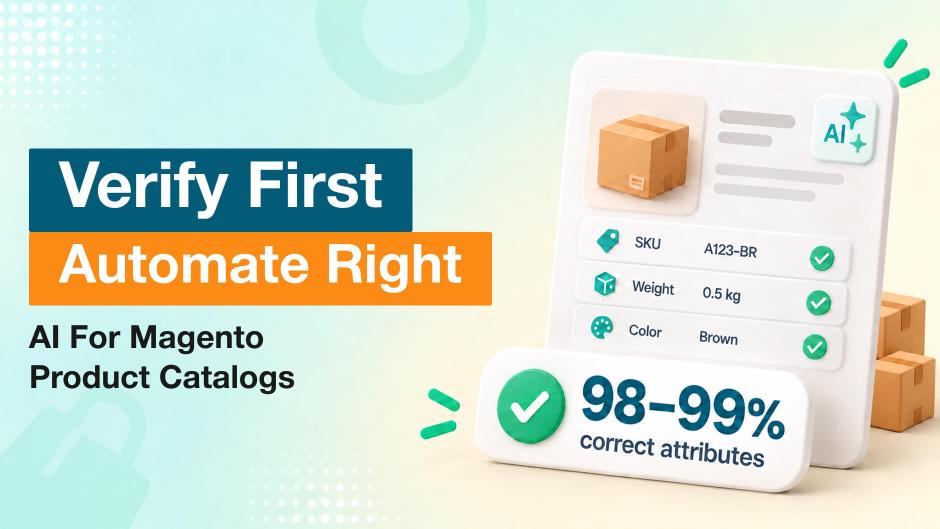
- Attribute fill-in. In 98–99% of cases, the model identified specs correctly and mapped them onto values that already existed in the store's database.
- Meta Title and Description generation. A direct word-match comparison isn't possible here, but the model self-scored the generated text against SEO patterns and came back with high marks.
Honestly, about this test's limits. The sample is Amazon products, mass-market items already well documented online; there's a real risk the model just found the same listing through search instead of deriving the attribute on its own, and we didn't separate that case out. Attributes were checked directly against fact, but meta fields were scored by the model itself against patterns, which is a weaker level of evidence.
We ran this test while building the AI Content Automation module. Part of that logic is already live in our AI Assistant for Magento 2 as Bulk Content Automation with a dry run: you see the result before it's applied to the product.
How Photo Recognition Actually Works
When all the input data you have is a product photo, the model goes through two steps:
- Identification. From the photo (or text on a label the model reads off the image), it works out exactly which product this is: its name or SKU.
- Search and mapping. With the name in hand, it finds the product's official specs online, pulls out the parameters it needs, and maps them onto the values your Magento actually uses (fitting them, say, to a specific option in a drop-down).
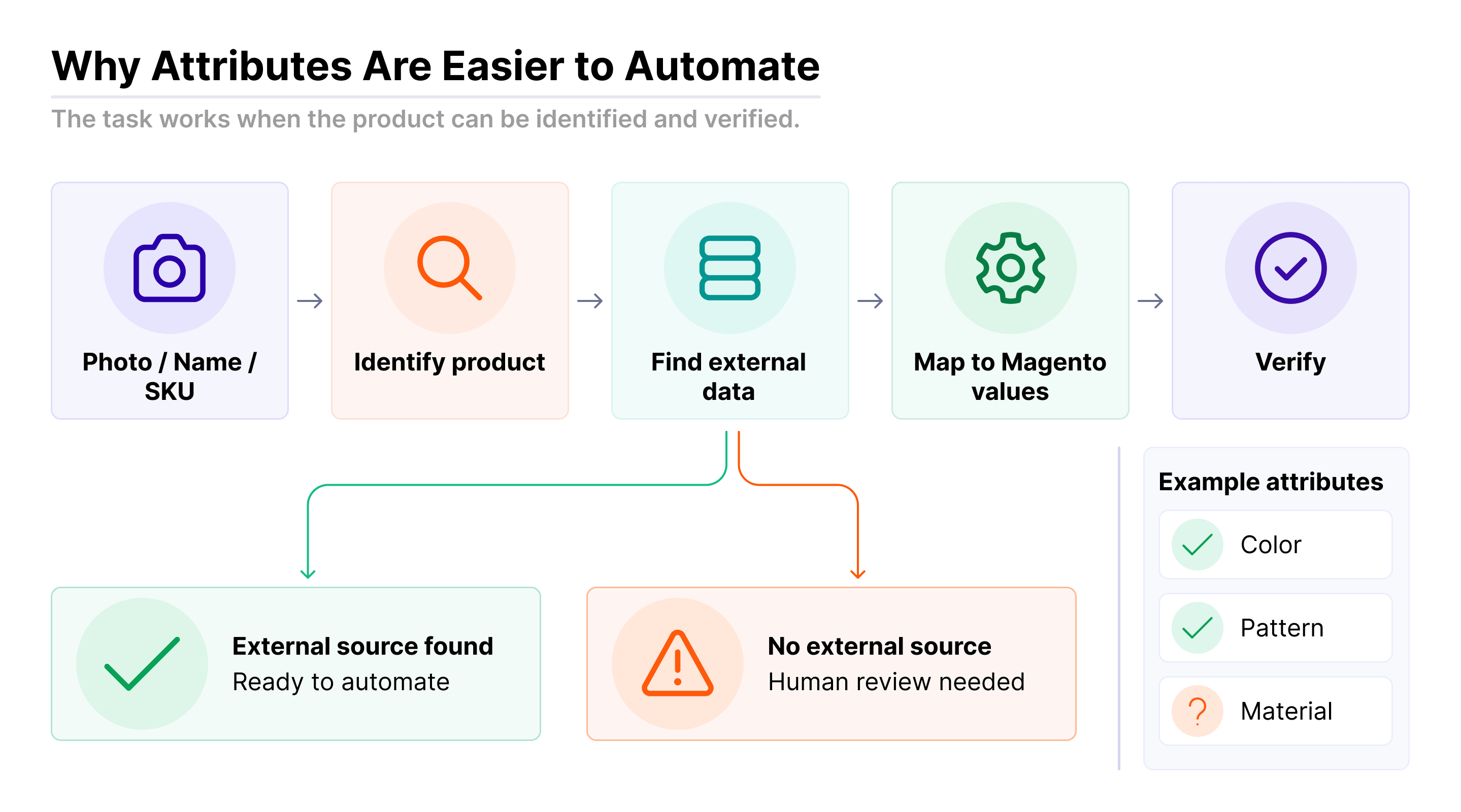
Where does this break down? Automation stops working the moment a product can't be pinned down out in the world. Clothing is a good example: hundreds of variations exist. A model can easily read color or print off a photo, but it can't work out fabric composition (say, 80% cotton, 20% polyester) from an image alone, because that needs a text source.
An open question. How a value the model just found online should map onto how that same attribute is already written in your store. We don't have a ready-made procedure for this yet, and it's more honest to say so than to make up an answer.
Where Generation Breaks: What 3 Years of Support Tickets Show
Looking at real support tickets from our Magento module users reveals one pattern: failures don't happen in the attribute value, they happen in language, field format, and markup. When automation breaks, the problem is almost never a made-up attribute or a hallucination. The real errors come from the gap between how a model behaves in a regular chat and how it behaves inside a module.
In a chat, the model sees history, fills in context on its own, and tries to be polite. A Magento module sends a bare-bones request through the API. If context isn't spelled out explicitly in the prompt, something breaks.
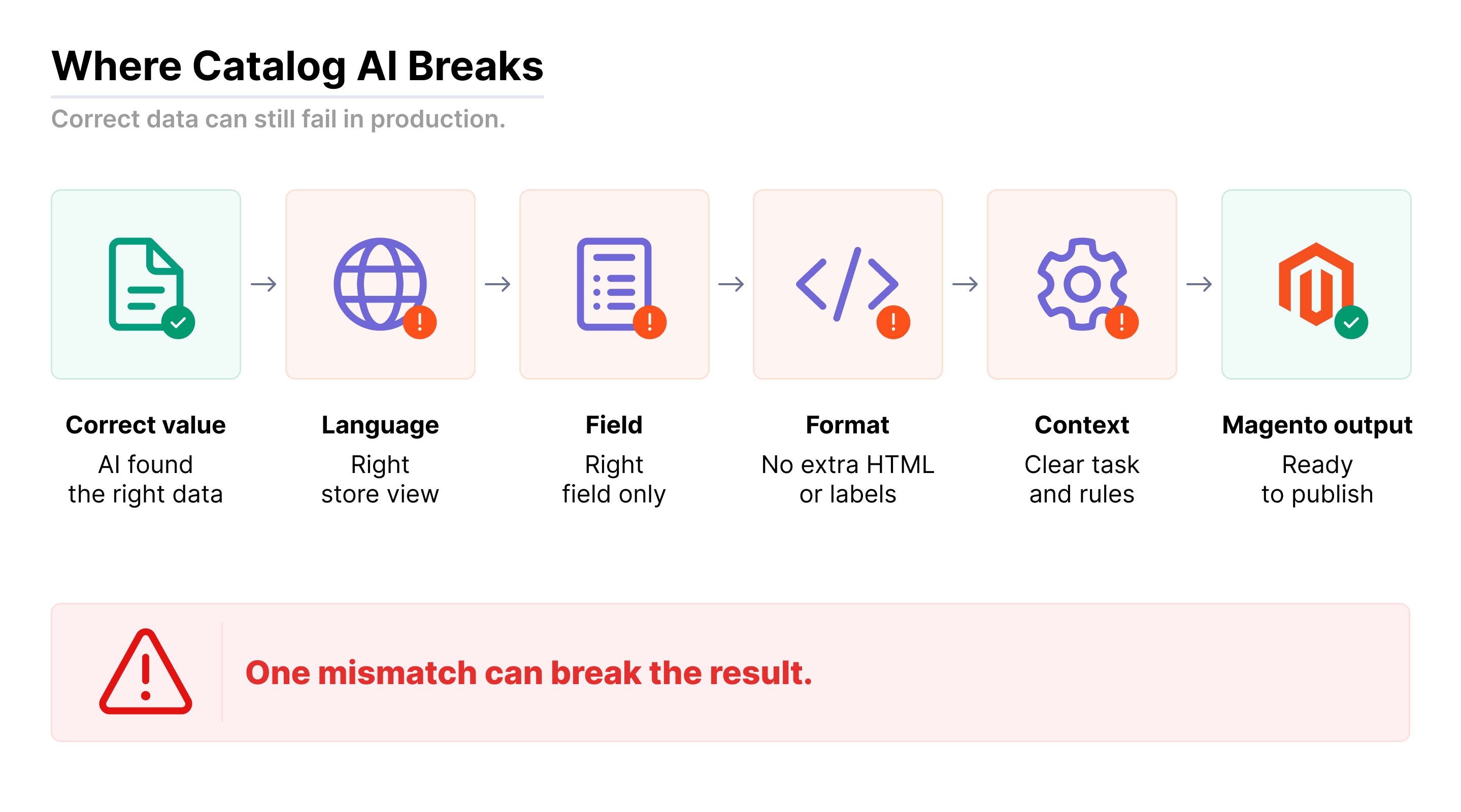
Here are the three main technical issues:
Language Mix-Ups Across Multiple Store Views
Why it happens. This is the most common type of language failure in our support tickets from 2023–2026: 31 tickets. In Magento's architecture, one product can carry different descriptions for different Store Views (Ukrainian, English, German). If the current or most recent description contains words from another language (say, a German brand name or detail), the model picks up on that context and can generate its answer in the source language instead of the target store's language.
How to fix it. Lock the output language explicitly in the system prompt at the level of the specific Store View. For example: Generate the text exclusively in English. Keep brand names in their original language.
Stray Labels in Fields (Meta Title: …)
Why it happens. Models are trained to structure answers for a human reader. By default, AI wants to add a label: Meta Title: Buy Nike Sneakers.... If a module writes that output straight into Magento's database, the label ends up live on the site.
How to fix it. Explicitly forbid intro words or labels in the prompt.
A practical prompt line: "Give your answer in this format: [Text] (don't add the field name, a greeting, or any lead-in words at the start or end)."
Descriptions for the Product Feed (Google Merchant Center)
Why it happens. Many store owners feed their SEO fields (Meta Title or Meta Description) straight into the Google Shopping feed, figuring they're already polished and optimized. But the criteria for SEO and the criteria for marketplaces are quite different.
Google Merchant Center has strict requirements for descriptions, laid out directly in its product data specification. Feed text needs to be short, packed with as much useful product information as possible, and completely stripped of HTML tags or Page Builder syntax. Feed it a regular page description with HTML markup, and Google can disapprove your products.
How to fix it. The right fix, though pricier, is keeping a separate field just for the feed. That lets you build tight, information-dense descriptions built to meet aggregators' requirements. In our own ecosystem, this is handled through AI profiles in Advanced Product Feeds.
Does Your Store Risk Its Google Rankings
Does generated content hurt your SEO rankings? It's one of the most common questions we hear from SEO specialists and store owners. The answer is clear: no, as long as content quality holds up.
In July 2026, Ahrefs checked this by analyzing over 331,000 pages out of a million pulled from the top-10 results for 100,000 search queries. They found that pages with a low or moderate AI-text share pull in 2–3x more impressions than pages with a high share, and that 5.3% of top-3 pages are fully AI-generated. Ahrefs' conclusion is short: Google isn't against AI content, it's against bad content. That lines up with Google's policy on scaled content abuse, which targets mass page generation with no reader value, not the fact that AI was involved in writing it.
But the same caveat this article opened with applies here too: Ahrefs looked at articles, meaning pages in search results, not catalog fields. That's exactly the split we pointed out at the start.
Search engines evaluate content for relevance, accuracy, and usefulness to the reader, not for which tool wrote it. The usual warnings about AI text don't carry over to catalog fields, for a few reasons:
- Attribute values. For individual specs (say, Color: red, Weight: 1.2 kg), there's simply no way to tell whether a human or a machine filled them in.
- Short descriptions. A Short Description is too small a sample for AI-content detectors to score reliably. The margin of error there is huge.
- Full coverage. If the generated information is correct, clear, and fully satisfies a shopper's intent, then even 100% generated content in a catalog is perfectly fine.
Why the Full Description Still Needs a Human Editor
With the Full Description, the risk isn't that the model invents a fact (for a mass-market product, the facts check out). The risk is tone and structure.
A long piece of text can come out sounding nothing like your store. Here, a person isn't needed for fact-checking, but for editorial work, to bring the text in line with the right tone of voice and sales logic.
Where to Start Automating a Large Catalog
If your Magento store has tens of thousands of SKUs with empty specs, don't try to generate everything at once. Running mass generation without testing first risks spreading errors across your whole catalog before you even notice them.
We recommend the following 5-step approach:
- Segment your catalog. Split products into logical groups, ideally by attribute set. Home appliances need completely different prompts than clothing.
- Pick your first group. There's one criterion for choosing it: whether you can actually validate the changes. The group needs to be large enough, and its products need to actually be selling.
- Record your baseline metrics. Before you run generation, capture conversion and traffic numbers for the chosen group. For easier analysis, you can connect Magento to Google Analytics through MCP (Model Context Protocol).
- Calibrate and QA. Tune your prompts, run generation on the pilot group, and spot-check the results for stray labels or language errors.
- Measure the effect. Check the group's numbers 30–90 days after the update. Once you've confirmed the trend is positive, roll the process out to the rest of the catalog.
The Future of E-Commerce: AI Agents as the Main Consumers of Content
AI agents are already reading product pages today, and that's not just a forecast. In our August scan of live Magento stores, only 10.8% of product pages had a visible spec table, and only 28.2% carried Product markup in the page's back-end code (ld+json, the data bots read, not people). An agent reading a product page today mostly sees price and availability, and almost no specs. More on this in Magento Structured Data: 79% Fail the AI-Ready Test.
The whole way people consume information online is shifting fast. People are gradually moving away from the classic search we all grew up with. Shoppers are turning to AI agents that search the web on their own, pull specs together from different sites, and hand back an answer that's already digested and ready to use. We've written separately about how an agent actually finds a store today, in AI Agents Can Already Buy From Magento.
In that reality, the main consumer of your product page content becomes a machine. And for an AI agent to pick your store, your catalog has to be as structured, accurate, and transparent as it can be. Automating attribute and spec fill-in today isn't just about saving your content manager's time, it's fundamental groundwork for getting your Magento store ready for the new era of autonomous commerce.
FAQ
Does AI-generated product content hurt my Magento store's Google rankings?
No, as long as the content is accurate and useful. Ahrefs' July 2026 analysis of over 331,000 top-10 pages found that pages with a low or moderate AI-text share actually pull in 2-3x more impressions than pages with a high share, and that 5.3% of top-3 results are fully AI-generated. Google's own scaled content abuse policy targets mass page generation with no reader value, not the use of AI itself.
Which Magento catalog tasks can AI handle without a human review?
Attribute values for mass-market products, SEO fields (H1, Meta Title, Meta Description), short descriptions, category descriptions, feed content for platforms like Google Shopping, and Help Center/FAQ classification from existing tickets. These are high-volume, low-risk fields where errors are easy to catch and rules translate cleanly into a prompt.
Which product content still needs a human editor?
The Full Description and any blog, article, or knowledge base content. A model won't usually invent facts about a mass-market product, but a long description can drift from your store's tone and sales logic, and a blog post needs original expertise and a point of view a model can't supply on its own.
How accurate is AI at filling in product attributes?
In our tests on over 1,000 real Amazon products with the input data stripped down to a photo and a basic name, the model identified specs correctly and mapped them to existing database values in 98-99% of cases. That figure holds for mass-market, well-documented items; for a niche product or your own manufacturing, there's no external source for the model to pull from, so manual review becomes non-negotiable.
Where does AI catalog automation typically break in practice?
Almost never on the attribute value itself. Looking at 3 years of support tickets, the real failures come from language mix-ups across multiple Store Views, stray labels the model adds to a field (like "Meta Title: ..."), and page descriptions fed straight into a product feed without meeting the aggregator's stricter formatting rules.
How should I start automating content for a large Magento catalog?
Don't generate everything at once. Segment your catalog by attribute set, pick one sellable group you can actually measure, record baseline conversion and traffic, calibrate your prompts on that pilot group, and check the numbers 30-90 days later before rolling the process out further.
Head of Product at Mirasvit
Promote your products and achieve higher sales by using the power of marketplaces and comparison shopping engines with magento data feed extension. You can automatically generate and deliver feeds of your product catalog to those services with Magento Product Feeds extension.
This tool is unbelievably quick to use and is also outstandingly flexible. It's compatible with all major shopping and advertising services, including Google Shopping.
Feeds go straight to Google Merchant Center through Google's API, and AI profiles can rewrite titles, map Google categories and fill in missing attributes before your catalog ever reaches a marketplace.
Simply install the module, generate your very own product feed, present your catalog to a wider audience, and boost your sales right now!
AI Assistant writes the content your catalog needs, inside the Magento 2 admin: product and category descriptions, meta tags, blog posts, ticket replies, and newsletters. It works with OpenAI (ChatGPT), Anthropic (Claude), Google (Gemini), and Grok (xAI), and bulk work runs as rules you can target by conditions and test with a dry run first.
Keep Learning